Showing posts with label Insects. Show all posts

Wednesday, July 15, 2020

Fossil "bee cell" from Tenerife Island

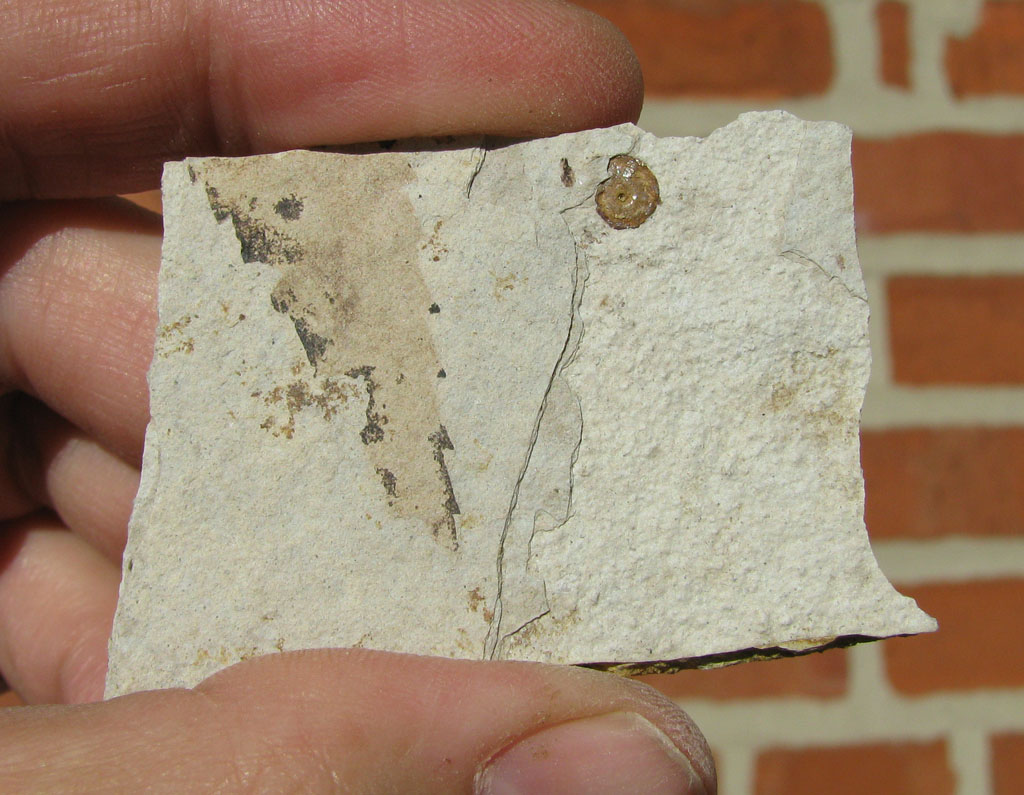
Many years ago I exchanged fossils with another collector in Spain. Some of the fossils he sent were from Tenerife Island which is part of the Canary Islands. One of the more interesting fossils was one of a "fossil wasp nest".


I was dubious of the provenance of the specimen and it remained in a box until January of 2020 when I saw someone post a similar fossil on the Fossil Forum.

It was then that I did some digging and found a paper online that explains these fossils: "Fossil bee cells from the Canary Islands. Ichnotaxonomy, palaeobiology and palaeoenvironments of Palmiraichnus castellanosi", La Roche Brier, Francisco & Genise, Jorge & Castillo, Carolina & Quesada, María & García-Gotera, Cristo & Nuez, Julio. (2014).  Palaeogeography, Palaeoclimatology, Palaeoecology. 409: 249–264.  DOI: 10.1016/j.palaeo.2014.05.012

Here is a quote from the paper
6. Conclusions
1) Fossil bee cells, attributable to the ichnospecies Palmiraichnus castellanosi, are recorded from the Pleistocene and Holocene of the easternmost Canary Islands. They are single cells with ovoid to
subcylindrical shape and a discrete wall covering a chamber and an antechamber. The chamber is internally polished and is sealed by a spiral closure. The antechamber, with smooth internal walls, has a structureless active filling of the same material from the palaeosol. This record constitutes the first documented evidence for bees, and Hymenoptera, in the Quaternary of the Canaries and the first one of this ichnospecies in Africa.
 
2) Specimens of Palmiraichnus castellanosi are similar to extant cells of Andrena savignyi studied herein, regarding shape, and the presence of a discrete wall, spiral closure and antechamber. This indicates that the members of the genus Andrena (Andrenidae) were the trace makers of P. castellanosi in the Canary Islands.
 
3) The high percentage (95%) of open cells indicate a high level of breeding success, favoured by the lack of predators or parasites and optimal environmental conditions, at least in the Pleistocene.
 
4) Palaeoecological and statistical data suggest that five species may have produced Palmiraichnus castellanosi in the Canary Islands. One on Lanzarote in the Holocene, another in south Fuerteventura in the Upper Pleistocene, two on Gran Canaria during theMiddle Pleistocene (one on the north coast and the second in the east) and the last on Montaña Clara, also in the Middle Pleistocene.

5) The abundance in the Pleistocene of Palmiraichnus castellanosi in the lowlands, reflecting a large number of individuals and species of Andrena, suggests a rich flora with probably many endemic shrubby species in accordance with present and other palaeobotanical and palaeoanthropological evidences.

6) The favourable climate attested by high densities of Palmiraichnus castellanosi associated with helicids may have been similar to thatprevalent at present in the lowlands of the Canaries, but probably
with a higher MAP.

7) The land-snail assemblage associated with the low densities of Palmiraichnus castellanosi in the Holocene at mid-altitude suggests a cool moist palaeoenvironment, with lower temperatures than in
the Pleistocene lowlands,more favourable for the success of the beetle producers of Rebuffoichnus than for bees producing P. castellanosi.
Some pictures from the paper:


While I am not 100% sure the fossil I have is one of these "Bee cells" that the paper describes, it certainly looks similar.  If nothing else I at least learned a bit more about fossilization processes and paleoclimates by reading the paper.


Monday, March 23, 2020

Fossil Wasp from the Green River Formation

Here is another insect that I found in the Parachute Creek member of the Green River formation. I believe it is a wasp of the order Hymenoptera based on an image of a similar insect I found on this slide show. You can see the head, eyes, and antennae very clearly and the wings are somewhat visible too. The abdomen is not very detailed  and may not have preserved as well. I also do not see any of the legs and maybe they are preserved under the body.


I collected this fossil near the FAA radar dome in Garfield County, Colorado near Douglass Pass. The Parachute Creek member of the Green River formation is Eocene in age, Lutetian stage (about 46 mya)

Saturday, March 21, 2020

Plecia sp. fossil "March Fly" from the Green River Formation

Today I have a couple of specimens of an insect from the family Bibionidae that come from the Parachute Creek member of the Green River formation. I think they can be narrowed down to the genus Plecia but beyond that I am unsure of what species have been described from the Green River formation. The specimens that I identify as Plecia sp. have an abdomen that is at least twice as long as it is wide with wings that are as long or longer than the abdomen. The wings are rounded on the far ends resembling an oval shape.

Specimen #1


Specimen #2


Members of the genus Plecia are still found today and are often called "March Flies" or "Love Bugs" due to their appearance early in the year to mate in large swarms.

I collected these fossils at the FAA radar dome in Garfield County, Colorado near Douglass Pass. The Parachute Creek member of the Green River formation is Eocene in age, Lutetian stage (about 46 mya)

Thursday, March 19, 2020

Cricket from the Green River formation

A rare find for me from the Parachute Creek member of the Green River formation is the cricket fossil below.  Crickets belong to the family Gryllidae and generally have long bodies with round heads and six pairs of legs, a pair of which are modified to be longer than the others and are used for jumping. It's those longer legs that lead me to believe the specimen below is a cricket.  I do not know enough about crickets to be able to narrow the ID down to the genera or species, especially as I don't know what species have been described from the Green River formation.


I collected this fossil near the FAA radar dome in Garfield County, Colorado near Douglass Pass. The Parachute Creek member of the Green River formation is Eocene in age, Lutetian stage (about 46 mya)

Tuesday, March 17, 2020

Fossil Weevil from the Green River formation

Insects from the Green River formation can be difficult to ID down to a species, let alone a generic level. Often you are trying to compare a 2D fossil to 3D pictures of extant insects and all you can do is hope you are correct.  Below is a specimen I purchased because of the good preservation, but also because it had been ID'ed as a Weevil already.  I need to go through my own findings to confirm but I think I have found examples of this same kind of insect on my collecting trips.

I am still trying to find some good resources that list known insect genera from the Green River formation but they are hard to find or expensive to purchase.  At this point I can only say that this fossil is of a member of the Superfamily  Curculionidaea.


A low light shot of the fossil shows some nice details

A direct light shot shows the true color of the fossil better.

This fossil was found in the Parachute Creek shale member of the Green River formation, in Rio Blanco County, Colorado. The Green River formation is dated to the Eocene period, Lutetian stage (about 46 mya).

Check out an older post of mine where I discuss the geology of the Eocene lakes that once existed in SW Wyoming and NW Colorado.

In another one I posted some of my exceptional finds from Douglass Pass.

Tuesday, May 24, 2016

Results from a short visit to the Florissant Fossil Quarry

As part of my vacation last fall I had an hour or so to kill in my schedule and happened to be passing near Florissant, Co. The town is well known for the Florissant Fossil Beds National Monument which preserves an ancient lake bed from the Eocene that was near a field of volcanoes. The volcanoes would erupt with lots of ash and this would rain onto the lake and the surrounding environment. As the ash settled it would cover anything that happened to be floating on or above the lake surface. The ash layers deposited as thin films and millions of years later have been compressed into "paper" shale (so called because each layer is as thin as a sheet of paper). Splitting the shale is easy but also hard. You have to use a very thin, sharp blade (a razor blade is perfect) to split the fine layers. If you are lucky you will find an insect or plant trace from long ago.

Outside of the park boundaries is a fee quarry, on private land, that allows you to split some of the paper thin shale and keep the fossils you find. It's called the Florissant Fossil Quarry and I've been to this site several times over the years. You can see some of the other fossils I've collected  by clicking here, here, here, or here. This trip only allowed me a hour but I found a few interesting specimens.

This is a small snail with a partial leaf. The shell has been crushed but you can still see some of the shiny nacre.


A beech or elm type leaf

A seed of some sort, although it looks like the seed itself is missing and only the surrounding "wings" are left. This looks similar to slippery elm seeds.


Lastly, a fly or bee (wasp?) of some sort. The preservation is not the best and it looks better from a distance than up close.


The Florissant fossil beds are called the Florissant formation and are dated to the latest Eocene epoch (Priabonian stage) of the Paleogene.

Friday, June 29, 2012

Insect fossils from the Florissant formation

Insects are somewhat commonly preserved in the shale layers of the Florissant formation. Below are some fine examples that I found over twenty years ago.

A Robber fly (?)


Some kind of wasp or flying ant (both sides)


A moth with some wing patterning preserved


The Florissant formation is the remains of a temporary lake that is dated to the Eocene period (Priabonian stage) and is located in Colorado.

Thursday, August 18, 2011

Jurassic insects from China?

I was going through some boxes of mixed fossils that I'd bought years and years ago when I was not so organized or focused. I came across these two plates of fossil insects from China. Unfortunately the labels only indicate "Jurassic" and "China" so I have no real ID on them.

Plate #1 has a single insect that looks like a fly of some kind.


Plate #2 has two insects, one that is similar to the first plate and a second that looks like some kind of beetle.


The rock that composes the plates does not look the same as that which comes from the famous Jethol Biota of Liaoning China. If anyone has any ideas on the origin of the fossils or insect genera, please let me know.

Thursday, September 16, 2010

Random fossil image from my archives

I'm trying to get a digital record of all the fossil and mineral specimens that are in my collection (this being a loose term used merely to identify anything I have in a box that I'm not willing to trade or sell at the moment). Sometimes I can give you a nice bit of info and backstory on something but these next two pieces are mysteries to me.


I'm a huge fan of fossil insects (and live ones too, check out this website to get a insect image fix). So when I came across these two plates I impulse purchased them quickly. They have a simple label "Hemiptura (True Bug)" stating they come from the "L. Jurassic - E. Cretaceous" and "Shangdong Province, China" but nothing else to help narrow down the genera. Not being an Entomologist I can only guess at what these insects were.

This looks similar to a modern water strider to me:


This one has another "water strider" and some kind of beetle looking critter:


Part of the problem with identifying these insects is the lack of information on the labels. Also, many times fossils from overseas, especially China, can be mislabeled in order to simplify the sellers task or hide the actual site from other collectors or authorities who might prevent valuable fossils from leaving. However, I like them enough to keep them around in my collection and maybe one day I will find out where they come from and what they are.

Wednesday, August 25, 2010

Parachute Creek member of the Green River Fm.

The Green River formation is an expansive group of rocks which all were lain down by a series of ancient lakes in the Eocene era of the Paleogene period. As you can see by the map below, the deposits that exist today are extensive.


The formation is really four interconnected basins from two major lakes called Lake Unita and Lake Gosiute. The best know parts of the formation are those from Wyoming around Kemmerer where the fossil fish are quarried from the sediments of former Lake Gosiute. To the south in Colorado and Utah, fossil Lake Unita left a similar record but the rock type is a little different. In Wyoming, the fossils are generally preserved in a freshwater limestone while in Colorado and Utah the rocks are oil shale. Both lakes had similar flora and fauna and record a sub tropical ecosystem.

One of the most accessible and well know sites to collect from the Lake Unita oil shales is at an FAA radar dome near Douglas Pass. Here the rocks are considered part of the Piceance Creek basin and the most collectible shales are found in the Parachute Creek member. They are exposed as thick bedded near horizontal layers of light gray shale. The fossil finding process involves taking a piece of the shale and splitting it parallel to the plane of fossilization. The layers are very thin and it's not easy to split the rock completely on a single plane. Often you wind up breaking off a spall and you hope you find something. Unweathered rock is light to dark brown, due to the hydrocarbon content, and the preservation is quite good with thin black carbon films that contrast well against the host rock.

I've had some success collecting at this site over the years and it is a favorite of mine. Here are some pictures of specimens from my collection:

Insects


Plants


I got lucky once and found both halves of a bird feather. The detail is superb and you can see color bands as well as the texture of the feather itself. Bird feather fossils are rare but not uncommon from the Parachute Creek member.


For more info on the Green River formation, check out this page at the Fossil Museum.

Or you can go the the University of California's Museum of Paleontology website and read their page.