Showing posts with label Colorado. Show all posts

Monday, March 23, 2020

Fossil Wasp from the Green River Formation

Here is another insect that I found in the Parachute Creek member of the Green River formation. I believe it is a wasp of the order Hymenoptera based on an image of a similar insect I found on this slide show. You can see the head, eyes, and antennae very clearly and the wings are somewhat visible too. The abdomen is not very detailed  and may not have preserved as well. I also do not see any of the legs and maybe they are preserved under the body.


I collected this fossil near the FAA radar dome in Garfield County, Colorado near Douglass Pass. The Parachute Creek member of the Green River formation is Eocene in age, Lutetian stage (about 46 mya)

Saturday, March 21, 2020

Plecia sp. fossil "March Fly" from the Green River Formation

Today I have a couple of specimens of an insect from the family Bibionidae that come from the Parachute Creek member of the Green River formation. I think they can be narrowed down to the genus Plecia but beyond that I am unsure of what species have been described from the Green River formation. The specimens that I identify as Plecia sp. have an abdomen that is at least twice as long as it is wide with wings that are as long or longer than the abdomen. The wings are rounded on the far ends resembling an oval shape.

Specimen #1


Specimen #2


Members of the genus Plecia are still found today and are often called "March Flies" or "Love Bugs" due to their appearance early in the year to mate in large swarms.

I collected these fossils at the FAA radar dome in Garfield County, Colorado near Douglass Pass. The Parachute Creek member of the Green River formation is Eocene in age, Lutetian stage (about 46 mya)

Thursday, March 19, 2020

Cricket from the Green River formation

A rare find for me from the Parachute Creek member of the Green River formation is the cricket fossil below.  Crickets belong to the family Gryllidae and generally have long bodies with round heads and six pairs of legs, a pair of which are modified to be longer than the others and are used for jumping. It's those longer legs that lead me to believe the specimen below is a cricket.  I do not know enough about crickets to be able to narrow the ID down to the genera or species, especially as I don't know what species have been described from the Green River formation.


I collected this fossil near the FAA radar dome in Garfield County, Colorado near Douglass Pass. The Parachute Creek member of the Green River formation is Eocene in age, Lutetian stage (about 46 mya)

Tuesday, March 17, 2020

Fossil Weevil from the Green River formation

Insects from the Green River formation can be difficult to ID down to a species, let alone a generic level. Often you are trying to compare a 2D fossil to 3D pictures of extant insects and all you can do is hope you are correct.  Below is a specimen I purchased because of the good preservation, but also because it had been ID'ed as a Weevil already.  I need to go through my own findings to confirm but I think I have found examples of this same kind of insect on my collecting trips.

I am still trying to find some good resources that list known insect genera from the Green River formation but they are hard to find or expensive to purchase.  At this point I can only say that this fossil is of a member of the Superfamily  Curculionidaea.


A low light shot of the fossil shows some nice details

A direct light shot shows the true color of the fossil better.

This fossil was found in the Parachute Creek shale member of the Green River formation, in Rio Blanco County, Colorado. The Green River formation is dated to the Eocene period, Lutetian stage (about 46 mya).

Check out an older post of mine where I discuss the geology of the Eocene lakes that once existed in SW Wyoming and NW Colorado.

In another one I posted some of my exceptional finds from Douglass Pass.

Tuesday, May 24, 2016

Results from a short visit to the Florissant Fossil Quarry

As part of my vacation last fall I had an hour or so to kill in my schedule and happened to be passing near Florissant, Co. The town is well known for the Florissant Fossil Beds National Monument which preserves an ancient lake bed from the Eocene that was near a field of volcanoes. The volcanoes would erupt with lots of ash and this would rain onto the lake and the surrounding environment. As the ash settled it would cover anything that happened to be floating on or above the lake surface. The ash layers deposited as thin films and millions of years later have been compressed into "paper" shale (so called because each layer is as thin as a sheet of paper). Splitting the shale is easy but also hard. You have to use a very thin, sharp blade (a razor blade is perfect) to split the fine layers. If you are lucky you will find an insect or plant trace from long ago.

Outside of the park boundaries is a fee quarry, on private land, that allows you to split some of the paper thin shale and keep the fossils you find. It's called the Florissant Fossil Quarry and I've been to this site several times over the years. You can see some of the other fossils I've collected  by clicking here, here, here, or here. This trip only allowed me a hour but I found a few interesting specimens.

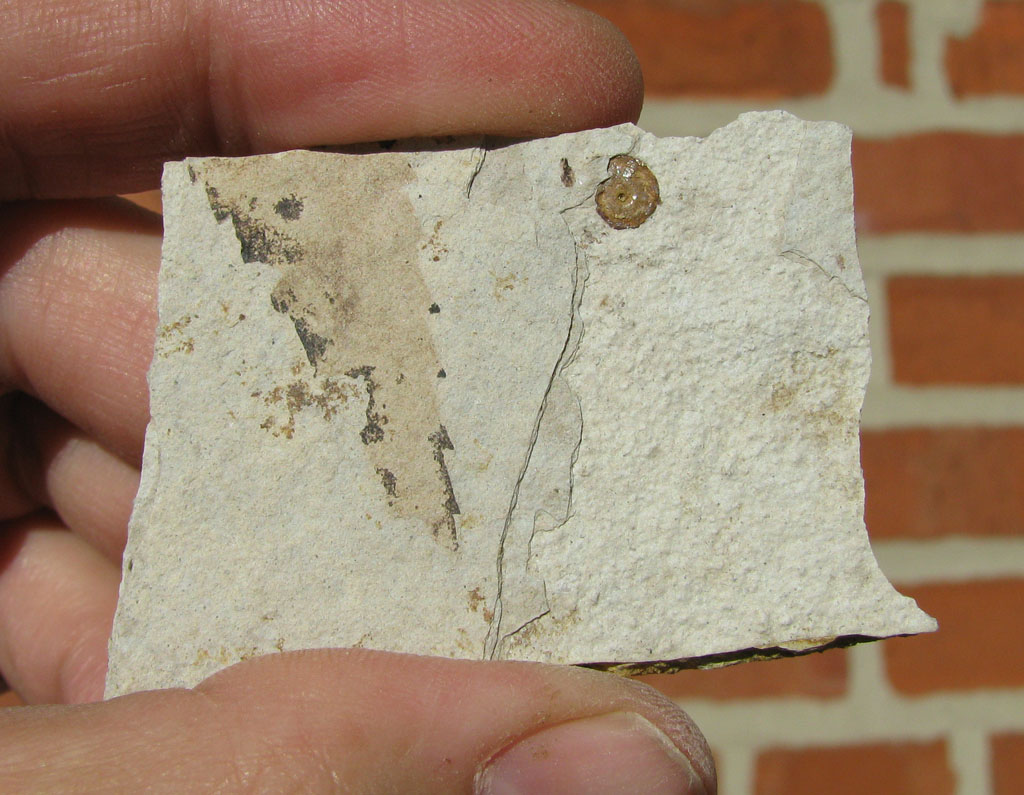
This is a small snail with a partial leaf. The shell has been crushed but you can still see some of the shiny nacre.


A beech or elm type leaf

A seed of some sort, although it looks like the seed itself is missing and only the surrounding "wings" are left. This looks similar to slippery elm seeds.


Lastly, a fly or bee (wasp?) of some sort. The preservation is not the best and it looks better from a distance than up close.


The Florissant fossil beds are called the Florissant formation and are dated to the latest Eocene epoch (Priabonian stage) of the Paleogene.

Monday, September 14, 2015

Cleaning, Sorting, Consolidating recent finds.

Hey All, I just got back from a vacation to Texas, Oklahoma, Utah, Wyoming and Colorado and am working on cleaning and identifying my finds. Sorry for the lack of updates but I will be back in a week or two with new content. In the meantime, enjoy some scenery from the places I visited.


Ammonite in North Texas

Bois d'Arc formation in Oklahoma

Green River formation in Kemmerer, WY

Neozoic Rhyolite flows with Geodes from Dugway, UT

Weeks formation, limestone near Delta, UT

Marjum formation near Delta, UT

Green River formation Douglass Pass, Colorado

An old fossil on top of Pikes Peak, Colorado

Monday, October 6, 2014

Fossil bird feathers from the Green River Fm. of Colorado

Bird feathers are somewhat rare in the fossil record but some circumstances allow them to be more easily preserved. Such is the case in the Parachute Creek member of the Green River formation. The Parachute Creek member is an oil shale that was deposited by a series of freshwater lakes in the Eocene located in northwestern Colorado and northeastern Utah. Here are some examples of the feathers that can be found within these fossil lake deposits.

Specimen #1


Specimen #2


Specimen #3


All three of the feathers look to be fairly simple and could just be down feathers. Sometimes color patterns can be preserved but I don't see any on these.

Sunday, July 1, 2012

Other fossils from the Florissant formation

This is my last post regarding the fossils I found at Florissant, for now. Below are some fossils which I am particularly proud of then due to their rarity or uniqueness.

Freshwater snail (only a couple of mm across)


These fossils look like seeds from a grass of some sort.


The last few pictures here are of what I have tentatively identified as flowers. They are very small, only a few mm across.


The Florissant formation is the remains of a temporary lake that formed in a volcanic region during the Eocene (Priabonian stage).

Friday, June 29, 2012

Insect fossils from the Florissant formation

Insects are somewhat commonly preserved in the shale layers of the Florissant formation. Below are some fine examples that I found over twenty years ago.

A Robber fly (?)


Some kind of wasp or flying ant (both sides)


A moth with some wing patterning preserved


The Florissant formation is the remains of a temporary lake that is dated to the Eocene period (Priabonian stage) and is located in Colorado.

Wednesday, June 27, 2012

More plant fossils from the Florissant formation

Here are some more plant fossils from the Florissant formation that I found 20 years ago.

This is only a partial leaf but it reminds me of an alder tree

Pine needle

Some sort of evergreen foliage I think.

Fossil reeds


Both halves of a partial oak leaf


The Florissant formation is the remains of a temporary lake that is dated to the Eocene period (Priabonian stage) and is located in Colorado.

If you want a good book with pictures of some spectacular fossils that have been found in the Florissant formation, check this book out: Fossils of Florissant, by Herbert W Meyer.