Showing posts with label Eocene. Show all posts

Monday, June 15, 2020

Biomphalaria sp. & Goniobasis sp. Gastropods from the Green River Formation

Within the limestone layers of the Green River formation that are exposed in the split fish quarries you will occasionally find some gastropod fossils. The degree of preservation is variable but I have found at least two genera during my trips to Kemmerer, WY.

The most common genus that I have found is Goniobasis sp. which is a high spired, conical shell. Specimen #1 below is fairly well preserved and you can see the aperture on both the positive and negative slab.

Positive and negative slabs followed by close ups of each slab


Specimen #2 - Less well preserved. Positive and negative slabs


The other genus is Biomphalaria sp. and I only have one example. It is a small planispiral shell with no ornamentation and very narrow whorls.

Positive and negative slabs


I used the book "The Lost World of Fossil Lake: Snapshots from Deep Time", Lance Grande, University of Chicago Press, 2013, page 91, figure 40 to identify the above specimens (figure below).

These fossils come from the Fossil Butte member of the Green River formation (Paleogene period, Eocene epoch, Ypresian stage). I found them at the Thompson Ranch split fish quarries which are publicly available to collect in at a number of commercial quarries which lease access.

Saturday, March 21, 2020

Plecia sp. fossil "March Fly" from the Green River Formation

Today I have a couple of specimens of an insect from the family Bibionidae that come from the Parachute Creek member of the Green River formation. I think they can be narrowed down to the genus Plecia but beyond that I am unsure of what species have been described from the Green River formation. The specimens that I identify as Plecia sp. have an abdomen that is at least twice as long as it is wide with wings that are as long or longer than the abdomen. The wings are rounded on the far ends resembling an oval shape.

Specimen #1


Specimen #2


Members of the genus Plecia are still found today and are often called "March Flies" or "Love Bugs" due to their appearance early in the year to mate in large swarms.

I collected these fossils at the FAA radar dome in Garfield County, Colorado near Douglass Pass. The Parachute Creek member of the Green River formation is Eocene in age, Lutetian stage (about 46 mya)

Thursday, March 19, 2020

Cricket from the Green River formation

A rare find for me from the Parachute Creek member of the Green River formation is the cricket fossil below.  Crickets belong to the family Gryllidae and generally have long bodies with round heads and six pairs of legs, a pair of which are modified to be longer than the others and are used for jumping. It's those longer legs that lead me to believe the specimen below is a cricket.  I do not know enough about crickets to be able to narrow the ID down to the genera or species, especially as I don't know what species have been described from the Green River formation.


I collected this fossil near the FAA radar dome in Garfield County, Colorado near Douglass Pass. The Parachute Creek member of the Green River formation is Eocene in age, Lutetian stage (about 46 mya)

Tuesday, March 17, 2020

Fossil Weevil from the Green River formation

Insects from the Green River formation can be difficult to ID down to a species, let alone a generic level. Often you are trying to compare a 2D fossil to 3D pictures of extant insects and all you can do is hope you are correct.  Below is a specimen I purchased because of the good preservation, but also because it had been ID'ed as a Weevil already.  I need to go through my own findings to confirm but I think I have found examples of this same kind of insect on my collecting trips.
I am still trying to find some good resources that list known insect genera from the Green River formation but they are hard to find or expensive to purchase.  At this point I can only say that this fossil is of a member of the Superfamily  Curculionidaea.


A low light shot of the fossil shows some nice details

A direct light shot shows the true color of the fossil better.

This fossil was found in the Parachute Creek shale member of the Green River formation, in Rio Blanco County, Colorado. The Green River formation is dated to the Eocene period, Lutetian stage (about 46 mya).

Check out an older post of mine where I discuss the geology of the Eocene lakes that once existed in SW Wyoming and NW Colorado.

In another one I posted some of my exceptional finds from Douglass Pass.

Sunday, March 15, 2020

Salix sp. leaf from the Green River formation

This long, narrow leaf is most likely from a member of the Willow family, Salix sp. and comes from the Parachute Creek member of the Green River formation (Eocene, Lutetian stage).  It was found in Bonanza, Utah and I purchased it because it came with an ID. I am hoping that I can use this and other identified specimens that I purchase to help ID fossils that I have found in the field. There are not many resources easily accessible that show pictures and names for plant and insect fossils from the Green River formation.  I know I have found other examples of Salix sp. that are larger and more recognizable than this specimen but I need to go through my findings and locate it.


Friday, March 13, 2020

Cardiospermum coloradensis leaf from the Green River formation

Soapberry plants are typically found in the tropics and their presence in a northerly latitude like where NE Utah is indicates that the climate used to be much warmer than it is now. Below is a leaf from the Soapberry family,  called Cardiospermum coloradensis, that is also called "Balloon Vine".   Fossils of these leaves are somewhat common in the Parachute Creek member of the Green River formation (Eocene, Lutetian stage), but most of what I have found are smaller. I purchased this piece because of the good preservation and size of the leaf.  I identified it based on this image from James St. John's Flickr page.


Wednesday, March 11, 2020

Caesalpinites sp. leaf from the Green River formation

Here is another fossil leaf from the Parachute Creek member of the Green River formation (Eocene, Lutetian stage) that I purchased because it came with an ID. It's a leaf called Caesalpinites sp.  The fossil is small and somewhat faint against the rock but you can make out the central vein and overall shape of the leaf.  This specimen comes from a site near Bonanza, Utah.  I'm having a hard time finding any more info about this genus to try and narrow down the species. I've seen other leaves labelled as Caesalpinites falcata from the same area but they look different than my specimen. It could be a different species or maybe the plant had different shaped leaves on different areas. 


Thursday, August 25, 2016

An agatized pelecypod from the Genus Astarte from Morocco

Among the many examples of agatized gastropods, from the Eocene layers of the Dakhla region of Morocco, that are appearing on the market, I found two pelecypod specimens. They are small, about an inch (2.54 cm) in diameter and appear to be the same species. I don't have any literature that can get me an ID down to even the species level but it appears that they belong to the Genus Astarte. The closest Subgenus I could possible winnow them down to could be Laevastarte but beyond that I would need to see the interior of the shells.

Specimen #1- Right valve
Ventral view of both valves

Left valve
Anterior view of both valves
Dorsal view of both valves
Posterior view of both valves

Specimen #2 - Left Valve
Right Valve
Ventral view of both valves
Anterior view of both valves
Dorsal view of both valves
Posterior view of both valves

Tuesday, May 24, 2016

Results from a short visit to the Florissant Fossil Quarry

As part of my vacation last fall I had an hour or so to kill in my schedule and happened to be passing near Florissant, Co. The town is well known for the Florissant Fossil Beds National Monument which preserves an ancient lake bed from the Eocene that was near a field of volcanoes. The volcanoes would erupt with lots of ash and this would rain onto the lake and the surrounding environment. As the ash settled it would cover anything that happened to be floating on or above the lake surface. The ash layers deposited as thin films and millions of years later have been compressed into "paper" shale (so called because each layer is as thin as a sheet of paper). Splitting the shale is easy but also hard. You have to use a very thin, sharp blade (a razor blade is perfect) to split the fine layers. If you are lucky you will find an insect or plant trace from long ago.

Outside of the park boundaries is a fee quarry, on private land, that allows you to split some of the paper thin shale and keep the fossils you find. It's called the Florissant Fossil Quarry and I've been to this site several times over the years. You can see some of the other fossils I've collected  by clicking here, here, here, or here. This trip only allowed me a hour but I found a few interesting specimens.

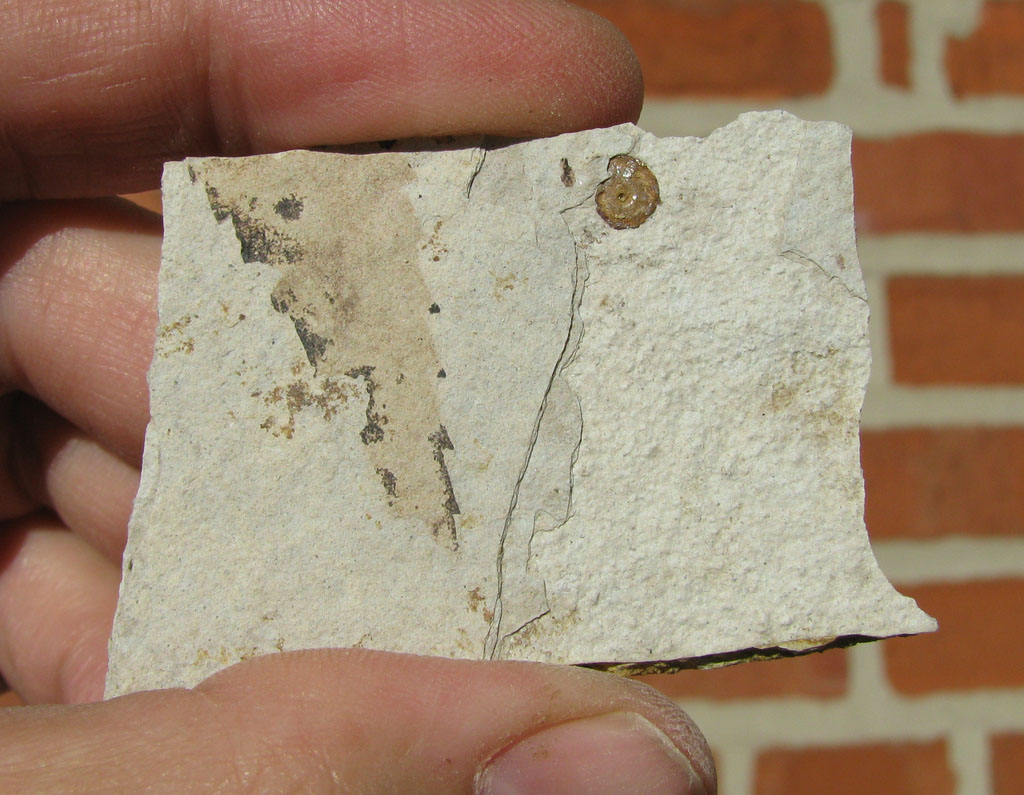
This is a small snail with a partial leaf. The shell has been crushed but you can still see some of the shiny nacre.


A beech or elm type leaf

A seed of some sort, although it looks like the seed itself is missing and only the surrounding "wings" are left. This looks similar to slippery elm seeds.


Lastly, a fly or bee (wasp?) of some sort. The preservation is not the best and it looks better from a distance than up close.


The Florissant fossil beds are called the Florissant formation and are dated to the latest Eocene epoch (Priabonian stage) of the Paleogene.

Sunday, November 23, 2014

Mioplosus labracoides fish head from the Green River Formation

I purchased this fish fossil from a collector just because of it's size and preservation. The collector didn't know what the genus of fish it was but I did a little digging and I think it's a Mioplosus labracoides. The fossil was collected from the Green River formation near Kemmerer, Wyoming (Paleogene, Eocene epoch, Ypresian stage). I have not yet found any Mioplosus fossils myself so this filled a hole in the collection as well as being a cool looking fossil.


Sunday, October 12, 2014

Arbacina monilis echinoid from Hungary

The wee regular echinoid pictured below is Arbacina monilis from the Eocene near Nyirád, Hungary. I received them as part of an exchange with a collector in Hungary. The fossils have a bit of matrix on them still but you can clearly see the tubercles (the round bumps that the spines attach to). The fossils are from the Badenian stage of the Miocene which corresponds to the Langhian stage of the ICS).

Apical side

Oral side


Thanks to Karoly for the fossils!