Today I have a couple of Orthoconic cephalopod sections to show you. Both come from the island of Oland which lies off the eastern coast of Sweden near the town of Gillberga. Nearby, exposed in cliffs along the coast and a local quarry, are layers of limestone that are dated to the middle Ordovician (Darriwillian stage).
This is a section of an Orthoceras (possibly Endoceras)
This piece of conch belongs to a genera called Anthoceras vaginatum. It has a red coloration because part of the original shell is impregnated with Hematite.
I found this paper online that gives a description of the local stratigraphy of Oland and a field trip guide (useful for anyone who wants to visit).
Showing posts with label Sweden. Show all posts
Sunday, August 4, 2013
Monday, July 29, 2013
Agnostus pisiformis trilobites from Sweden
Continuing with the theme from my last post, here are some pieces of coquinoid limestone that are composed primarily of Agnostus pisiformis molts. They come from the Late Cambrian Alum Shale formation near Kinnekulle in Vastergotland, Sweden. It's amazing to see so many Trilobite molts all clumped together. There must have been so many of the animals that they looked like a swarm of bees or gnats or possibly a school of fish.
Thanks to Christian for sending me these fossils!
Saturday, July 27, 2013
Olenus & Ctenocephalus Trilobites from Sweden
From my exchanges with my friend Christian in France, here are some Trilobite fossils that he collected in Sweden.
First up are a couple of black shale pieces that have partial cephalon pieces from two species of Trilobites: Ctenocephalus exsulans and Bailiella impressa - Cambrian - Brantevik, Sweden
Here are some links to pages with more info on Bailiella impressa
http://trilobites.naturalforum.net/t1387-bailiella-impressa
This page is from Christian's Flickr account and you can see a piece with intact cephalons from both Ctenocephalus exsulans and Bailiella impressa
http://www.flickr.com/photos/supergrevling/5513007208/in/set-72157608639773962
Next up are some Olenus truncatus (BRUNNICH, 1789) fossils from the Late Cambrian Alum Shale formation near Scania, Andrarum, Sweden.
Specimen #1
Specimen #2
Specimen #3
Thanks to Christian for these fossils. They help expand the Cambrian portion of my collection!
As I was researching these trilobites I came across Per Hansson's website and suggest a visit if you have even a passing interest in Trilobites. He has an impressive page of Trilobites that he has collected from various locations in Sweden.
I also came across an interesting paper here that discusses the environmental record saved within the Alum Shale formation.
First up are a couple of black shale pieces that have partial cephalon pieces from two species of Trilobites: Ctenocephalus exsulans and Bailiella impressa - Cambrian - Brantevik, Sweden
Here are some links to pages with more info on Bailiella impressa
http://trilobites.naturalforum.net/t1387-bailiella-impressa
This page is from Christian's Flickr account and you can see a piece with intact cephalons from both Ctenocephalus exsulans and Bailiella impressa
http://www.flickr.com/photos/supergrevling/5513007208/in/set-72157608639773962
Next up are some Olenus truncatus (BRUNNICH, 1789) fossils from the Late Cambrian Alum Shale formation near Scania, Andrarum, Sweden.
Specimen #1
Specimen #2
Specimen #3
Thanks to Christian for these fossils. They help expand the Cambrian portion of my collection!
As I was researching these trilobites I came across Per Hansson's website and suggest a visit if you have even a passing interest in Trilobites. He has an impressive page of Trilobites that he has collected from various locations in Sweden.
I also came across an interesting paper here that discusses the environmental record saved within the Alum Shale formation.
Thursday, July 25, 2013
Large Heliophylum coral from Gotland, Sweden
Another item that my friend Christian sent me was this giant Heliophylum coral. It is a little over 6in (15cm) long and nearly 3in (7.5cm) wide.
One side looks totally normal for a horn coral....
..but as you turn it you can see that one side is nearly flat.
This was the cup of the coral
The flat nature of the fossil is not a growth limit nor typical for the genera, rather it shows that this coral sat exposed on the seafloor after it died and toppled over. Time enough for the exposed surface to be eroded away before it finally became buried. I like fossils like this as it gives you some insight into the environment in which these animals used to live.
The fossil came from the Visby limestone near Häftingsklint on the island of Gotland, Sweden. The rocks are dated to the Wenlock stage of the Silurian.
One side looks totally normal for a horn coral....
..but as you turn it you can see that one side is nearly flat.
This was the cup of the coral
The flat nature of the fossil is not a growth limit nor typical for the genera, rather it shows that this coral sat exposed on the seafloor after it died and toppled over. Time enough for the exposed surface to be eroded away before it finally became buried. I like fossils like this as it gives you some insight into the environment in which these animals used to live.
The fossil came from the Visby limestone near Häftingsklint on the island of Gotland, Sweden. The rocks are dated to the Wenlock stage of the Silurian.
Tuesday, July 23, 2013
Palaeocyclus porpitus coral from Gotland, Sweden
I pestered my friend Christian to send me some Palaeocyclus fossils from Gotland and he came through in our last exchange. These are small little solitary rugose corals that lived during the Silurian and colonized the substrate. They are an important fossil genera for correlation of rocks found across Europe but they are not so common here in North America.
Here is a loose specimen
And one that is embedded in the matrix.
Both specimens come from the Visby limestone beds near Hallshuk on the island of Gotland, Sweden. The Visby limestone is dated to the Wenlock stage of the Siluran.
Here is a loose specimen
And one that is embedded in the matrix.
Both specimens come from the Visby limestone beds near Hallshuk on the island of Gotland, Sweden. The Visby limestone is dated to the Wenlock stage of the Siluran.
Sunday, July 21, 2013
Eospirifer radiatus Brachiopod from Gotland, Sweden
Back in 2011, I wrote about a fossil I'd found in Indiana called Eospirifer radiatus. Last year I received a package from my friend Christian that had some brachiopods from Gotland, Sweden and included with them was a Eospirifer radiatus. This is a very good specimen compared to the one I found in Indiana but the same general features can be seen.
Brachial valve
Anterior
Pedicle valve
Posterior
Profile
The very fine detail of the ribbing and costae (the wavy folds) are preserved nicely. If the costae were more strongly expressed and continued farther across the shell towards the hinge line the fossil would then be called Eospirifer eudora as in this specimen from England or this one from Indiana.
A couple of detail shots of the attached Spirorbis and bryozoan epibonts.
The specimen comes from the Mulde limestones exposed on the island of Gotland in Sweden. The Mulde beds are Silurian in age (Wenlock stage).
Brachial valve
Anterior
Pedicle valve
Posterior
Profile
The very fine detail of the ribbing and costae (the wavy folds) are preserved nicely. If the costae were more strongly expressed and continued farther across the shell towards the hinge line the fossil would then be called Eospirifer eudora as in this specimen from England or this one from Indiana.
A couple of detail shots of the attached Spirorbis and bryozoan epibonts.
The specimen comes from the Mulde limestones exposed on the island of Gotland in Sweden. The Mulde beds are Silurian in age (Wenlock stage).
Sunday, June 3, 2012
Orusia lenticularis brachiopod from Sweden
Here is a piece of matrix that I received from my friend Christian that he collected in Brantevik, Sweden. It has many impressions and shells of the brachiopod Orusia lenticularis.
The specimen comes from the upper Cambrian which is nice as I don't have very many Cambrian aged fossils in my collection.
Labels:
Brachiopod,
Cambrian,
Sweden
Location:
Nygatan 10, 272 38 Brantevik, Sweden
Thursday, May 24, 2012
Actinocamax and Belemnellocamax cephalopods from Sweden
Finishing up my theme of fossils from the Ignaberga, Sweden area are these Belemnites.
This first specimen is Actinocamax (Goniotheutis) quadrata
The second specimen is Belemnellocamax mammillatus
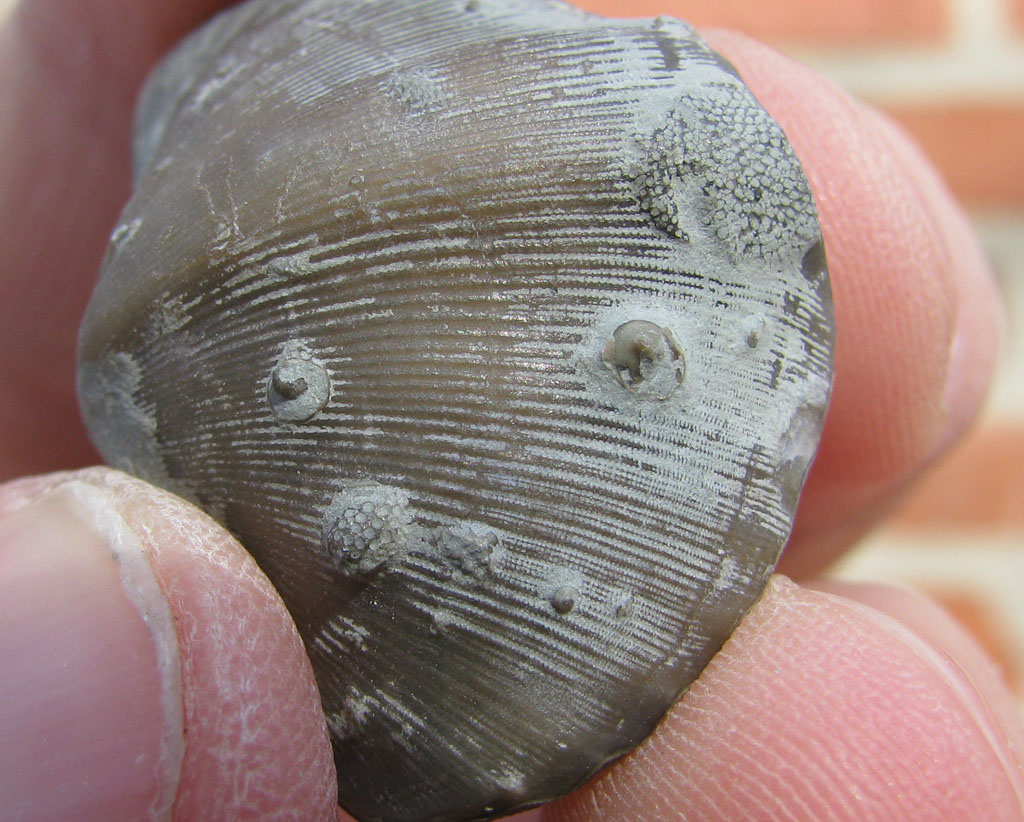
For the life of me I can't tell the two species apart and am going by the labels that were sent with them. Both are from the Campanian stage of the Cretaceous and were sent to me by my friend Christian.
This first specimen is Actinocamax (Goniotheutis) quadrata
The second specimen is Belemnellocamax mammillatus
For the life of me I can't tell the two species apart and am going by the labels that were sent with them. Both are from the Campanian stage of the Cretaceous and were sent to me by my friend Christian.
Labels:
Cephalopod,
Cretaceous,
Sweden
Location:
Ignaberga, Sweden
Tuesday, May 22, 2012
Salenia and Echinogalerus echinoids from Sweden
A couple more fossils from Ignaberga are some tiny echinoids.
Echinogalerus peltiformis is an irregular echinoid.
Adapical surface (top)
Side profile
Adoral surface (underside or bottom)
Posterior (rear)
Anterior (front)
The other is Salenia aerolata which is a regular echinoid.
Adapical surface (top)
Side profile
Adoral surface (underside or bottom)
Both specimens come from the same quarry near Ignaberga in the providence of Scanie, Sweden. The quarry mines a layer of rock that is from the Campanian stage of the Cretaceous. Thank you to Christian for sending me these specimens.
Adapical surface (top)
Side profile
Adoral surface (underside or bottom)
Posterior (rear)
Anterior (front)
The other is Salenia aerolata which is a regular echinoid.
Adapical surface (top)
Side profile
Adoral surface (underside or bottom)
Both specimens come from the same quarry near Ignaberga in the providence of Scanie, Sweden. The quarry mines a layer of rock that is from the Campanian stage of the Cretaceous. Thank you to Christian for sending me these specimens.
Labels:
Cretaceous,
Echinoid,
Sweden
Location:
2023, 281 92 Hässleholm, Sweden
Subscribe to:
Posts (Atom)


