Showing posts with label Gotland. Show all posts

Thursday, July 25, 2013

Large Heliophylum coral from Gotland, Sweden

Another item that my friend Christian sent me was this giant Heliophylum coral. It is a little over 6in (15cm) long and nearly 3in (7.5cm) wide.

One side looks totally normal for a horn coral....

..but as you turn it you can see that one side is nearly flat.


This was the cup of the coral

The flat nature of the fossil is not a growth limit nor typical for the genera, rather it shows that this coral sat exposed on the seafloor after it died and toppled over. Time enough for the exposed surface to be eroded away before it finally became buried. I like fossils like this as it gives you some insight into the environment in which these animals used to live.

The fossil came from the Visby limestone near Häftingsklint on the island of Gotland, Sweden. The rocks are dated to the Wenlock stage of the Silurian.

Tuesday, July 23, 2013

Palaeocyclus porpitus coral from Gotland, Sweden

I pestered my friend Christian to send me some Palaeocyclus fossils from Gotland and he came through in our last exchange. These are small little solitary rugose corals that lived during the Silurian and colonized the substrate. They are an important fossil genera for correlation of rocks found across Europe but they are not so common here in North America.

Here is a loose specimen


And one that is embedded in the matrix.


Both specimens come from the Visby limestone beds near Hallshuk on the island of Gotland, Sweden. The Visby limestone is dated to the Wenlock stage of the Siluran.

Sunday, July 21, 2013

Eospirifer radiatus Brachiopod from Gotland, Sweden

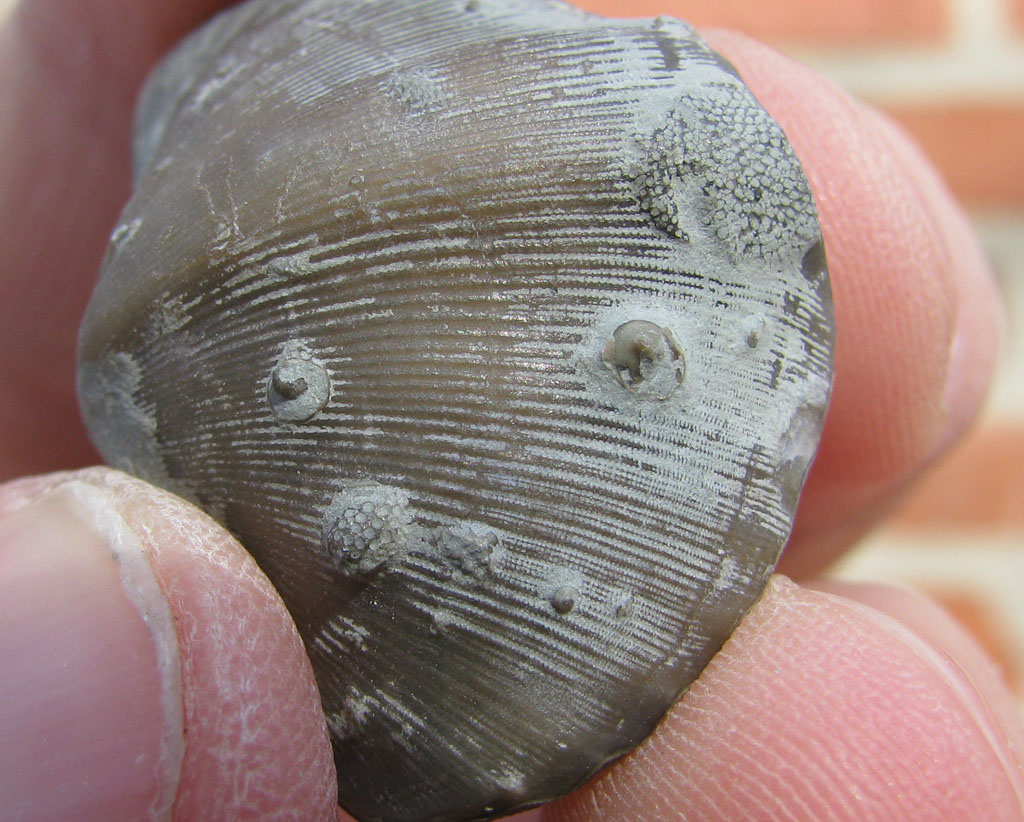
Back in 2011, I wrote about a fossil I'd found in Indiana called Eospirifer radiatus. Last year I received a package from my friend Christian that had some brachiopods from Gotland, Sweden and included with them was a Eospirifer radiatus. This is a very good specimen compared to the one I found in Indiana but the same general features can be seen.

Brachial valve

Anterior

Pedicle valve

Posterior

Profile

The very fine detail of the ribbing and costae (the wavy folds) are preserved nicely. If the costae were more strongly expressed and continued farther across the shell towards the hinge line the fossil would then be called Eospirifer eudora as in this specimen from England or this one from Indiana.

A couple of detail shots of the attached Spirorbis and bryozoan epibonts.


The specimen comes from the Mulde limestones exposed on the island of Gotland in Sweden. The Mulde beds are Silurian in age (Wenlock stage).