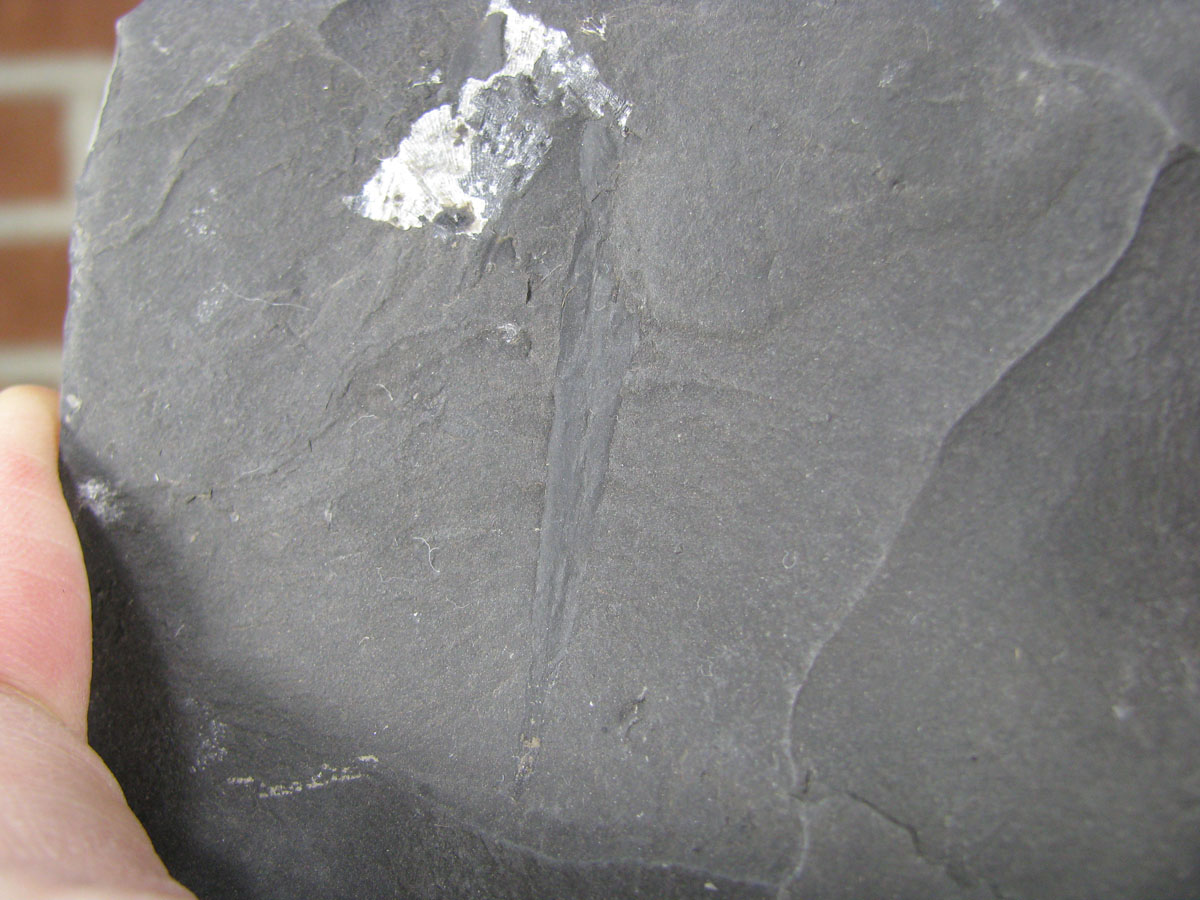
There are lots of orthoconic cephalopod fossils from the Paleozoic that often get lumped into the "Orthoceras", or in the Devonian period "Michelinoceras", name because of a lack of defining features. Sometimes though you do find a smaller, thinner variation on the theme that can be narrowed down to the Bactrites genus. Below are two examples of the species Bactrites aciculum from the Windom shale in New York. They are long and thin with a max width of 1cm. Often the shells are crushed laterally during the compression of the mud they are encased in which leaves them with a line or ridge running the length of the shell.
Specimen #1 - This is a nearly complete specimen with only part of the living chamber extening off the rock and the narrowest part of the start of the shell still hidden by rock. Note that there appears to be chamber lines perpendicular to the main shell axis present on this specimen.
Specimen #2 is smaller and less complete but you can also just make out what appear to be chamber segments.
These specimens were found at a borrow pit on Deep Springs Road in Madison County, NY which exposes the Windom shale member of
the Moscow formation (middle Devonian in age, Givetian stage.)
Showing posts with label Cephalopod. Show all posts
Thursday, April 16, 2020
Friday, April 10, 2020
Tornoceras uniangulare goniatite from the Moscow formation
Goniatites are primitive Cephalopods that had coiled shells and lived prior to the more well known Ammonites during the Paleozoic. They had chambered shells and can be identified by the suture pattern, as in Ammonites, however the patterns are far simpler than their younger cousins.
Below is a decently sized example of the goniatite Tornoceras uniangulare from the Moscow formation of New York. It is a partial example with a large section of the living chamber missing. I believe it has also been compressed at a slight angle. I'm not sure if it is pareidolia or not but it seems like you can see some of the sutures along the leading edge of the largest chamber (upper left side of the fossil) just before it cuts off.
Specimen #1
A couple of smaller specimens
Specimen #2
Specimen #3
Sometimes you only find partial sections...
Other times the fossil is warped due to how it was laying in the sediment prior to compression.
These specimens were found at a borrow pit on Deep Springs Road in Madison County, NY which exposes the Windom shale member of the Moscow formation (middle Devonian in age, Givetian stage.)
Below is a decently sized example of the goniatite Tornoceras uniangulare from the Moscow formation of New York. It is a partial example with a large section of the living chamber missing. I believe it has also been compressed at a slight angle. I'm not sure if it is pareidolia or not but it seems like you can see some of the sutures along the leading edge of the largest chamber (upper left side of the fossil) just before it cuts off.
Specimen #1
A couple of smaller specimens
Specimen #2
Specimen #3
Sometimes you only find partial sections...
Other times the fossil is warped due to how it was laying in the sediment prior to compression.
These specimens were found at a borrow pit on Deep Springs Road in Madison County, NY which exposes the Windom shale member of the Moscow formation (middle Devonian in age, Givetian stage.)
Monday, April 6, 2020
Spryoceras sp. cephalopod from the Moscow formation
Spyroceras sp. is a genera that is known from the Ordovician period up through the Devonian period. that gives it an age range of 100 million years that the genus is recognized in the fossil record. It's doubtful that a single species lasted that long, but it does speak to the success of the genus. Below is an example of the genus that I found at the Deep Springs Rd. borrow pit in New York. It comes from the Windom shale member of the Moscow formation (middle Devonian, Givetian stage). It is easily recognized by the straight, orthoconic shell that has regularly spaced growth rings that are perpendicular to the rest of the shell. If there was enough detail on the impression I might be able to narrow down the species based on the presence of striae that can sometimes be seen between the growth rings but are parallel to the shell's growth.
Specimen #1
This is a 3-D fossil cast of the shell so it pops off and you can see both sides.
Specimen #2 - This may be a different species, perhaps Spyroceras nuntium which is known for having more closely spaced annulations and coarser striae.
I found an example of Spyroceras sp. in the Ordovician aged Verulam formation here (scroll to the bottom of the post).
These specimens were found at a borrow pit on Deep Springs Road in Madison County, NY which exposes the Windom shale member of the Moscow formation (middle Devonian in age, Givetian stage.)
Specimen #1
This is a 3-D fossil cast of the shell so it pops off and you can see both sides.
Specimen #2 - This may be a different species, perhaps Spyroceras nuntium which is known for having more closely spaced annulations and coarser striae.
I found an example of Spyroceras sp. in the Ordovician aged Verulam formation here (scroll to the bottom of the post).
These specimens were found at a borrow pit on Deep Springs Road in Madison County, NY which exposes the Windom shale member of the Moscow formation (middle Devonian in age, Givetian stage.)
Saturday, February 8, 2020
Geisonoceras tenuistriatum cephalopod from the Whitby formation
I've found a couple of examples of small Cephalopods in the Collingswood member of the Whitby formation. They are hard to photograph as they do not contrast much with the black shale but I can see they are conical in shape and taper to a point. Some examples have fine ribbing or striations parallel to the shell growth. According to William Hessin these are likely Geisonoceras tenuistriatum which is restricted to the Whitby formation.
Specimen #1
Specimen #2
The Whitby formation is Ordovician in age (late Ordovician, Katian/Mohawkian stage).
These fossils were collected from the St. Mary's Limestone Quarry in Bowmanville, Ontario. I used William Hessin's book "South Central Ontario Fossils", 2009, Self Published, pg. 155 to help identify these fossils.
Specimen #1
Specimen #2
The Whitby formation is Ordovician in age (late Ordovician, Katian/Mohawkian stage).
These fossils were collected from the St. Mary's Limestone Quarry in Bowmanville, Ontario. I used William Hessin's book "South Central Ontario Fossils", 2009, Self Published, pg. 155 to help identify these fossils.
Wednesday, April 8, 2015
Leymeriella regularis ammonite from France
The fossil for today is Leymeriella regularis from the Albian stage (Jurassic) rocks near Bellegarde sur Valserine, Ain Department, France. The whorls are not overly wide but do cover approximately 90% of the previous generation. Moderate ribbing marks the sides of the whorls but does not continue completely across the keel of the shell. The cross section of the living chamber is square in shape.
Specimen #1
Specimen #2
Thanks to Gery for the specimens!
Specimen #1
Specimen #2
Thanks to Gery for the specimens!
Saturday, April 4, 2015
Lissoceratoides erato ammonite from France
Here is another ammonite from near Poitiers, Vienne Department, France. It's Lissoceratoides erato and is from Oxfordian aged rocks (Jurassic).
The whorls are wide and overlap each other quite a bit so that there is
just a small area in the center that gives evidence of previous shell. It is a fairly flat shell in cross section.
Here is a closeup of the shell and the visible sutures...
..and an image of the pattern lain flat.
Suture pattern image taken from "Renz O, Imlay R, Lancelot Y, Ryan WBF (1975)
Ammonite rich Oxfordian limestones from the base of the continental slope
off Northwest Africa. Eclogae geol Helv Vol 68 /2: 431–448"
Thanks to Gery for the fossil!
Here is a closeup of the shell and the visible sutures...
..and an image of the pattern lain flat.
Thanks to Gery for the fossil!
Thursday, April 2, 2015
Trimarginites trimarginatus ammonite from France
I apologize for the darker than usual photos of this specimen but I must have taken them on a cloudy day. they are of an ammonite called Trimarginites trimarginatus that comes from the Oxfordian stage sediments (Jurassic) near Poitiers, Vienne Department, France. The whorls are wide and overlap each other quite a bit so that there is just a small area in the center that gives evidence of previous shell. The cross section of the shell is flat.
The sutures are very complex. Here is a closeup of the shell and the visible sutures...
..and an image of the pattern lain flat.
Suture pattern image taken from "Renz O, Imlay R, Lancelot Y, Ryan WBF (1975) Ammonite rich Oxfordian limestones from the base of the continental slope off Northwest Africa. Eclogae geol Helv Vol 68 /2: 431–448"
The Ammonites.fr website has a page on this species that can be found here. Thanks to Gery for the fossil!
The sutures are very complex. Here is a closeup of the shell and the visible sutures...
..and an image of the pattern lain flat.
Suture pattern image taken from "Renz O, Imlay R, Lancelot Y, Ryan WBF (1975) Ammonite rich Oxfordian limestones from the base of the continental slope off Northwest Africa. Eclogae geol Helv Vol 68 /2: 431–448"
The Ammonites.fr website has a page on this species that can be found here. Thanks to Gery for the fossil!
Sunday, March 29, 2015
Belemnitella mucronata cephalopod from France
My friend Gery sent me some specimens of Belemnitella mucronata from the Toarcian stage aged (Jurassic) rocks in Vendee Department, France. They are small and show the typical round cross sections. Had they not been labelled I would not be able to tell them apart from many other Belemnite fossils. These are just the internal "skeletons" of squid like animals that were surrounded by soft tissue and mostly were used to anchor muscles.
Friday, March 6, 2015
Pristeroceras timidum cephalopod from the Bertie Formation
This is one of the oddest fossils I've found in the Bertie limestone, it's a cephalopod called Pristeroceras timidum. It appears to have possessed a very thin shell or maybe one that was not permineralized like other cephalopods. Pristeroceras timidum is considered a breviconic type of Cephalopod in that it did not form a long conical shell but instead opted for a subovoid shape. In the Bertie formation the shell is often very compressed and so fossils do not present many details.
This is the specimen as found in the field. Note the light colored pattern on the darker colored shell.
The other side of the enclosing limestone broke into a number of smaller pieces that I've glued back together.
The cast of the fossil popped off the matrix and allows me to see both side. Here is the impression of the side that was hidden from view in the first picture.
A closer view of the top limestone later
Here is the body fossil itself. The pattern that is evident on the shell is the opening where the animals head and tentacles emerged.
The back side of the fossil shows a wrinkled pattern due to the compression.
I got some of the info for this post, including the image below, from the following paper:
"A Restudy of the Silurian Nautiloid Genus Pristeroceras Ruedemann"by Walter C. Sweet and Willard P. Leutze,Journal of Paleontology, Vol. 30, No. 5 (Sep., 1956), pp. 1159-1164
This is the specimen as found in the field. Note the light colored pattern on the darker colored shell.
The other side of the enclosing limestone broke into a number of smaller pieces that I've glued back together.
The cast of the fossil popped off the matrix and allows me to see both side. Here is the impression of the side that was hidden from view in the first picture.
A closer view of the top limestone later
Here is the body fossil itself. The pattern that is evident on the shell is the opening where the animals head and tentacles emerged.
The back side of the fossil shows a wrinkled pattern due to the compression.
I got some of the info for this post, including the image below, from the following paper:
"A Restudy of the Silurian Nautiloid Genus Pristeroceras Ruedemann"by Walter C. Sweet and Willard P. Leutze,Journal of Paleontology, Vol. 30, No. 5 (Sep., 1956), pp. 1159-1164
Subscribe to:
Posts (Atom)