A recent addition to my Moroccan trilobites is this Asaphellus fezouataensis from the Ordovician (Floian stage), Fezouata Formation in the Draa Valley near Zagora, Morocco (Western Sahara). I bought this at a fossil show and it was fairly inexpensive. I see some now on E-bay that are priced much higher so either I got a good deal, I found it early enough on the market or (more likely) the sellers are trying to get as much as they can for it.
The fossil looks very similar to Isotelus species that are found here in North America within late Orodvician rocks.
Showing posts with label Trilobites. Show all posts
Friday, November 21, 2014
Saturday, July 27, 2013
Olenus & Ctenocephalus Trilobites from Sweden
From my exchanges with my friend Christian in France, here are some Trilobite fossils that he collected in Sweden.
First up are a couple of black shale pieces that have partial cephalon pieces from two species of Trilobites: Ctenocephalus exsulans and Bailiella impressa - Cambrian - Brantevik, Sweden
Here are some links to pages with more info on Bailiella impressa
http://trilobites.naturalforum.net/t1387-bailiella-impressa
This page is from Christian's Flickr account and you can see a piece with intact cephalons from both Ctenocephalus exsulans and Bailiella impressa
http://www.flickr.com/photos/supergrevling/5513007208/in/set-72157608639773962
Next up are some Olenus truncatus (BRUNNICH, 1789) fossils from the Late Cambrian Alum Shale formation near Scania, Andrarum, Sweden.
Specimen #1
Specimen #2
Specimen #3
Thanks to Christian for these fossils. They help expand the Cambrian portion of my collection!
As I was researching these trilobites I came across Per Hansson's website and suggest a visit if you have even a passing interest in Trilobites. He has an impressive page of Trilobites that he has collected from various locations in Sweden.
I also came across an interesting paper here that discusses the environmental record saved within the Alum Shale formation.
First up are a couple of black shale pieces that have partial cephalon pieces from two species of Trilobites: Ctenocephalus exsulans and Bailiella impressa - Cambrian - Brantevik, Sweden
Here are some links to pages with more info on Bailiella impressa
http://trilobites.naturalforum.net/t1387-bailiella-impressa
This page is from Christian's Flickr account and you can see a piece with intact cephalons from both Ctenocephalus exsulans and Bailiella impressa
http://www.flickr.com/photos/supergrevling/5513007208/in/set-72157608639773962
Next up are some Olenus truncatus (BRUNNICH, 1789) fossils from the Late Cambrian Alum Shale formation near Scania, Andrarum, Sweden.
Specimen #1
Specimen #2
Specimen #3
Thanks to Christian for these fossils. They help expand the Cambrian portion of my collection!
As I was researching these trilobites I came across Per Hansson's website and suggest a visit if you have even a passing interest in Trilobites. He has an impressive page of Trilobites that he has collected from various locations in Sweden.
I also came across an interesting paper here that discusses the environmental record saved within the Alum Shale formation.
Saturday, October 20, 2012
A couple of Bohemeian trilobites
No, this post is not about Trilobites that hang out in coffee shops reading poetry, rather it's to display two fossils from the western region of the Czech Republic.
The first is Aulacopleura konincki. It comes from the Liten fm. near Lodenice and is dated to the Silurian (Wenlock series).
The second fossil is Ellipsocephalis hoffi from the Jince fm. near Jince and is dated to the middle Cambrian period.
The website Trilobites.info has a page dedicated to the Trilbites found in the Jince formation.
The first is Aulacopleura konincki. It comes from the Liten fm. near Lodenice and is dated to the Silurian (Wenlock series).
The second fossil is Ellipsocephalis hoffi from the Jince fm. near Jince and is dated to the middle Cambrian period.
The website Trilobites.info has a page dedicated to the Trilbites found in the Jince formation.
Labels:
Cambrian,
Czech Republic,
Silurian,
Trilobites
Location:
Jince, Czech Republic
Wednesday, July 25, 2012
Crinoid roots and Calymene Trilobites from the Waldron formation
I've been showing off alot of fossils that I purchased recently and this is one of my favorites. It's a pair of Crinoid holdfasts or "roots" which has a pair of Calymene trilobites huddled underneath. It comes from the Waldron shale on Indiana which is Silurian (Sheinwoodian to Homerian stage) in age.
Here you can see the two holdfasts looking like stumps in a freshly cut forest.
Underneath the larger of the two holdfasts are the Trilobites.
They are both complete and fully articulated
This specimen was found by Mark Palatas from whom I purchased it. I was fortunate enough to see some of his collection and his prepping work station when I visited his home a few months ago. This specimen, however, was not prepped by Mark but by one of his friends.
Here you can see the two holdfasts looking like stumps in a freshly cut forest.
Underneath the larger of the two holdfasts are the Trilobites.
They are both complete and fully articulated
This specimen was found by Mark Palatas from whom I purchased it. I was fortunate enough to see some of his collection and his prepping work station when I visited his home a few months ago. This specimen, however, was not prepped by Mark but by one of his friends.
Labels:
Arthropod,
Crinoid,
Indiana,
Silurian,
Trilobites,
Waldron Shale
Location:
St Paul, IN, USA
Sunday, February 5, 2012
Bufoceraurus or Ceraurus matranseris
Sometimes all you find is a fragment of a Trilobite, like the partial Amphilichas cephalon I detailed a couple of weeks back. Such is the case with the single, isolated cephalon below.
After reviewing the book "South-Central Ontario Fossils" by William Hessin, my first thought is that it came from a Bufoceraurus.
I posed the question to my friend Kevin who responded: "Your "Bufoceraurus" may be correct, but I think it may more likely be Ceraurus matranseris. There's a close up pic in Bill's book (pg 185) so you can compare for yourself. I base that choice on not seeing any tubercules on the first axial ring."
I need to examine the specimen more before I make a decision as to what name is correct and in order to do that I need to get it cleaned up a little more. I'll post an update in the future once the work is complete.
After reviewing the book "South-Central Ontario Fossils" by William Hessin, my first thought is that it came from a Bufoceraurus.
I posed the question to my friend Kevin who responded: "Your "Bufoceraurus" may be correct, but I think it may more likely be Ceraurus matranseris. There's a close up pic in Bill's book (pg 185) so you can compare for yourself. I base that choice on not seeing any tubercules on the first axial ring."
I need to examine the specimen more before I make a decision as to what name is correct and in order to do that I need to get it cleaned up a little more. I'll post an update in the future once the work is complete.
Wednesday, February 1, 2012
Calyptulax trilobite cephalon from the Verulam fm.
When I first found my first Calyptulax cephalon in the Verulam formation I had to ask my friend Kevin: "What the heck is a Phacops doing in the Ordovician?" He pointed out to me that the glabella on a Calyptulax doesn't look quite like the one on a Phacops but they do both share similar eyes.
Calyptulax is a somewhat common trilobite in the Verulam with it's cephalon being the easiest part to spot. The plate below has one as well as a pygidium from a Felxicalymene among other fossil debris.
Another plate holds at least three.
An angled view of of of the cephalons from the above plate/
Kevin has been very patient and put up with my many mispronunciations of Calyptulax (Calypsolax, Collapasox, Californiax, etc.). Calyptulax is a Phacopid trilobite and is related to Flexicalymene, Greenops, Dalmanites, Dipleura as well as Phacops for which the order is named.
Calyptulax is a somewhat common trilobite in the Verulam with it's cephalon being the easiest part to spot. The plate below has one as well as a pygidium from a Felxicalymene among other fossil debris.
Another plate holds at least three.
An angled view of of of the cephalons from the above plate/
Kevin has been very patient and put up with my many mispronunciations of Calyptulax (Calypsolax, Collapasox, Californiax, etc.). Calyptulax is a Phacopid trilobite and is related to Flexicalymene, Greenops, Dalmanites, Dipleura as well as Phacops for which the order is named.
Saturday, January 28, 2012
Partial Ceraurus trilobite from the Verulam fm.
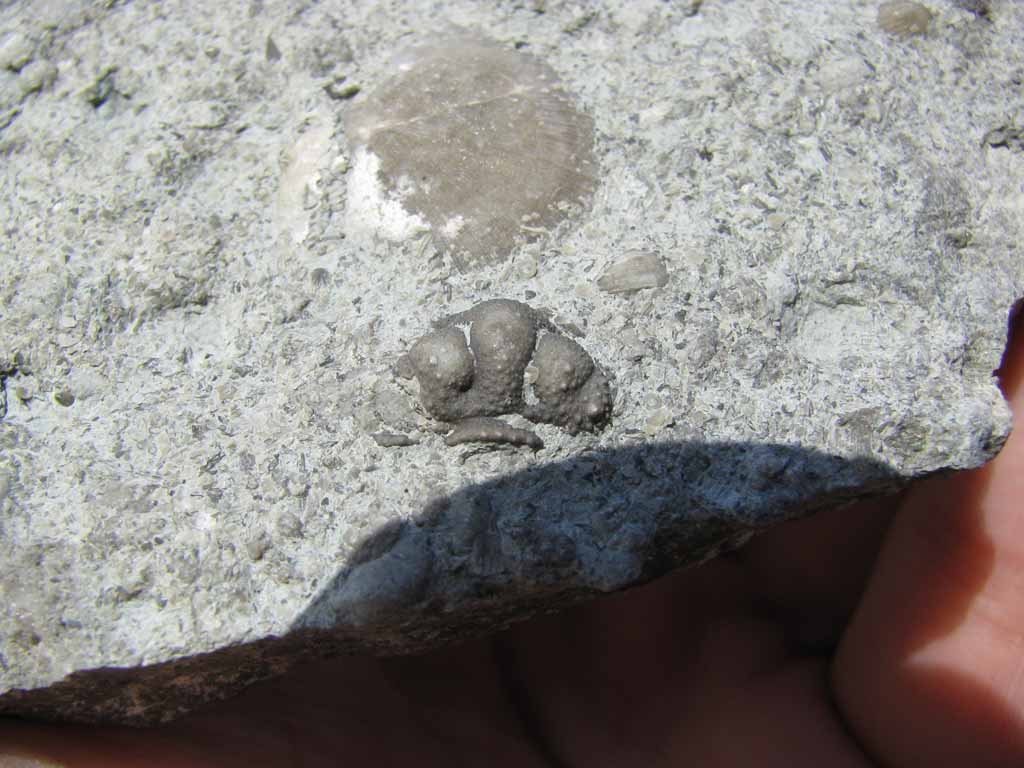
The first Ceraurus I've ever found was from the Verulam formation and is pictured below. It's not complete but it is enrolled. You can see the stubs of one of the spines which extend from the Pygidium curving out.
Here is an angled view that shows the meet point between the Cephalon and Thorax
Based on the images in William Hessin's book "South Central Ontario Fossils", 2009, I am going to go out on a limb and say that this trilobite might be a Ceraurus globulobatus. I can'tr really be sure until I get the cephalon cleaned off a little more.
The specimen was collected from a quarry near Brechin, Ontario, Canada in the Verulam formation which is middle Ordovician in age (Katian/Mohawkian stage).
Here is an angled view that shows the meet point between the Cephalon and Thorax
Based on the images in William Hessin's book "South Central Ontario Fossils", 2009, I am going to go out on a limb and say that this trilobite might be a Ceraurus globulobatus. I can'tr really be sure until I get the cephalon cleaned off a little more.
The specimen was collected from a quarry near Brechin, Ontario, Canada in the Verulam formation which is middle Ordovician in age (Katian/Mohawkian stage).
Thursday, January 26, 2012
Thaleops (or Nanillaenus) trilobite cephalon from the Verulam fm.
Another new trilobite genera for me, from the Verulam formation, is Thaleops. I found two specimens on my last trip up to Canada.
This first specimen is a somewhat complete cephalon
A closer view shows the glabella. the body would have extended back towards the top of the picture.
A view looking at the back of the Cephalon.
The second piece I found was an isolated glabella.
Both specimens were collected from the Verulam formation (although at different levels) which is Ordovician (Katian/Mohawkian stage) in age.
My friend Kevin has a nice specimen, that he found in the same quarry as my specimens above, of what he called Nanillaenus in his gallery on the Fossil Forum.
There is some debate about Thaleops and Nanillaenus and which is a proper name. I found a paper from 2004 published in the "Journal of Systematic Paleontology" that synonimizes Nanillaenus with Thaleops. See the link below:
A SYSTEMATIC REVISION OF Thaleops (TRILOBITA: ILLAENIDAE) WITH NEW SPECIES FROM THE MIDDLE AND LATE ORDOVICIAN OF OKLAHOMA AND NEW YORK
By Lisa Amati and Stephen R. Westrop (2004) from the Journal of Systematic Palaeontology, Volume 2,
Issue 03, September 2004 pp 207-256
This first specimen is a somewhat complete cephalon
A closer view shows the glabella. the body would have extended back towards the top of the picture.
A view looking at the back of the Cephalon.
The second piece I found was an isolated glabella.
Both specimens were collected from the Verulam formation (although at different levels) which is Ordovician (Katian/Mohawkian stage) in age.
My friend Kevin has a nice specimen, that he found in the same quarry as my specimens above, of what he called Nanillaenus in his gallery on the Fossil Forum.
There is some debate about Thaleops and Nanillaenus and which is a proper name. I found a paper from 2004 published in the "Journal of Systematic Paleontology" that synonimizes Nanillaenus with Thaleops. See the link below:
A SYSTEMATIC REVISION OF Thaleops (TRILOBITA: ILLAENIDAE) WITH NEW SPECIES FROM THE MIDDLE AND LATE ORDOVICIAN OF OKLAHOMA AND NEW YORK
By Lisa Amati and Stephen R. Westrop (2004) from the Journal of Systematic Palaeontology, Volume 2,
Issue 03, September 2004 pp 207-256
Sunday, January 22, 2012
Partial Amphilichas trilobite cephalon from the Verulam fm.
This next specimen was a surprise find for me. I flipped a piece of rock upside down and saw the fossil below lying on the surface. It's the glabella from a cephalon of the trilobite Amphilichas. From talking to my friend Kevin, who regularly collects in the quarry we were in, it's pretty rare to even find this much in the Verulam fm.
It's too bad there wasn't more of the cephalon present but I'm pretty happy with this new genera to add to my collection. Based on the book "South Central Ontario Fossils" by William Hessin, the specimen could be Amphilichas ottawaensis. I found this in the Verulam formation of Ontatio, Canada which is middle Ordovician (Katian/Mohawkian stage) is age.
A slightly more complete cephalon of a Amphilichas can be seen here.
The Dry Dredgers have a page here with several examples of this genera found in the rocks around Cincinnati.
It's too bad there wasn't more of the cephalon present but I'm pretty happy with this new genera to add to my collection. Based on the book "South Central Ontario Fossils" by William Hessin, the specimen could be Amphilichas ottawaensis. I found this in the Verulam formation of Ontatio, Canada which is middle Ordovician (Katian/Mohawkian stage) is age.
A slightly more complete cephalon of a Amphilichas can be seen here.
The Dry Dredgers have a page here with several examples of this genera found in the rocks around Cincinnati.
Friday, January 20, 2012
Hemiarges paulianus trilobite cephalon from the Verulam
Hemiarges paulianus is one of the many trilobites found in the Verulam fm of Ontario, Canada. I've only found the cephalon of this species thus far as can be seen below.
I like the bumpy surface on the exterior of the cephalon. I've read where these may have had sensory hairs or other organs to help the animal find it's way. Otherwise I think it is blind as I can't see any eye structures.
My friend Joe has a complete specimen on his website here.
I like the bumpy surface on the exterior of the cephalon. I've read where these may have had sensory hairs or other organs to help the animal find it's way. Otherwise I think it is blind as I can't see any eye structures.
My friend Joe has a complete specimen on his website here.
Saturday, January 14, 2012
Hypodicranotus striatulus trilobite hypostome from the Verulam
One of the nice things about the middle Ordovician aged (Katian/Mohawkian stage) Verulam formation is the abundance or Trilobite remains. Most times they are whole specimens, like the Flexicalymene I found, but more often they are the scattered bits of the skeleton left after a molt. Below is one such piece which is a Hypostome from a trilobite called Hypodicranotus striatulus.
The Hypostome is thought to be one of the mouth parts on a trilobite. Some research suggests that they used them like claws in order to hold prey in place while feeding or that they were an integral part of the feeding apparatus.
The website Trilobites.info has a great page here that discusses Hypostomes and their varied shapes as well as how they were attached to the cephalon of trilobites.
Harvard's website has a great set of pictures of a whole specimen, click here, as well as some of the Hypostomes from the Walcott-Rust quarry in NY.
You can check out another Hypostome from a Hypodicranotus in the gallery of my friend Kevin on the Fossil Forum here. Thanks to Kevin for IDing the specimen for me.
The Hypostome is thought to be one of the mouth parts on a trilobite. Some research suggests that they used them like claws in order to hold prey in place while feeding or that they were an integral part of the feeding apparatus.
The website Trilobites.info has a great page here that discusses Hypostomes and their varied shapes as well as how they were attached to the cephalon of trilobites.
Harvard's website has a great set of pictures of a whole specimen, click here, as well as some of the Hypostomes from the Walcott-Rust quarry in NY.
You can check out another Hypostome from a Hypodicranotus in the gallery of my friend Kevin on the Fossil Forum here. Thanks to Kevin for IDing the specimen for me.
Thursday, January 12, 2012
Anazyga recurvirostra plate from the Verulam
Below is a plate that is packed with Anazyga recurviostra brachiopods. I found it at a quarry in the Verulam formation up in Canada. I like that the piece has so many individual brachiopods that are in good shape and well exposed. The fact that they are all intact tells me they were probably swept together during a storm event. The only other fossil included in the mass of brachiopods is a small trilobite pygidium piece, possibly from a small Isotelus.
Detail of the pygidium and brachiopods. Note that the brachiopods are facing in random directions. This is another indication of a storm event. Had they been grouped together by a current many of the shells would be oriented in the same direction.
Thanks to my friend Kevin for the correction that the brachiopods were Anazyga and not Zygospira as well as the Isotelus ID. The Verulam formation is middle Ordovician in age (Katian/Mohawkian stage).
Detail of the pygidium and brachiopods. Note that the brachiopods are facing in random directions. This is another indication of a storm event. Had they been grouped together by a current many of the shells would be oriented in the same direction.
Thanks to my friend Kevin for the correction that the brachiopods were Anazyga and not Zygospira as well as the Isotelus ID. The Verulam formation is middle Ordovician in age (Katian/Mohawkian stage).
Tuesday, January 10, 2012
Felxicalymene trilobite from the Verulam fm.
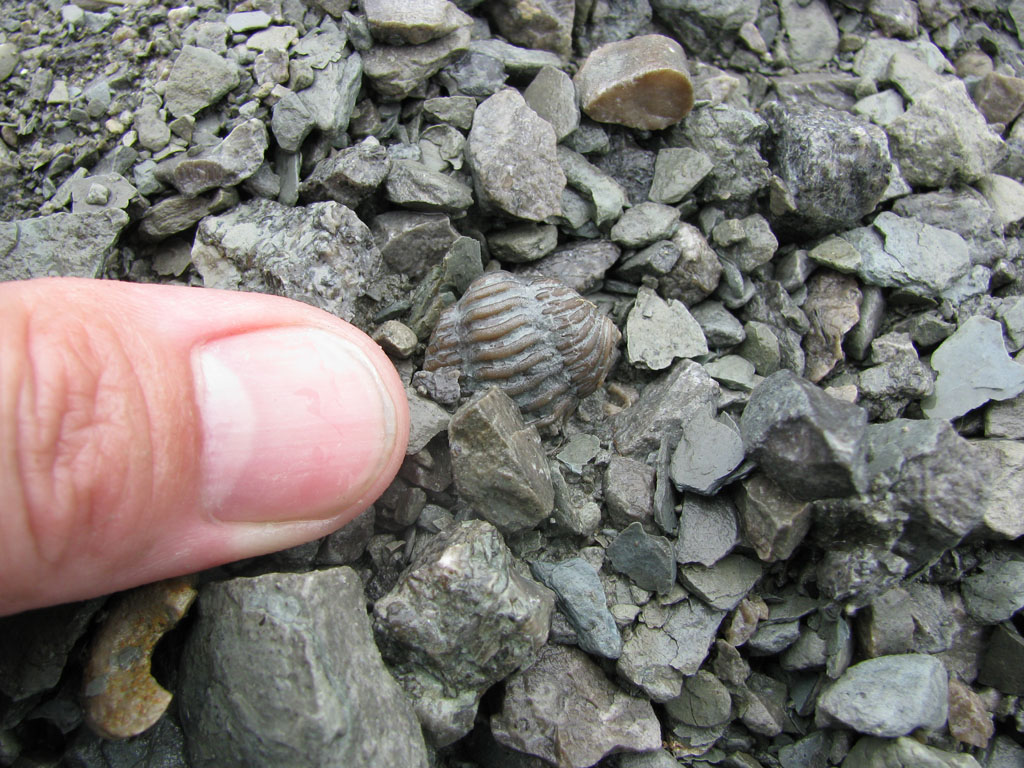
On the last trip I took up to the Verulam formation quarries this past fall, I finally found my first enrolled Flexicalymene trilobite. Here it is "in situ" as I found it.
I found the trilobite on the large mounds of crushed rock that had been set aside as a reserve. It's rather remarkable that the fossil survived the crushing process intact. Here is what it looked like when I picked it up.
And here it is once I got it home to be cleaned up. Looking down on the cephalon, essentially the "top" of the specimen.
Turned 90 degrees to look at the "front" of the specimen with the interlocking cephalon and pygidium. You can see a little bit of the cephalon's egde is chipped off. Otherwise the specimen is in great shape.
Thoracic segments on the "bottom of the specimen.
"Back" side of the specimen with more thoracic segments.
A profile view of the specimen. You can see that it has been slightly compressed and is not a truly round shape.
I was at the quarry that day with my friend Kevin who then showed me up by finding an enrolled specimen of a small Isotelus in the same piles. However he hasn't yet found any Monoplacophorans so I can still hold that over his head. *grin* The Verulam formation is middle Ordovician in age (Katian/Mohawkian stage).
I found the trilobite on the large mounds of crushed rock that had been set aside as a reserve. It's rather remarkable that the fossil survived the crushing process intact. Here is what it looked like when I picked it up.
And here it is once I got it home to be cleaned up. Looking down on the cephalon, essentially the "top" of the specimen.
Turned 90 degrees to look at the "front" of the specimen with the interlocking cephalon and pygidium. You can see a little bit of the cephalon's egde is chipped off. Otherwise the specimen is in great shape.
Thoracic segments on the "bottom of the specimen.
"Back" side of the specimen with more thoracic segments.
A profile view of the specimen. You can see that it has been slightly compressed and is not a truly round shape.
I was at the quarry that day with my friend Kevin who then showed me up by finding an enrolled specimen of a small Isotelus in the same piles. However he hasn't yet found any Monoplacophorans so I can still hold that over his head. *grin* The Verulam formation is middle Ordovician in age (Katian/Mohawkian stage).
Subscribe to:
Posts (Atom)