Showing posts with label Trilobite. Show all posts

Monday, June 29, 2020

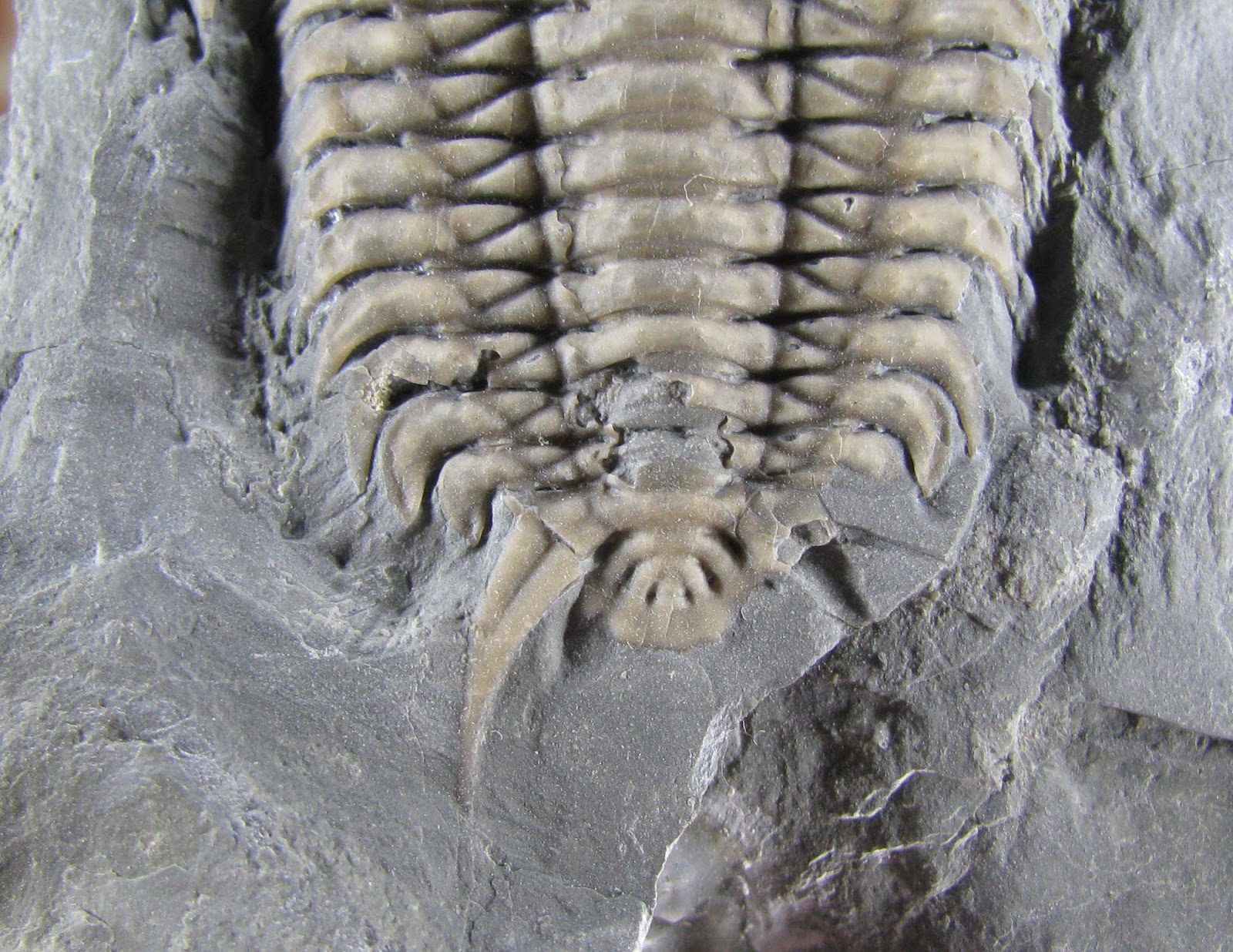
Ceraurus globulobatus Trilobite from the Verulam formation

I've mentioned before that I don't often have luck with finding Trilobites, well the specimen below is a definite exception to the rule. It's a Ceraurus globulobatus from the Verulam formation. I found it a few years back and a friend, M.T., did the prep work to clean it up. It's not a perfect specimen but it's darn nice. The glabella is slightly crushed and one of the tail spines is missing as well as a small section of shell from the end of the thorax. All in all though, it's a large fossil and a species I never had before.


It is a very flat specimen so perhaps more evolved to swim in the water column?

The eyes are fairly well preserved and not crushed. I am not able to see any lenses though.

Here is what it looked like before it was cleaned up.


I collected this fossil in 2017 at the James Dick quarry near Gamebridge, Ontario. The Verulam formation is late Ordovician in age, Katian/Mohawkian stage.

Saturday, June 13, 2020

Cyphaspis carrolli trilobite from the Haragan formation

The lower Devonian rocks of Oklahoma are full of really cool trilobites and I've had a chance to collect some from the Bois D'Arc formation. The Haragan formation is stratigraphically similar and  is mined by Bob Carroll for the trilobites that it contains. He has been mining for decades and doing his own prep work of the majority of his finds. When I saw this specimen of Cyphaspis carrolli (named for Bob) for sale I had to add it to my collection.

It's a small trilobite with raised eyes and spines coming off each side of the cephalon as well as one off the middle of the thorax. The specimen has been expertly prepped by Bob and looks like it is just resting before moving on.


The Haragan formation is Devonian in age (Lockhovian stage). The Bois d'Arc and Haragan formations interfinger with each other and are roughly the same age (Devonian, Lockhovian stage). They are both roughly correlative to the Helderberg fauna of New York and thus are contemporaneous with the Coyemans, Kalkberg and New Scotland formations.

Thursday, May 14, 2020

Greenops sp. trilobites from the Moscow formation

Greenops sp. is a commonly found trilobite at Deep Springs Rd. and I have a number of specimens. I have left the ID at the generic level as I need to study the features that differentiate the species from one another a little more.

For example, here is a partial specimen that I found but the eyes are missing, the pygidium is tucked under the thorax, and the genal spines are missing or hidden. All of these features are needed to narrow the species down from a list of three or four.


One of the ways you can ID the species of a Greenops is by the configuration of the spines (also called pleural lappets) that extend from the pygidium. As pygidium are very common, one might be able to find a couple of species without having the full body fossil. In the case of the three specimens below, I believe all are Greenops boothi as they all have "short, rounded pleural lappets" (Wilson, 2014).

Specimen #1

Specimen #2

Specimen #3


* Wilson, Karl. (2014). Field Guide to the Devonian Fossils of New York. pg 204

These specimens were found at a borrow pit on Deep Springs Road in Madison County, NY which exposes the Windom shale member of the Moscow formation (middle Devonian in age, Givetian stage.)  

Sunday, May 10, 2020

Dipleura dekayi trilobite from the Moscow formation

Dipleura dekayi is the largest trilobite that I have found in middle Devonian aged rocks. At Deep Springs Road, in the Windom shale member of the Moscow formation, it is not uncommon to find dis-articulated pieces of this species.  Based on the characteristics of Dipleura I suspect it was a burrowing species more so than free swimming or walking on the surface of the sea bottom.  The exoskeleton is typically smooth and streamlined with no obvious spines. The only noticeable feature are small bumps or pits that cover the surface. These could have been sensory points with tiny hairs or other organic extension that allowed the animal to sense movement, electrical impulses, or perhaps smell it's prey.

Specimen #1 - An isolated cephalon which is mostly intact except for some distortion (likely incurred during burial and compression of the sediments) and one of the eyes missing.
You can see some of the small pinpoints that are present on the surface


Specimen #2 - An isolated pygidium that really shows off the pinpoint pits.


Specimen #3 - A dis-articulated, but complete exoskeleton. This is clearly a molt that was buried quickly as only the Cephalon has moved from it's original position.


Check out this specimen from the Mahantango formation (scroll to the bottom of the post) that shows only the cast of the exoskeleton. You can see the pits that are preserved on the above specimens are merely small columns or bumps. This is what leads me to believe there was some sort of organic connection from the soft body of the trilobite.

Another nice pygidium from the Windom shale that I found at Penn Dixie can be seen here.

And here is a post of some specimens of Dipleura dekayi from the slightly older Panther Mountain formation of New York.

These specimens were found at a borrow pit on Deep Springs Road in Madison County, NY which exposes the Windom shale member of the Moscow formation (middle Devonian in age, Givetian stage.) 

Friday, March 27, 2020

Calymene celebra Trilobite from the Joliet formation

Calymene celebra is the state fossil of Wisconsin and a somewhat common fossil in the white/light grey/tan Silurian aged dolostones that can be found across a number of midwest states. Rocks like this stretch from Wisconsin and Iowa down through Illinois and Indiana into Kentucky.  Below is a specimen of  Calymene celebra from the Joliet formation near Grafton Illinois. It was likely found in a quarry as productive exposures of the Joliet formation are not easy to find. 

This fossil is a cast of the interior of the trilobite exoskeleton so it's missing some of the details one would normally see.  I like this specimen due to the presence of black specks that are present. It kind of reminds me of a Dalmation dog's coat.  I think the black spots are oxidized Pyrite or Marcasite.


I've been fortunate enough to find one specimen of Calymene celebra myself. It comes from a breakwater along Lake Michigan in Milwaukee, Wisconsin where I spotted it among the rocks being used to stabilize the shoreline. It was in a small flat slab so I didn't have to smash anything to collect the specimen. You can see that it was exposed for a time as one side is smooth and some of the fossil detail has been lost.  Since the rocks had been moved from their original location, I am not sure what formation this fossil comes from.


These fossils come from the Silurian period, Llandovery stage (roughly 438-436 mya) which corresponds to the basal Niagaran series in the old N. American chronostratigraphy.

Monday, March 9, 2020

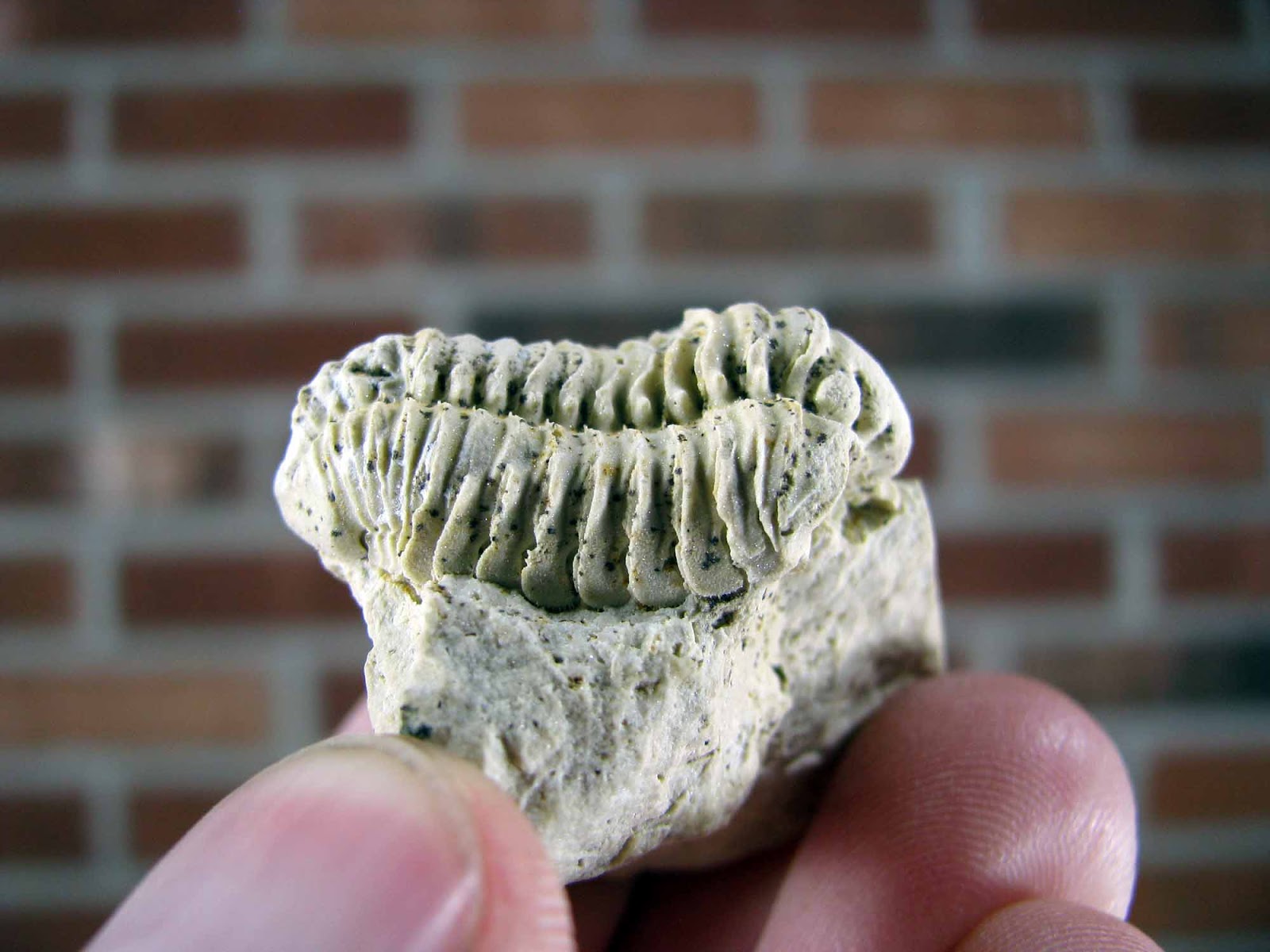
Eldredgeops iowensis southworthi trilobite from the Widder formation

I don't often have luck finding trilobites as I am usually distracted by brachiopods and corals.  However a couple of years ago I managed to find the fossil shown below while searching near Arkona, Ontario.  It's a rare example of an enrolled Eldredgeops iowensis southworthi

Pics of the specimen as it was found, before cleaning.


It comes from the Hungry Hollow member of the Widder formation and the trilobites are often crushed like this one is. It still retains some 3D detail but the cephalon is all mushed up.  I wasn't even really looking for anything when I found this. I was talking to a friend and he joked that I should go find a trilobite. I glanced down at his feet and I saw this fossil sitting right on the surface. 

I gave the specimen to a friend of mine, M.T., who did a superb job of cleaning off the excess mud and matrix.

Pics in natural light


High contrast pictures


I collected this specimen from the Hungry Hollow member of the Widder formation which is Devonian is age, Givetian stage.