Showing posts with label Whitby formation. Show all posts

Tuesday, February 18, 2020

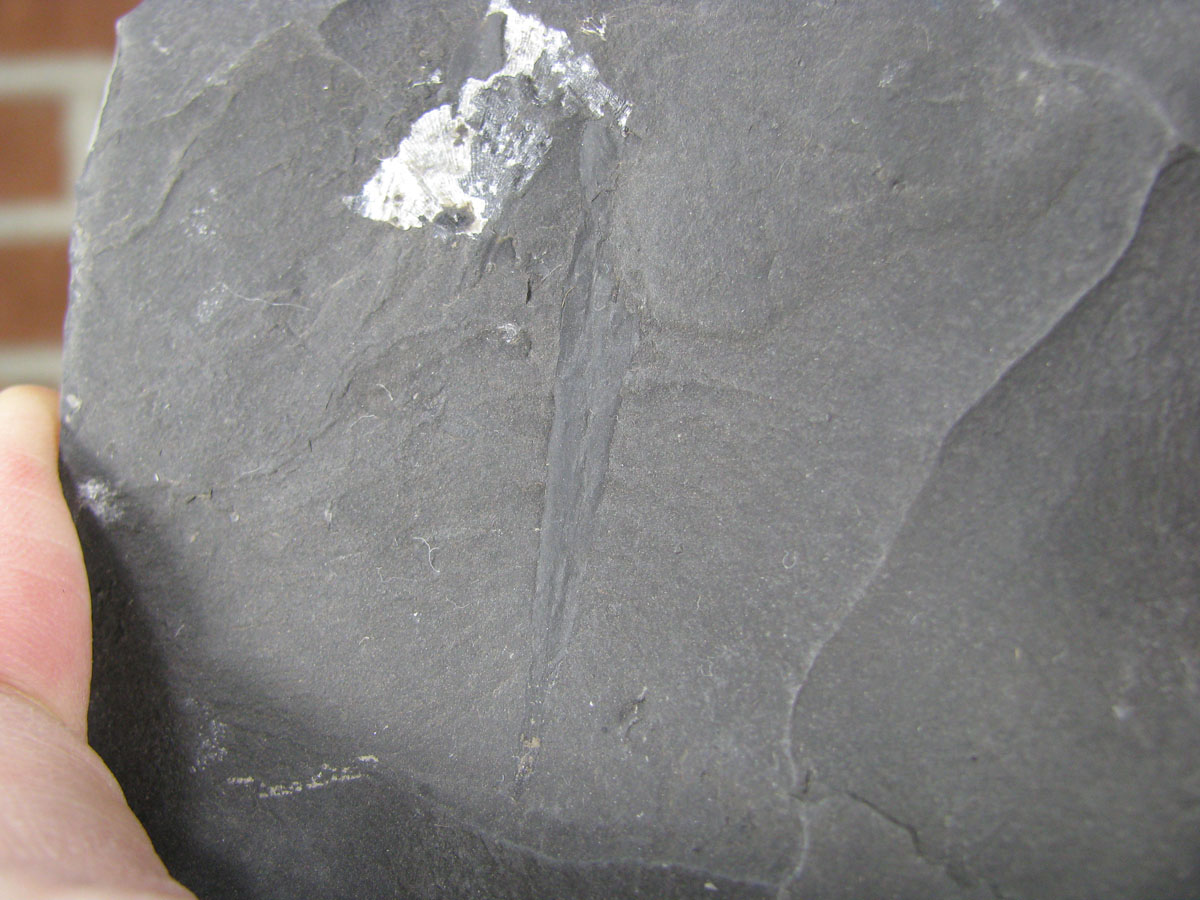
Climacograptus typicalis graptolite from the Whitby formation

As Climacograptus typicalis is the most common graptolite found at Bowmanville, and in my experience everywhere in the upper Ordovician, I should not be surprised to find it in the Collingswood member of the Whitby formation. I have only found one specimen so far and it is super hard to get a good photo of the black carbonaceous film on black shale. But in the second photo below you can see the square shape of the thecae where the animals lived.


The Whitby formation is Ordovician in age (late Ordovician, Katian/Mohawkian stage).
These fossils were collected from the St. Mary's Limestone Quarry in Bowmanville, Ontario. I used William Hessin's book "South Central Ontario Fossils", 2009, Self Published, pg. 263 to help identify these fossils.

Sunday, February 16, 2020

Plaesiomys sp. brachiopod from the Whitby formation

Another Brachiopod genus that I've found in the Collingswood member of the Whitby formation is Plaesiomys sp. This is a small round shell with the pedicle valve having a prominent beak and deeper shell than the brachial valve. I have two specimen, both of which I believe are pedicle valves.

Specimen #1


Specimen #2


William Hessin states in his book that in order to ID down to the species level you need to count the number of ribs.  Neither specimen is preserved well enough for me to say for sure which species they are. Especially as he writes "Plaesiomys subquadrata (Hall) has from fifty to seventy five ribs whereas Plaesiomys iphigenia (Billings) generally has fewer; from forty five to sixty ribs." I am not sure if those number ranges are based on the starting number of ribs near the beak, and then the end number of ribs near the margin, or just a range of the total number of ribs that are found along the margin.

The Whitby formation is Ordovician in age (late Ordovician, Katian/Mohawkian stage).
These fossils were collected from the St. Mary's Limestone Quarry in Bowmanville, Ontario. I used William Hessin's book "South Central Ontario Fossils", 2009, Self Published, pg. 122 to help identify these fossils.

Friday, February 14, 2020

Pseudogygites latimarginatus trilobite from the Whitby formation

The main reason to collect in the black shales of the Collingswood member of the Whitby formation is in the hopes of finding an articulated Pseudogygites latimarginatus. Most of the time the only parts found are the isolated pygidiums.  I have been fortunate enough to find one mostly intact example.

Specimen #1 - The large slab with a partially disarticulated example

Closer view of the specimen

This the the counterpart on a smaller flake of shale


Specimen #2 - An isolated pygidium


Specimen #3 - another pygidium

The Whitby formation is Ordovician in age (late Ordovician, Katian/Mohawkian stage).
These fossils were collected from the St. Mary's Limestone Quarry in Bowmanville, Ontario. I used William Hessin's book "South Central Ontario Fossils", 2009, Self Published, pg. 200 to help identify these fossils.

Wednesday, February 12, 2020

Rafinesquina alternata and Sowerbyella sericea brachiopods from the Whitby formation

This slab is a two for one in terms of species present. It has an example of Rafinesquina alternata as well as Sowerbyella sericea. It's from the Collingswood member of the Whitby formation. These are both uncommon fossils to find in the Collingswood member and could be washed in from another location by a storm as black shales generally represent anoxic, deeper water conditions.

Overview of the slab

Rafinesquina alternata


Sowerbyella sericea

The Whitby formation is Ordovician in age (late Ordovician, Katian/Mohawkian stage).
These fossils were collected from the St. Mary's Limestone Quarry in Bowmanville, Ontario. I used William Hessin's book "South Central Ontario Fossils", 2009, Self Published, pg. 125-126, 128 to help identify these fossils.

Monday, February 10, 2020

Triarthrus eatoni Trilobite from the Whitby formation

Certain layers within the Collingswood member of the Whitby formation are rife with the shed exuviae of the Trilobite Triarthrus eatoni. Like the similar (but older) rocks of the Utica shale in New York, most of the fossils are either partially or completely disarticulated. Most commonly found are articulated portions of the thorax/pygidium and disarticulated pieces of the cephalon.

Specimen #1 - A large slab with multiple examples


Note the disarticulated glabella from a Pseudogygites sp. Trilobite and Lingula cobourensis brachiopods.


Specimen #2 - Partial cephalon which is mostly just the glabella.
Specimen #3
Specimen #4


The Whitby formation is Ordovician in age (late Ordovician, Katian/Mohawkian stage).
These fossils were collected from the St. Mary's Limestone Quarry in Bowmanville, Ontario. I used William Hessin's book "South Central Ontario Fossils", 2009, Self Published, pg. 205 to help identify these fossils.

Saturday, February 8, 2020

Geisonoceras tenuistriatum cephalopod from the Whitby formation

I've found a couple of examples of small Cephalopods in the Collingswood member of the Whitby formation. They are hard to photograph as they do not contrast much with the black shale but I can see they are conical in shape and taper to a point. Some examples have fine ribbing or striations parallel to the shell growth. According to William Hessin these are likely Geisonoceras tenuistriatum which is restricted to the Whitby formation.

Specimen #1


Specimen #2


The Whitby formation is Ordovician in age (late Ordovician, Katian/Mohawkian stage).
These fossils were collected from the St. Mary's Limestone Quarry in Bowmanville, Ontario. I used William Hessin's book "South Central Ontario Fossils", 2009, Self Published, pg. 155 to help identify these fossils.

Thursday, February 6, 2020

Ecculiomphalus sp. gastropod and Ctenodonta sp. Pelecypod from the Whitby formation

Splitting the black shale of the Collingswood member of the Whitby formation I've found a few examples of what is likely a gastropod. The slab below shows what may be an example of  Ecculiomphalus sp. or possibly Liospira sp.  Both of those species are low conispiraled gastropods although Ecculiomphalus sp. should have some fine ornamentation on the shell. I don't see that on this specimen but William Hessin states that it is only found in the lower part of the Whitby formation (Craigleith member which is equivalent to the Collingswood member).


There is also a cast of a Pelecypod present on this slab that I believe is a species of Ctenodonta

The Whitby formation is Ordovician in age (late Ordovician, Katian/Mohawkian stage).
These fossils were collected from the St. Mary's Limestone Quarry in Bowmanville, Ontario. I used William Hessin's book "South Central Ontario Fossils", 2009, Self Published, pg. 137-138, 144 to help identify these fossils.

Tuesday, February 4, 2020

Lingula corbourgensis brachiopod from the Whitby formation

The most common Brachiopod to be found in the Collingswood member of the Whitby formation is Lingula corbourgensis. It is an inarticulate Brachiopod with a phosphatic shell and can get relatively large. Below are several examples that occur on slabs that I've split.

Specimen #1

Specimen #2

Specimen #3


The Whitby formation is Ordovician in age (late Ordovician, Katian/Mohawkian stage).
These fossils were collected from the St. Mary's Limestone Quarry in Bowmanville, Ontario. I used William Hessin's book "South Central Ontario Fossils", 2009, Self Published, pg. 117 to help identify these fossils.

Sunday, February 2, 2020

Primitiella ulrichi ostracod from the Whitby formation

In the black oil shales of the Collingswood member of the Whitby formation there are often found great shoals of Ostracod fossils.William Hessin states in his book that the only known species of Ostracod found in these shales is Primitiella ulrichi.  The fossils are plain and oval shaped, kinda boring really and easily overlooked except for their numbers.

Here are two pieces of shale that shows how one typically notices them.


Under the microscope is where you can see them up close. Rarely are the shells still present as they often flake off when the shale splits. All of the pictures below were taken with my camera through a microscope.


The Whitby formation is Ordovician in age (late Ordovician, Katian/Mohawkian stage).
These fossils were collected from the St. Mary's Limestone Quarry in Bowmanville, Ontario. I used William Hessin's book "South Central Ontario Fossils", 2009, Self Published, pg. 211 to help identify these fossils.

Friday, January 3, 2020

St. Mary's Cement Quarry site overview

I'm going to start a series of posts that will focus on the fossils I have found in the Coburg and Whitby formation at the St. Mary's Cement Quarry in Bowmanville, Ontario.  I have been fortunate enough to get into the quarry three times in the last two years and I need to consolidate what I have collected and get everything labelled and named.  The quarry is private property and is actively worked my visits are as a member of a local club, Gem and Mineral Club of Scarborugh, during official club trips.

A view from inside the quarry

The quarry mines primarily the Coburg formation but the very top most layers are part of the Whitby formation while the very bottom most belong to the Verulam formation.  This exposes a nice chunk of upper Ordovician rock that is rich with fossils. The Coburg formation is primarily composed of  limestone beds with some thin layers of inter-bedded shale. The layers tend to vary from 1"-12" thick.  The Coburg formation has two members within it's layers, the Hillier and the Hallowell. The Hillier member comprises the majority of the Coburg with the Hallowell confined to the lower portion above the Verulam formation. The largest difference between the members is that the Hallowell has thicker limestone beds with a coarser grain.

I have found Trilobites, Crinoids, Cephalopods, Corals, Bryozoans, Graptolites, Ostracods, Pelecypods, and Brachiopods during my trips. I primarily hunt for fossils by looking at the surface of the rocks in a pile and see if I find anything of interest. If not I will try to split the rock and look some more. Sometimes you find the best fossils when you split.  Not many of the fossils weather loose and are easy to pick up. The limestone is a little bit harder and more erosion resistant and there are less fossil in the shaly layers.

A big pile of Coburg formation to search.

The Whitby formation is primarily represented by a thick section of black shales known as the Collingswood member. Typically black shales don't often have many fossils but the Collingswood surprises you with a decent amount of variety. I've found Trilobites, Cephalopods, Ostracods, Pelecypods, Gastropods, and Brachiopods in my searches. The primary method to find the fossils is splitting the thin bedded shales.

The Verulam formation is at the bottom of the quarry and is not extracted as much as the Coburg. It is more shaly and not as desirable for some construction purposes.  I've not spent much time collecting in the Verulam at Bowmanville as I tend to spend my time in the Coburg or Whitby formations. The fauna of the Verulam is similar to the overlying Coburg formation but with slightly different genera or species. It is easier to pick up loose specimens from the Verulam formation as the limestone seems to be a little softer and the shaly layers have more fossils.

As I mentioned before, this is an active quarry and we are sometimes limited as to where we can collect. As you can see from the picture below, the quarry machinery is quite large and would not notice if you were in their way.


That's it for the introduction, The next post will start on the fossils that I have found from this quarry so far.

I used William Hessin's book "South Central Ontario Fossils", 2009, Self Published, as a source for the technical info in this post