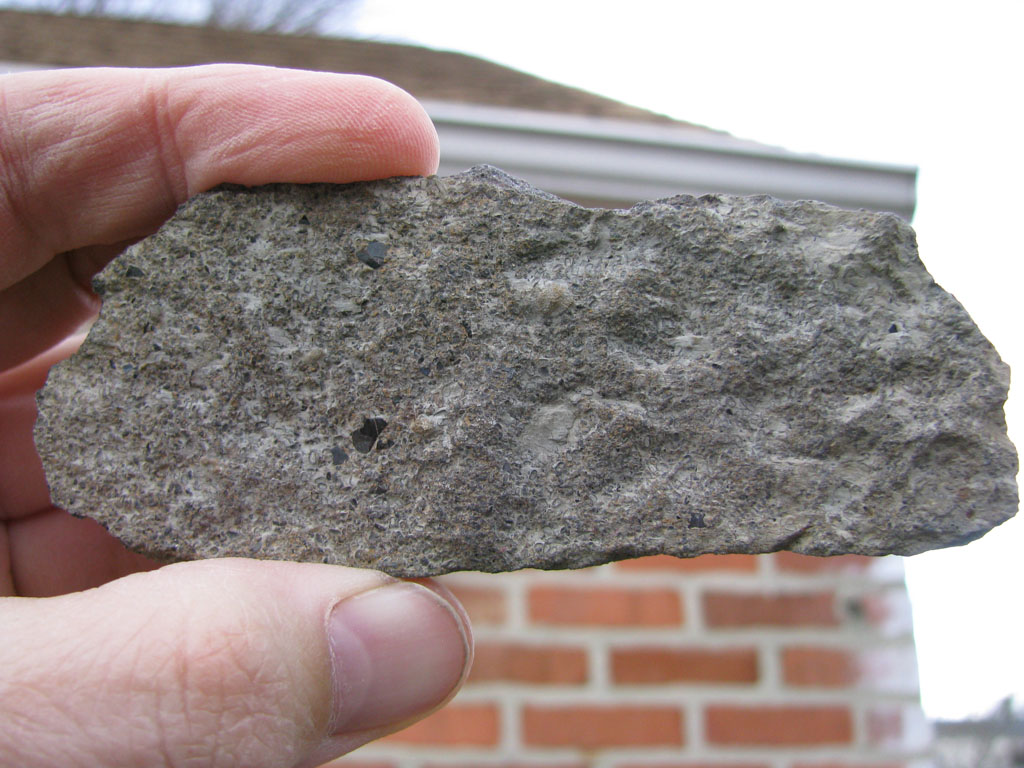
In the black oil shales of the Collingswood member of the Whitby formation there are often found great shoals of Ostracod fossils.William Hessin states in his book that the only known species of Ostracod found in these shales is Primitiella ulrichi. The fossils are plain and oval shaped, kinda boring really and easily overlooked except for their numbers.
Here are two pieces of shale that shows how one typically notices them.
Under the microscope is where you can see them up close. Rarely are the shells still present as they often flake off when the shale splits. All of the pictures below were taken with my camera through a microscope.
The Whitby formation is Ordovician in age (late Ordovician, Katian/Mohawkian stage).
These
fossils were collected from the St. Mary's Limestone Quarry in
Bowmanville, Ontario. I used William Hessin's book "South Central
Ontario Fossils", 2009, Self Published, pg. 211 to help identify these
fossils.
Showing posts with label Ostracod. Show all posts
Sunday, February 2, 2020
Sunday, April 7, 2013
Euglyphella ostracod from the Silica Shale
There are five different species of Euglyphella ostracod found in the Silica Shale. Below is one I found in my sample from Sylvania, Ohio.
I referred to "Ostracods of the Middle Devonian Silica Formation" to see if I could figure out which one the above specimen was. It's not particularly clean and is still embedded in the matrix so that hides some of the detail. On plate 76 (pg. 355) is a comparison of all five species. After reviewing the plate I think this most closely resembles Euglyphella sigmoidalis (although there could be an arguement that it's E. projecta). I collected this from eroded residue of the Silica Shale (Devonian, Givetian stage) near Sylvania, Ohio.
Labels:
Devonian,
Microfossils,
Ohio,
Ostracod,
Silica shale
Friday, April 5, 2013
Ulrichia ostracod from the Silica Shale
Another Ostracod from the Silica Shale sample from Sylvania, OH that I've found is Ulrichia.
A review of the book "Ostracods of the Middle Devonian Silica Formation" there are several different Ulrichia species. I think this most closely resembles Ulrichia spinifera based on plate 43 (pg. 270). I collected this from eroded residue of the Silica Shale (Devonian, Givetian stage) near Sylvania, Ohio.
Labels:
Devonian,
Microfossils,
Ohio,
Ostracod,
Silica shale
Wednesday, April 3, 2013
Arcyzona ostracod from the Silica Shale
Jumping over to the Silica shale here is a Arcyzona ostracod that I found in the Silica Shale.
Looking through the book "Ostracods of the Middle Devonian Silica Formation" there are several different Arcyzona species. I think this most closely resembles Arcyzona homlosagenota based on plate 8 (pg. 199). The other species of Arcyzona all seem to have linked ridges ornamenting their surfaces while A. homlosagenota has a "honeycomb" like surface decoration. I collected this from eroded residue of the Silica Shale (Devonian, Givetian stage) near Sylvania, Ohio.
References: "Ostracods of the Middle Devonian Silica Formation" by Kesling, R. V.; Chilman, R. B, 1978, FUMMP Papers on Paleontology No. 18
Looking through the book "Ostracods of the Middle Devonian Silica Formation" there are several different Arcyzona species. I think this most closely resembles Arcyzona homlosagenota based on plate 8 (pg. 199). The other species of Arcyzona all seem to have linked ridges ornamenting their surfaces while A. homlosagenota has a "honeycomb" like surface decoration. I collected this from eroded residue of the Silica Shale (Devonian, Givetian stage) near Sylvania, Ohio.
References: "Ostracods of the Middle Devonian Silica Formation" by Kesling, R. V.; Chilman, R. B, 1978, FUMMP Papers on Paleontology No. 18
Labels:
Devonian,
Microfossils,
Ohio,
Ostracod,
Silica shale
Monday, April 1, 2013
Octonaria ostracod from the Centerfield Mbr.
Continuing my search through the screened remains of the Centerfield member of the Ludlowville formation (Devonian, Givetian stage), I came across a couple of specimens of Octonaria. This is a typical specimen that I took a photo of with my rigged up Canon S3 IS camera.
Looking through the book "Ostracods of the Middle Devonian Silica Formation" there are a couple of different Octonaria species. I think this most closely resembles Octonaria quadricosta based on plate 87 (pg. 358). It could be O. crescentiformis but I don't think that the furrows in the surface of the shell are curved enough.
References: "Ostracods of the Middle Devonian Silica Formation" by Kesling, R. V.; Chilman, R. B, 1978, FUMMP Papers on Paleontology No. 18
Looking through the book "Ostracods of the Middle Devonian Silica Formation" there are a couple of different Octonaria species. I think this most closely resembles Octonaria quadricosta based on plate 87 (pg. 358). It could be O. crescentiformis but I don't think that the furrows in the surface of the shell are curved enough.
References: "Ostracods of the Middle Devonian Silica Formation" by Kesling, R. V.; Chilman, R. B, 1978, FUMMP Papers on Paleontology No. 18
Saturday, March 30, 2013
Acanthoscapa devonica ostracod from the Centerfield Fm.
Parsing through a sample of the Centerfield Limestone looking for microfossils, I was pleasantly surprised to find some small "rice grains". They didn't look like Ostracods to me because they were not round nor did they have any ornamentation to them. A quick scan through the book "Ostracods of the Middle Devonian Silica Formation" changed my mind.
These are a species called Acanthoscapa devonica. Each fossil is about 2mm long. If I did my math right, the full size image is 50x (since the fossils are shown 100mm long on my screen)
According to the book (vol 1, pg 86) They are known from the Silica Shale but have also been found in the Hungry Hollow member of the Widder Formation in Ontario as well as the Centerfield member of the Ludlowville Formation in New York. They are illustrated on plate 7 (vol 2, pg. 16-17) where there is a comment that the specimen shown is from the Hungry Hollow formation and that specimens from the Silica shale often have their ends broken off.
References: "Ostracods of the Middle Devonian Silica Formation" by Kesling, R. V.; Chilman, R. B, 1978, FUMMP Papers on Paleontology No. 18
These are a species called Acanthoscapa devonica. Each fossil is about 2mm long. If I did my math right, the full size image is 50x (since the fossils are shown 100mm long on my screen)
According to the book (vol 1, pg 86) They are known from the Silica Shale but have also been found in the Hungry Hollow member of the Widder Formation in Ontario as well as the Centerfield member of the Ludlowville Formation in New York. They are illustrated on plate 7 (vol 2, pg. 16-17) where there is a comment that the specimen shown is from the Hungry Hollow formation and that specimens from the Silica shale often have their ends broken off.
References: "Ostracods of the Middle Devonian Silica Formation" by Kesling, R. V.; Chilman, R. B, 1978, FUMMP Papers on Paleontology No. 18
Thursday, March 28, 2013
Quasillites concentricus? Ostracod from the Arkona shale
Here are another couple of Ostracod fossils from the Arkona Shale. They are Quasillites and I think they are Q. concentricus. They stand out because of the fingerprint like pattern on the surface.
I found the above specimens from a piece of the Arkona Shale that I soaked overnight in some water and then screened. The Arkona Shale is middle Devonian in age (Givetian stage).
Tuesday, March 26, 2013
Poloniella cingulata ostracod from Arkona
Here is one of the Ostracods I have been able to identify from my Arkona screenings. I think they are Poloniella cingulata. This is a species that is listed in the "Checklist of Fossil Invertebrates Described from the Middle Devonian Rocks of the Thetford-Arkona Region of Southwestern Ontario" by Stumm and Wright.
I found the above specimens from a piece of the Arkona Shale that I soaked overnight in some water and then screened. The Arkona Shale is middle Devonian in age (Givetian stage).
Friday, March 22, 2013
Screening the Arkona shale for microfossils
I ran a sample of the Arkona shale through my screen set to see what I could find. I didn't look too long or closely as this was meant to be a dry run or proof of concept test.
This is the rock sample that I used. Note the Phacops fossil, you'll see more of it later.
The Arkona formation is mostly clay and readily breaks down when in contact with water. In preparation for this experiment I left the chunk of matrix in some water for 24 hours to let it completely break down.
It took about a hour to get all the screening completed, the biggest obstacle is that the water will become saturated with clay while washing and needs to be replaced. So far it has been much cleaner and easier to do all the screening outside with a bucket of clean water to occasionally rinse the screens through.
Here are the results. From the #35 screen I found at least two species of Ostracod, lots of Tentaculite pieces and bits of the Trilobite that disintegrated while the clay matrix broke down.
The #60 screen had smaller bits and pieces (as is to be expected) along with some possible Ostracods but nothing that I was able to easily pick out and ID...
A Styliolinid...
Part of a Conodont/Scolecodont....
And other stuff.
Now we are getting to the really tiny stuff. The #120 screen material looked like this:
and the #230 screen material looked like this:
I took all the above photo's with my Zorb digital microscope but that only magnifies to 20X. To see anything meaningful in the #120 and #230 screens I would need a real microscope.
So the experiment was a success and I've learned a bit about how to best screen samples of clay matrix material. My next experiment will be with eroded Silica Shale from the dump piles near Sylvania, Ohio. The step after that will be to figure out the best way to separate the tiny samples for the fossils I want, ID what I find and then store them so they don't get lost.
This is the rock sample that I used. Note the Phacops fossil, you'll see more of it later.
The Arkona formation is mostly clay and readily breaks down when in contact with water. In preparation for this experiment I left the chunk of matrix in some water for 24 hours to let it completely break down.
It took about a hour to get all the screening completed, the biggest obstacle is that the water will become saturated with clay while washing and needs to be replaced. So far it has been much cleaner and easier to do all the screening outside with a bucket of clean water to occasionally rinse the screens through.
Here are the results. From the #35 screen I found at least two species of Ostracod, lots of Tentaculite pieces and bits of the Trilobite that disintegrated while the clay matrix broke down.
The #60 screen had smaller bits and pieces (as is to be expected) along with some possible Ostracods but nothing that I was able to easily pick out and ID...
A Styliolinid...
Part of a Conodont/Scolecodont....
And other stuff.
Now we are getting to the really tiny stuff. The #120 screen material looked like this:
and the #230 screen material looked like this:
I took all the above photo's with my Zorb digital microscope but that only magnifies to 20X. To see anything meaningful in the #120 and #230 screens I would need a real microscope.
So the experiment was a success and I've learned a bit about how to best screen samples of clay matrix material. My next experiment will be with eroded Silica Shale from the dump piles near Sylvania, Ohio. The step after that will be to figure out the best way to separate the tiny samples for the fossils I want, ID what I find and then store them so they don't get lost.
Friday, November 9, 2012
Stuff found on the undersides of Microcyclus from Arkona
Microcyclus sp. are solitary corals that lived on the muddy bottoms of the Devonian sea 389mya and were preserved as part of the Arkona formation. The seafloor that they lived in was only periodically oxygenated enough for life to sustain itself and so Microcyclus is found primarily in a thin horizon within the formation. Since the seafloor was soft and muddy the corals needed some hard surface to attach to as polyps in order to grow, otherwise they would be smothered by the sediment.
This Microcyclus grew on a small Chonetes sp. brachiopod shell.
This specimen grew on a Tentaculites or Crinoid stem.
Ostracods are sometimes found under the bases. This one was along the edge of the Microcyclus and so was likely not the initial attachment point for the base. I think this might be Ponderodictya punctulifera.
Here is another species of Ostracod, called Dizygopleura trisinuata but again it was not the initial germination spot and may be just a piece of debris that got caught under the coral as it grew.
Finally we see this coral that grew on an accumulation of Ostracod and other shelly debris.
My ID's for the above Ostracods are based on the book "Ostracods of the Middle Devonian Silica Formation" by Robert V. Kesling and Ruth B. Chilman, 1978, Papers on Paleontology No. 18, University of Michigan Museum of Paleontology.
All the above specimens came from the Arkona formation (Devonian, Givetian stage) near Arkona, Ontario, Canada. They came from a particular horizon that a friend of mine (Darrell) pointed out to me. Thanks to his tip I found four dozen different specimens of Microcyclus including those pictured above.
This Microcyclus grew on a small Chonetes sp. brachiopod shell.
This specimen grew on a Tentaculites or Crinoid stem.
Ostracods are sometimes found under the bases. This one was along the edge of the Microcyclus and so was likely not the initial attachment point for the base. I think this might be Ponderodictya punctulifera.
Here is another species of Ostracod, called Dizygopleura trisinuata but again it was not the initial germination spot and may be just a piece of debris that got caught under the coral as it grew.
Finally we see this coral that grew on an accumulation of Ostracod and other shelly debris.
My ID's for the above Ostracods are based on the book "Ostracods of the Middle Devonian Silica Formation" by Robert V. Kesling and Ruth B. Chilman, 1978, Papers on Paleontology No. 18, University of Michigan Museum of Paleontology.
All the above specimens came from the Arkona formation (Devonian, Givetian stage) near Arkona, Ontario, Canada. They came from a particular horizon that a friend of mine (Darrell) pointed out to me. Thanks to his tip I found four dozen different specimens of Microcyclus including those pictured above.
Friday, March 2, 2012
Kloedenella sp. ostracods from the Mifflintown Fm.
I took a trip not long ago up to an old quarry that I'd head about near Lock Haven, PA. The quarry exposes the Silurian aged Mifflintown formation which is contemporaneous and interfingers with the Bloomsburg formation. The Bloomsburg formation is a prominent group of red shales and sandstones in eastern Pennsylvania but as you head farther south and west the Bloomsburg grades into the shales and limestones of the Mifflintown. In Maryland and West Virginia, the Mifflintown formation is called the McKenzie formation (which is also the name of a member within the Mifflintown formation). To better illustrate this complex interaction, here is a stratigraphic chart of the Silurian in PA.
Note that the base of the Bloomsburg formation and top of the Mifflintown formation interfinger with each other as shown by the zigzag line separating them. The approximate age for the rocks exposed in the quarry is middle Silurian (Wenlock epoch, Homerian stage).
But I digress, I went to the quarry as I'd read that fossils could be found there and I don't have many Silurian aged fossils from PA. I parked my car along the side of the road and hiked back to the quarry which can be seen from Highway 220. This was my view as I approached (as always, click the picture to view it in more detail):
You can see the rock layers are set at a high angle so you get a view of a large surface area. Note the large ripple marks in the darker colored rocks. Those are mega ripples and are indicative of a current as opposed to direct wave action.
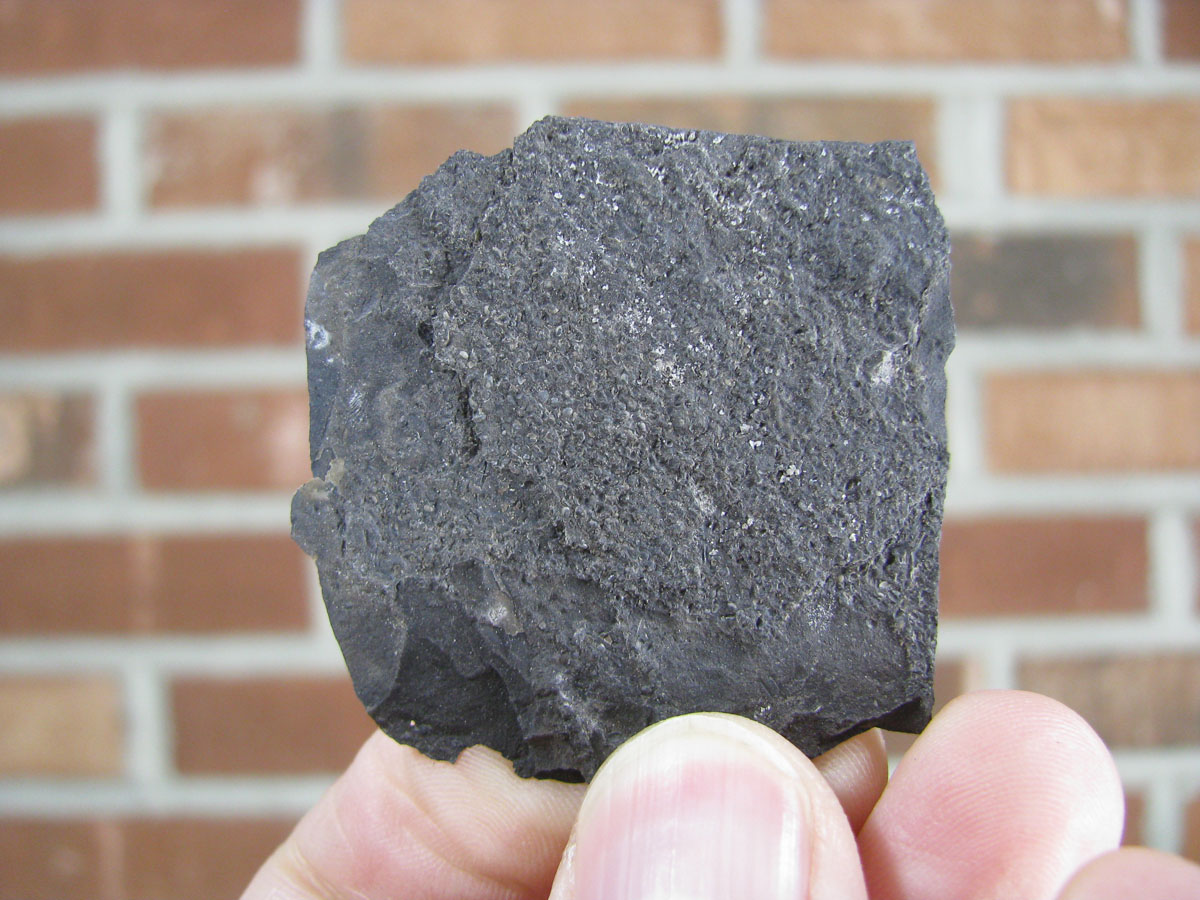
As I got closer to the rock face I started to search the talus piles for fossils. I was expecting body fossils of brachiopods, gastropods etc. but I wasn't finding too much. Then I took a closer look at the rocks themselves and realized that there were hundreds of Ostracods preserved within them. Here is a typical chunk of rock.
When viewed closely you see all the tiny Ostracods.
It's a limestone but a type called packstone because it is composed almost entirely of shells. Here is aAnother piece of rock with some black chunks that might be Brachiopod shell pieces.
A third piece that I had broken off a larger chunk of rock. the surface has the same weathered appearance as others I found.
I put it under my Zorb camera and magnified it 20x to give me the picture below.
This is the back side of the rock which, on a whim, I placed under the Zorb as well.
I was amazed to find even more Ostracods and they had better detail than those on the surface in some cases.
After reading up some more on the quarry I realized that the limestone was coming from the layer with the mega ripples. It seems that the Ostracods proliferated in the warm shallow seas and coated the sea floor with their shells. The currents organized them into the ripples as it moved over the surface. At times the sediment influx would increase in the area and a muddier shale was lain down which does not contain many fossils at all. This would cycle back and forth and can be seen in the layers within the quarry. After looking up the Mifflintown formation and McKenzie formation I determined that the majority of the Ostracods that I can see and ID are Kloedenella (the ones that look like the a puffy letter E). There are other species present but I don't have the capabilities to truly study and ID them all.
Note that the base of the Bloomsburg formation and top of the Mifflintown formation interfinger with each other as shown by the zigzag line separating them. The approximate age for the rocks exposed in the quarry is middle Silurian (Wenlock epoch, Homerian stage).
But I digress, I went to the quarry as I'd read that fossils could be found there and I don't have many Silurian aged fossils from PA. I parked my car along the side of the road and hiked back to the quarry which can be seen from Highway 220. This was my view as I approached (as always, click the picture to view it in more detail):
You can see the rock layers are set at a high angle so you get a view of a large surface area. Note the large ripple marks in the darker colored rocks. Those are mega ripples and are indicative of a current as opposed to direct wave action.
As I got closer to the rock face I started to search the talus piles for fossils. I was expecting body fossils of brachiopods, gastropods etc. but I wasn't finding too much. Then I took a closer look at the rocks themselves and realized that there were hundreds of Ostracods preserved within them. Here is a typical chunk of rock.
When viewed closely you see all the tiny Ostracods.
It's a limestone but a type called packstone because it is composed almost entirely of shells. Here is aAnother piece of rock with some black chunks that might be Brachiopod shell pieces.
A third piece that I had broken off a larger chunk of rock. the surface has the same weathered appearance as others I found.
I put it under my Zorb camera and magnified it 20x to give me the picture below.
This is the back side of the rock which, on a whim, I placed under the Zorb as well.
I was amazed to find even more Ostracods and they had better detail than those on the surface in some cases.
After reading up some more on the quarry I realized that the limestone was coming from the layer with the mega ripples. It seems that the Ostracods proliferated in the warm shallow seas and coated the sea floor with their shells. The currents organized them into the ripples as it moved over the surface. At times the sediment influx would increase in the area and a muddier shale was lain down which does not contain many fossils at all. This would cycle back and forth and can be seen in the layers within the quarry. After looking up the Mifflintown formation and McKenzie formation I determined that the majority of the Ostracods that I can see and ID are Kloedenella (the ones that look like the a puffy letter E). There are other species present but I don't have the capabilities to truly study and ID them all.
Subscribe to:
Posts (Atom)