Showing posts with label Site report. Show all posts

Wednesday, May 4, 2016

Oklahoma Roadcut through Ordovician strata near Sulphur, OK

As I was driving through Oklahoma, on US 177 south of Sulphur, I approached a large roadcut and stopped to investigate. This roadcut had been a target of mine when I was planning my trip. It appeared to be exposing Ordovician aged rocks and my research told me that the cut exposed the Viola formation which overlies the Bromide formation. Having never sampled either unit I was hopeful to find some fossils.

Here is a panorama of the east side of the cut, North is to the left. Click the picture to see more detail.


The light colored rock that makes up the bulk of the exposure is the upper part of the Viola formation. It is a light grey limestone with nodules and some chert. I didn't find too much in it, just a portion of a trilobite (see below).  The right 1/3rd of the cut, in the photo above, appears to be the lower part of the Viola formation with darker grey limestone mixed with brown, more argillaceous (containing more clay) rock. It was within theses layers that I found some brachiopods and lots of bryozoan fossils. The Viola formation (or Viola group in some references) is upper Ordovician in age, roughly Katian stage.

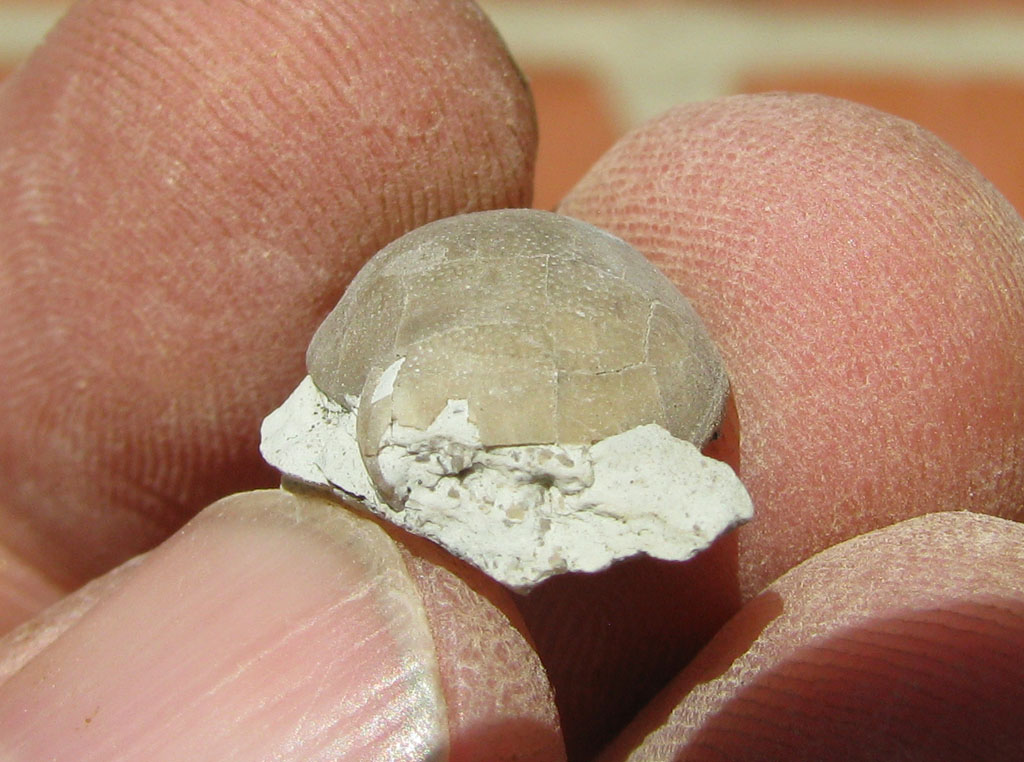
I'll detail some of the more identifiable finds in upcoming posts but here is the isolated trilobite fragment I found in the upper Viola formation rocks. It appears to be either the partial cephalon or pygidium from an Illaenid type trilobite like Bumastoides sp. or Thaleops sp.


Saturday, February 6, 2016

The Bois d'Arc formation of Oklahoma

      While the majority of my vacation last fall was to Utah and Wyoming, I did a quick couple of days in Texas and Oklahoma. Texas was kind of a bonus for the visit as my primary goal was to collect in the prolifically fossiliferous exposures of lower Devonian aged rocks found around Clarita, Oklahoma. There are two main formations that are extremely productive, the Haragan formation and the Bois d'Arc formation. They are sequential formations, with the latter overlying the former conformably. The faunas of both formations are very similar with only minor differences usually seen as rare species unique to each formation. Both formations roughly correspond to the New Scotland and Kalkberg formations of New York and the trilobite fauna has affinities with that of similar aged rocks in Morocco.

      On this trip I was able to arrange a visit to a large exposure of the Bois d'Arc formation on land owned and operated by Leon Theisen. I met him and his wife at the Clarita post office and they led me to their property for the fossil hunt. They are nice people to spend a day in the field with and were helpful and generous during my visit. Here are some pictures of the nearly mile long exposure I was exploring.


      Leon owns and maintains the land and the rock exposure and also hunts for trilobite fossils which he then prepares and sells. As with any fee quarry, Leon has the right to keep any rare specimens that are found but he won't leave you with nothing. He often will make a trade with you so that you get maybe a lesser specimen or a host of more common species. I was not fortunate enough to find anything truly rare during my trip but Leon and his wife were very generous and gave me several fossils of somewhat uncommon or rare animals.

       The weather was good for late August in Oklahoma, temps in the upper 70's to low 80's (24 to 30 degrees Celsius), light cloud cover and lower humidity. After a short primer on what to look for Leon turned me loose on the exposure. Finds were plentiful and came fast as the ground was littered with fossils of brachiopods, trilobites and coral. Within the first hour I'd found three complete Paciphacops trilobite fossils loose in the road gravel and a partial Cordania trilobite along with pygidiums of the larger trilobite Huntonia.

An initial collection pile


      A little research informed a little more about the exposure I was collecting at. It was most likely the Cravatt member of the Bois d'Arc formation which is a marly limestone that weathers easily. Amsden and other workers feel that the rocks represent a shallow water, off shore community that was below wave base. There are no real reef building organisms present, for example algae, stromatoporoids or sponges while the corals and bryozoans that are present are generally smaller, solitary species or encrusters. The fact that there are no concentrated shell beds, or only very thin horizons, nor are there shells present that show wear, is indicative of a calm water environment that didn't have many storms rolling through. This is likely also the reason that many trilobite fossils usually are intact and represent species with many delicate spiny features. Were this a more turbulent environment those parts of the shells would be broken and scattered quickly.

    There was some wildlife that I saw while collecting, but luckily none of the snakes, wild boars or tarantulas that I'd heard about.

A metalmark butterfly drinking up the salts I was sweating out.

A small lizard that was staying cool under a rock.

      I spent most of the day at this site collecting anything I could find that piqued my interest. Brachiopod were the most abundant and diverse but I snagged a number or trilobites as well. Perhaps the best was this plate with three enrolled Paciphacops logani.


     After eight hours climbing over rocks and bending to inspect potential fossils my feet, ankles, back and neck ached. Leon was quite gracious and said I could hunt for longer if I liked but I was about exhausted.  I was happy with what I had found but would have loved to take more home with me. As it was I had to limit or trim down any larger pieces of rock since I was getting on a plane the next afternoon. The weight was going to be too much for my suitcases so I opted instead to mail my finds home via USPS flat rate boxes. This worked well although the boxes were quite beat up by the time they arrived at my house.

     Over the next few weeks I'll be posting pictures and descriptions of the fossils I found during my visit to the Bois d-Arc formation in Clarita, OK.  I'm very interested in comparing the fossils I found there to those I've found in New York in the Kalkberg formation.


References: 
"Stratigraphy and Paleontology of the Hunton Group in the Arbuckle Mountain Region, Part V - Bois d'Arc Articulate Brachiopods " Amsden, 1958, Oklahoma Geological Survey Bulletin 82

Thursday, January 7, 2016

Rhipidomella nevadensis brachiopod from the Chainman formation of Utah

So it has been a few months since I posted anything new. It's been a busy time for me at work and this has been stressing me out so I tend not to write much. But things seem to be improving and I've been able to get a decent queue of posts lined up so you'll be seeing regular updates for the next couple of months (hopefully!). Thanks for reading and I hope you enjoy my posts.

      While on vacation in Millard County, Utah this past September I had the option to collect at numerous well exposed sites all through the Confusion Range. These are a range of mountains that are just west of the more often visited House Range and the Wheeler Amphitheater (known for it's Cambrian Trilobite fauna). As my time was limited I could only visit one site and I choose Conger Springs as the geologic map showed rocks that ranged from the Devonian to Pennsylvanian periods could be exposed.

      The trip to get to the site took a couple of hours with the last 10 miles on gravel roads. The gravel roads were graded well enough but, once at the springs, I heard a hissing noise as I got out of my vehicle. The noise was constant so I knew it wasn't a snake and immediately turned my ear to listen at each tire on the rental SUV I was driving. Sure enough, one of the tires had been punctured by a sharp rock. I am not ashamed to say that I briefly panicked because I was traveling alone, it was ten miles to the nearest highway, seventy miles to the nearest garage and I was in a high desert environment. My initial thought was to immediately drive back to the highway in the hopes that the punctured tire, which was not flat in any sense yet, would hold out at least until I got there and could flag someone down. This is not as good a prospect as you might think. The road I had come out on was US 6/50 which is often described as "the loneliest stretch of road in America". Driving out to the turn off to Conger Springs I had seen or passed only one other vehicle in the hour long journey. Tamping down the anxiety I felt, I then wondered if the rental vehicle had a spare. Lucky for me it did and it was a full size spare to boot! So I set about changing the tire and made sure none of the other tires had any problems. Task completed, I could now turn my attention to the main reason I had come out to this remote location, to look for fossils. Here are a couple of pictures of the area around the springs.

Looking south past an old fence.
Looking north at Conger Mountain which is capped by the Pennsylvanian/Permian aged Ely formation.

      I was really hoping to find some Devonian fossils so I set out to hike to some nearby hills, that my geologic maps showed had the right age of rock. I spent a few hours wandering around the scrubby terrain looking for ANY signs of fossils but with no luck. This is often the case when trying to prospect for a new location or find an old, obscure site. I returned to my vehicle and decided, in a last attempt, to look around the immediate area as Mississippian aged fossils were supposed to be present nearby. I lucked out and found a small hillside that had a number of fairly well preserved fossils eroding out. The day was getting long and the sun starting to set in the sky so I only spent a hour or so collecting. I did not want to have to drive unfamiliar gravel roads in the dark. I managed to fill a small lunch baggie with miscellaneous brachiopod fossils and crinoid stems which was enough to call the trip a success.

      Once back home in Pennsylvania, I set about to try and identify the fossils I found. The book "Geology of Millard County, Utah" by Hintze, Lehi F. and Fitzhugh, Davis D., Bulletin 133, Utah Geological Survey, 2003. and the geologic maps produced by the Utah Geological Survey indicated I had collected in the uppermost Chainman shale (actually a formation) which was lower Carboniferous in age. With that information I did some Google searches to see if anyone had written a paper that listed fossils that could be found in that rock unit. I found in the United States Geological Survey Professional Paper 1368, "Late Mississippian Gastropods of the Chainman Shale, West-Central Utah", Gordon, MacKenzie, Jr. and Yochelson, Ellis L.,  1987, this paragraph which was extremely helpful:
The upper beds of the Chainman Shale are exposed in the vicinity of Conger Spring in the NE V4 NW lk sec. 2, T. 19 S., R. 17 W. Brachiopods of these beds are those of the Rhipidomella nevadensis Zone, the uppermost brachiopod zone in the Chainman, particularly that part of the zone in which the productoid Carlinia phillipsi (Norwood and Pratten) also occurs. A small area of hillslope about 1,000 feet (305 m) south by east from the spring has provided a large collection of brachiopods (USGS colln. 17021-PC). A partial section measured by Gordon in June 1959, shows that a fauna is weathering from 14 feet (4.3 m) of greenish-gray shale, the top of which is 22 feet (6.7 m) below the base of the Ely Limestone.
Armed with this info I did more searches for the "Rhipidomella nevadensis" zone in the hopes I could find a list of the fauna typical of that zone. Unfortunately I found nothing specific but several other publications did give me clues. The reports "Brachiopoda of the Amsden Formation (Mississippian and Pennsylvanian) of Wyoming.", MacKenzie Gordon, Jr., 1975 and "Mississippian Stratigraphy of the Diamond Peak Area, Eureka County, Nevada",  MacKenzie Gordon, Jr., 1971 were helpful as they either provided lists of fauna found in equivalent strata or had detailed descriptions and plates to which I could compare my finds.

In fact, I did find an articulated fossil brachiopod which does indeed look like a Rhipidomella species that I think may be Rhipidomella nevadensis.

Brachial valve
 Anterior
 Pedicle valve
 Posterior (sadly much of the posterior shell is missing from this specimen, lost to weathering)
 Profile

Over the next few weeks I'll be posting more of the fauna I found in the Chainman formation. Should anyone have more experience and knowledge about this locality or the fossils please contact me.