Showing posts with label Oklahoma. Show all posts

Saturday, June 13, 2020

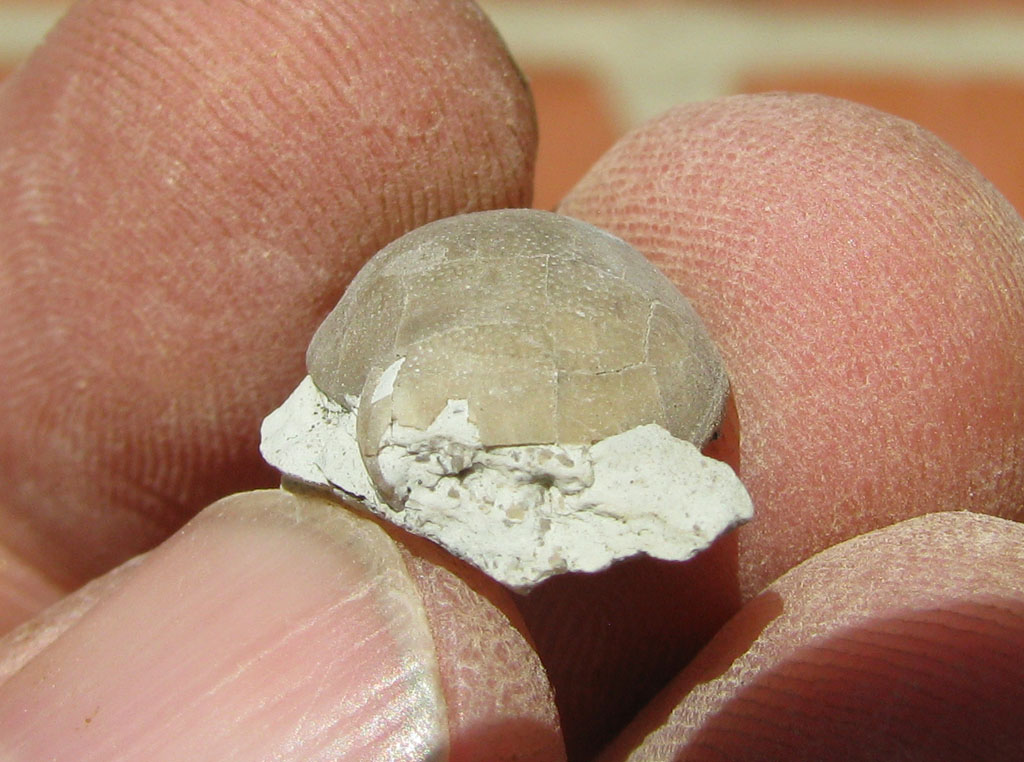
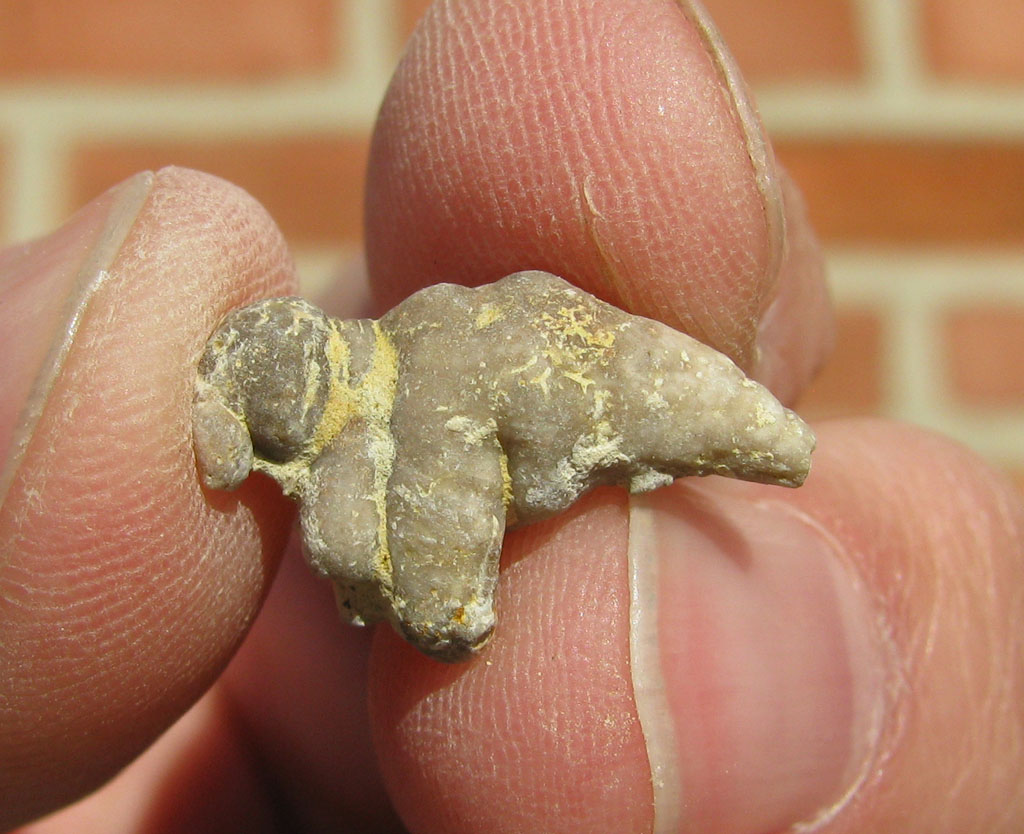
Cyphaspis carrolli trilobite from the Haragan formation

The lower Devonian rocks of Oklahoma are full of really cool trilobites and I've had a chance to collect some from the Bois D'Arc formation. The Haragan formation is stratigraphically similar and  is mined by Bob Carroll for the trilobites that it contains. He has been mining for decades and doing his own prep work of the majority of his finds. When I saw this specimen of Cyphaspis carrolli (named for Bob) for sale I had to add it to my collection.

It's a small trilobite with raised eyes and spines coming off each side of the cephalon as well as one off the middle of the thorax. The specimen has been expertly prepped by Bob and looks like it is just resting before moving on.


The Haragan formation is Devonian in age (Lockhovian stage). The Bois d'Arc and Haragan formations interfinger with each other and are roughly the same age (Devonian, Lockhovian stage). They are both roughly correlative to the Helderberg fauna of New York and thus are contemporaneous with the Coyemans, Kalkberg and New Scotland formations.

Tuesday, May 10, 2016

Glyptorthis costella brachiopod from the Viola formation from Oklahoma

The last, identifiable, fossil that I found during my brief visit to the roadcut in Oklahoma that exposed the Viola formation, is the brachiopod Glyptorthis costella. It has a subrectangular shape with valves that are equally convex and decorated with many fine, closely spaced striae. The margin of the valves is flat with no obvious fold/sulcus structure. The posterior of the shell has a nearly flat, wide interarea. Both valves are recurved in the umbo with the brachial valve moreso than the pedicle valve.

Brachial valve
Anterior
Pedicle valve
Posterior
Profile

This is a loose pedicle valve that I found.


The interior of the shell is nicely preserved with the muscle scars


These specimens comes from the Viola formation which is upper Ordovician (Sandbian to Katian stage) in age and overlies (unconformably?) the Bromide formation. I found them in a road cut along US 177, south of Sulphur, Oklahoma.

Sunday, May 8, 2016

Hindia sphaeroidalis sponge from the Viola formation of Oklahoma

I found one specimen of the sponge fossil called Hindia sphaeroidalis. in the Viola formation roadcut south of Sulphur, OK. This species spans many millions of years and is known in rocks from the Ordovician up through the lower Devonian. I've also found examples of this species from the lower Devonian aged Kalkberg formation of New York, but there they seemed to get much larger. The shape of the fossil is like a large pea with many small openings on all surfaces. The round shape seems to infer that it preferred an environment near the wave base where it would be rolled around at times. This is the first specimen I have found from the Ordovician.


A closer view showing the many tiny openings on the surface of the fossil.

This specimen comes from the Viola formation which is upper Ordovician (Sandbian to Katian stage) in age and overlies (unconformably?) the Bromide formation. I found it in a road cut along US 177, south of Sulphur, Oklahoma.

Friday, May 6, 2016

Oxoplecia gouldi brachiopod from the Viola formation of Oklahoma

Among the rubble that was the eroding rock of the Viola formation I found a few good examples of the brachiopod Oxoplecia gouldi. The shell is subrectangular to suboval in outline with both valves roughly equal in size and depth. There is a wide, shallow fold and sulcus structure present along with fine, widely spaced radiating striae on the surface of the valves. The pedicle valve extends out and curves back over the brachial valve. There is a wide, triangular interarea on the pedicle valve that is almost as long as the hinge line.

Specimen #1

Brachial valve
Anterior
Pedicle valve
Posterior
Profile


Specimen #2

Brachial valve
Anterior
Pedicle valve
Posterior
Profile


These specimens comes from the Viola formation which is upper Ordovician (Sandbian to Katian stage) in age and overlies (unconformably?) the Bromide formation. I found them in a road cut along US 177, south of Sulphur, Oklahoma.

Wednesday, May 4, 2016

Oklahoma Roadcut through Ordovician strata near Sulphur, OK

As I was driving through Oklahoma, on US 177 south of Sulphur, I approached a large roadcut and stopped to investigate. This roadcut had been a target of mine when I was planning my trip. It appeared to be exposing Ordovician aged rocks and my research told me that the cut exposed the Viola formation which overlies the Bromide formation. Having never sampled either unit I was hopeful to find some fossils.

Here is a panorama of the east side of the cut, North is to the left. Click the picture to see more detail.


The light colored rock that makes up the bulk of the exposure is the upper part of the Viola formation. It is a light grey limestone with nodules and some chert. I didn't find too much in it, just a portion of a trilobite (see below).  The right 1/3rd of the cut, in the photo above, appears to be the lower part of the Viola formation with darker grey limestone mixed with brown, more argillaceous (containing more clay) rock. It was within theses layers that I found some brachiopods and lots of bryozoan fossils. The Viola formation (or Viola group in some references) is upper Ordovician in age, roughly Katian stage.

I'll detail some of the more identifiable finds in upcoming posts but here is the isolated trilobite fragment I found in the upper Viola formation rocks. It appears to be either the partial cephalon or pygidium from an Illaenid type trilobite like Bumastoides sp. or Thaleops sp.


Monday, April 25, 2016

Misc. fossil bits and pieces from the Bois D'Arc formation

To close out this series of posts featuring fossils I found in the Bois D'Arc formation of Oklahoma, I have a few pieces left from my finds that don't merit a full blog post entry so I'm consolidating them here. They are each interesting in their own right and deserve at least a mention.

This is a piece I kept as a curiosity. It appears to be the mold from some sort of epitheca that belongs to a coral (like Favosites conicus) or Bryozoan (like Lichenalia sp.).  There is some sort of discolored trace on part of it which could represent a worm tube that may have been pyritized during fossilization.  The question is, was it formed under the base in the sediment or on top of the base after it had flipped over?


Leon Thiesen told me a story about a dealer who used to collect lots of these and then pass them off as "Jellyfish". Leon himself was convinced until one day he found one of them after a bryozoan colony popped off the matrix. When he told the dealer about this their response was that they sold better as "Jellyfish" than bryozoan or coral impressions. It goes to show that you need to pay attention to what you are buying and not always take the word of the seller.


Next is this strange fossil that Leon gave me and told me was somewhat rare. He thinks it may be a bryozoan of some sort but he always finds them as flat, six lobed features in the rock. I think my specimen is missing a lobe.


Here are two single valves from a Rhipdomelloides oblata that I found and photographed after I had written up the blog post which featured articulated specimens. These show the interior details of each valve. I think they are from two separate individuals though.


And finally we have this odd crinoid holdfast that are often called "Chicken Feet" by the local collectors. This specimen is "curled up" but I saw other specimens in the field (on large rocks I could not bring back with me) that really did appear to resemble bird feet.


Whew! That was a long series of blog posts for a single locality. The Bois D'Arc formation is profusely fossiliferous and has a very wide variety of preserved animals. I'm pretty sure I found all the common species and a number of the lesser common ones too. While I didn't find many of the showy trilobites, I made out pretty well for surface collecting. I'm itching to go back again and trying to figure out how to fit in another visit between my other vacations.

I found the specimens shown on this page in the Bois d'Arc formation (Cravatt member) near Clarita, OK which is Devonian in age (Lockhovian stage). The Bois d'Arc and Haragan formations interfinger with each other and are roughly the same age (Devonian, Lockhovian stage). They are both roughly correlative to the Helderberg fauna of New York and thus are contemporaneous with the Coyemans, Kalkberg and New Scotland formations.

Saturday, April 23, 2016

Huntoniatonia sp. trilobite from the Bois D'Arc formation of Oklahoma

From my experience collecting in the Bois D'Arc formation, I think that Huntoniatonia sp. (also sometimes called Huntonia) trilobites are possibly the most common trilobite to be found. I'm referring to the isolated parts of the trilobite not whole specimens. While there were a large number of whole Paciphacops sp. and Kaniops sp. fossils that I found I think I came across more detached pygidiums and cephalopns of Huntoniatonia sp. than anything else.

I did find a few whole specimens but none are in really good condition. This one is slightly enrolled and little warped.

Here is one still in the matrix (it was about two inches long) but it was lying exposed to the elements and thus has some missing shell.

Another one in the matrix that is partially enrolled. The pygidium and thorax are visible on the one side while the other side shows the front edge of the cephalon and a Phacopid trilobite.


Then I have some cephalon and pygidium pieces like this one from a Huntoniatonia huntonensis based on the shape of the spine extending from the cephalic margin.

A view of the eyes of the specimen.

This is a completely different specimen half embedded in the rock with just one eye poking out.


Finally we have a couple of pygidiums from two different specimens that show the size differences. Some of the Huntoniatonia got really big!


George Hansen's wonderful website indicates that there are at least three species of Huntoniatonia that are found in the Haragan and Bois D'Arc formations.  The main differences are the size and length of the spines that extend from the tip of the pygidium and cephalon.