The last, identifiable, fossil that I found during my brief visit to the roadcut in Oklahoma that exposed the Viola formation, is the brachiopod Glyptorthis costella. It has a subrectangular shape with valves that are equally convex and decorated with many fine, closely spaced striae. The margin of the valves is flat with no obvious fold/sulcus structure. The posterior of the shell has a nearly flat, wide interarea. Both valves are recurved in the umbo with the brachial valve moreso than the pedicle valve.
Brachial valve
Anterior
Pedicle valve
Posterior
Profile
This is a loose pedicle valve that I found.
The interior of the shell is nicely preserved with the muscle scars
These specimens comes from the Viola formation which is upper Ordovician (Sandbian to Katian stage) in age and overlies (unconformably?) the Bromide formation. I found them in a road cut along US 177, south of Sulphur, Oklahoma.
Showing posts with label Viola formation. Show all posts
Tuesday, May 10, 2016
Sunday, May 8, 2016
Hindia sphaeroidalis sponge from the Viola formation of Oklahoma
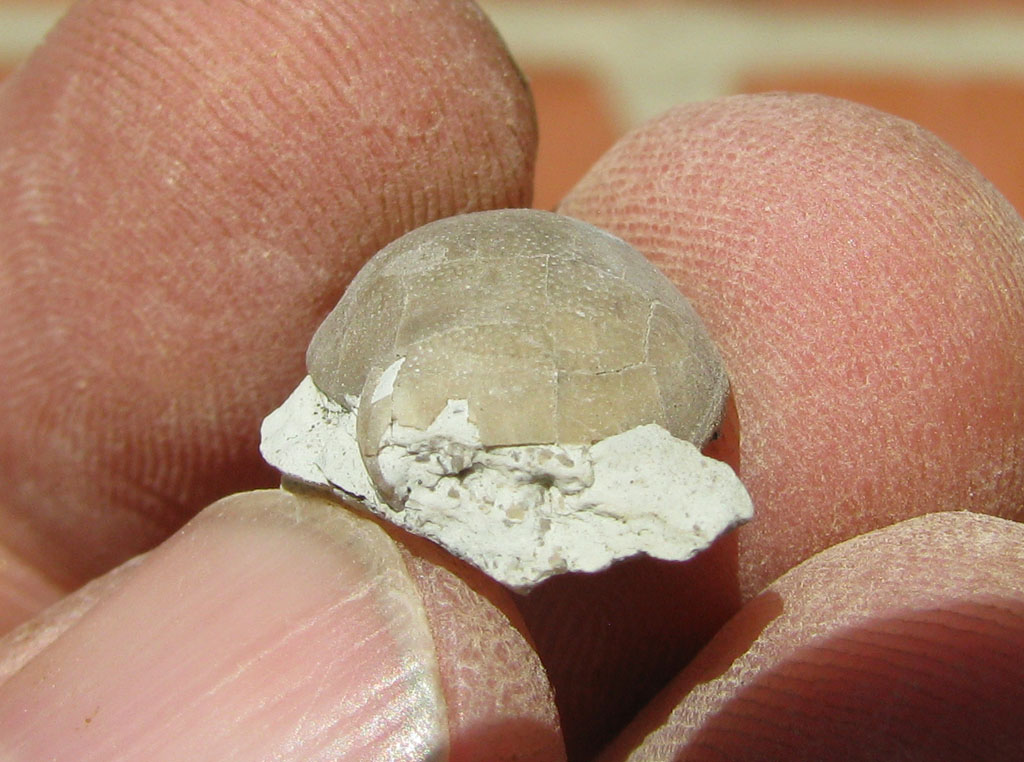
I found one specimen of the sponge fossil called Hindia sphaeroidalis. in the Viola formation roadcut south of Sulphur, OK. This species spans many millions of years and is known in rocks from the Ordovician up through the lower Devonian. I've also found examples of this species from the lower Devonian aged Kalkberg formation of New York, but there they seemed to get much larger. The shape of the fossil is like a large pea with many small openings on all surfaces. The round shape seems to infer that it preferred an environment near the wave base where it would be rolled around at times. This is the first specimen I have found from the Ordovician.
A closer view showing the many tiny openings on the surface of the fossil.
This specimen comes from the Viola formation which is upper Ordovician (Sandbian to Katian stage) in age and overlies (unconformably?) the Bromide formation. I found it in a road cut along US 177, south of Sulphur, Oklahoma.
A closer view showing the many tiny openings on the surface of the fossil.
This specimen comes from the Viola formation which is upper Ordovician (Sandbian to Katian stage) in age and overlies (unconformably?) the Bromide formation. I found it in a road cut along US 177, south of Sulphur, Oklahoma.
Friday, May 6, 2016
Oxoplecia gouldi brachiopod from the Viola formation of Oklahoma
Among the rubble that was the eroding rock of the Viola formation I found a few good examples of the brachiopod Oxoplecia gouldi. The shell is subrectangular to suboval in outline with both valves roughly equal in size and depth. There is a wide, shallow fold and sulcus structure present along with fine, widely spaced radiating striae on the surface of the valves. The pedicle valve extends out and curves back over the brachial valve. There is a wide, triangular interarea on the pedicle valve that is almost as long as the hinge line.
Specimen #1
Brachial valve
Anterior
Pedicle valve
Posterior
Profile
Specimen #2
Brachial valve
Anterior
Pedicle valve
Posterior
Profile
These specimens comes from the Viola formation which is upper Ordovician (Sandbian to Katian stage) in age and overlies (unconformably?) the Bromide formation. I found them in a road cut along US 177, south of Sulphur, Oklahoma.
Specimen #1
Brachial valve
Anterior
Pedicle valve
Posterior
Profile
Specimen #2
Brachial valve
Anterior
Pedicle valve
Posterior
Profile
These specimens comes from the Viola formation which is upper Ordovician (Sandbian to Katian stage) in age and overlies (unconformably?) the Bromide formation. I found them in a road cut along US 177, south of Sulphur, Oklahoma.
Wednesday, May 4, 2016
Oklahoma Roadcut through Ordovician strata near Sulphur, OK
As I was driving through Oklahoma, on US 177 south of Sulphur, I approached a large roadcut and stopped to investigate. This roadcut had been a target of mine when I was planning my trip. It appeared to be exposing Ordovician aged rocks and my research told me that the cut exposed the Viola formation which overlies the Bromide formation. Having never sampled either unit I was hopeful to find some fossils.
Here is a panorama of the east side of the cut, North is to the left. Click the picture to see more detail.
The light colored rock that makes up the bulk of the exposure is the upper part of the Viola formation. It is a light grey limestone with nodules and some chert. I didn't find too much in it, just a portion of a trilobite (see below). The right 1/3rd of the cut, in the photo above, appears to be the lower part of the Viola formation with darker grey limestone mixed with brown, more argillaceous (containing more clay) rock. It was within theses layers that I found some brachiopods and lots of bryozoan fossils. The Viola formation (or Viola group in some references) is upper Ordovician in age, roughly Katian stage.
I'll detail some of the more identifiable finds in upcoming posts but here is the isolated trilobite fragment I found in the upper Viola formation rocks. It appears to be either the partial cephalon or pygidium from an Illaenid type trilobite like Bumastoides sp. or Thaleops sp.
Here is a panorama of the east side of the cut, North is to the left. Click the picture to see more detail.
The light colored rock that makes up the bulk of the exposure is the upper part of the Viola formation. It is a light grey limestone with nodules and some chert. I didn't find too much in it, just a portion of a trilobite (see below). The right 1/3rd of the cut, in the photo above, appears to be the lower part of the Viola formation with darker grey limestone mixed with brown, more argillaceous (containing more clay) rock. It was within theses layers that I found some brachiopods and lots of bryozoan fossils. The Viola formation (or Viola group in some references) is upper Ordovician in age, roughly Katian stage.
I'll detail some of the more identifiable finds in upcoming posts but here is the isolated trilobite fragment I found in the upper Viola formation rocks. It appears to be either the partial cephalon or pygidium from an Illaenid type trilobite like Bumastoides sp. or Thaleops sp.
Subscribe to:
Posts (Atom)