Showing posts with label Bois d'Arc formation. Show all posts

Monday, April 25, 2016

Misc. fossil bits and pieces from the Bois D'Arc formation

To close out this series of posts featuring fossils I found in the Bois D'Arc formation of Oklahoma, I have a few pieces left from my finds that don't merit a full blog post entry so I'm consolidating them here. They are each interesting in their own right and deserve at least a mention.

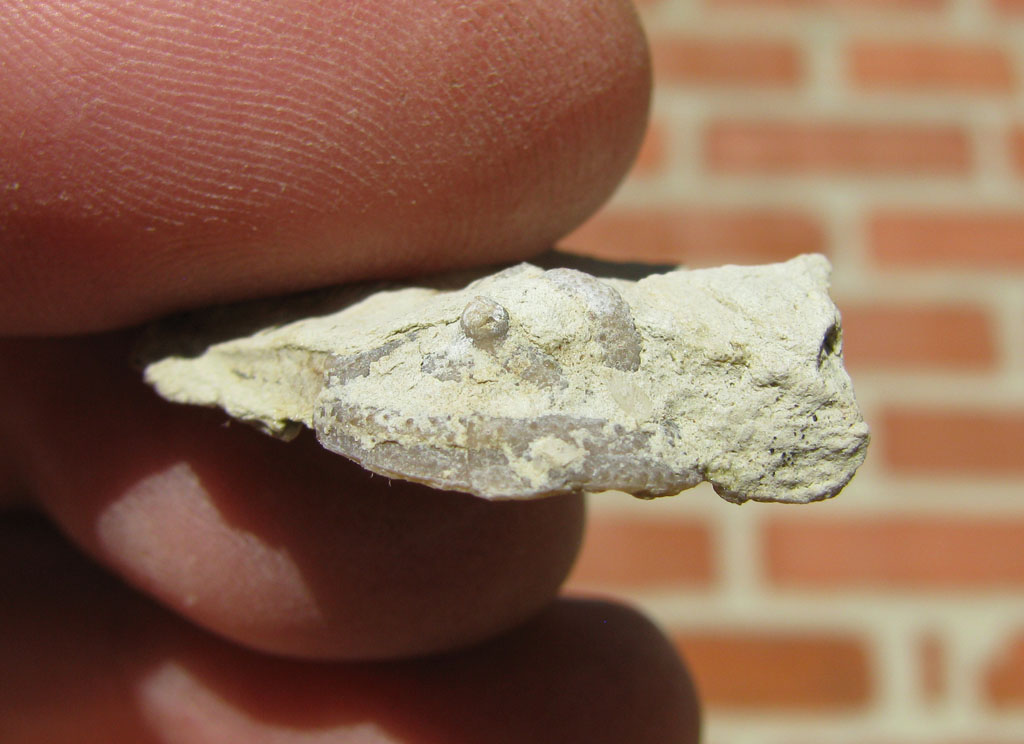
This is a piece I kept as a curiosity. It appears to be the mold from some sort of epitheca that belongs to a coral (like Favosites conicus) or Bryozoan (like Lichenalia sp.).  There is some sort of discolored trace on part of it which could represent a worm tube that may have been pyritized during fossilization.  The question is, was it formed under the base in the sediment or on top of the base after it had flipped over?


Leon Thiesen told me a story about a dealer who used to collect lots of these and then pass them off as "Jellyfish". Leon himself was convinced until one day he found one of them after a bryozoan colony popped off the matrix. When he told the dealer about this their response was that they sold better as "Jellyfish" than bryozoan or coral impressions. It goes to show that you need to pay attention to what you are buying and not always take the word of the seller.


Next is this strange fossil that Leon gave me and told me was somewhat rare. He thinks it may be a bryozoan of some sort but he always finds them as flat, six lobed features in the rock. I think my specimen is missing a lobe.


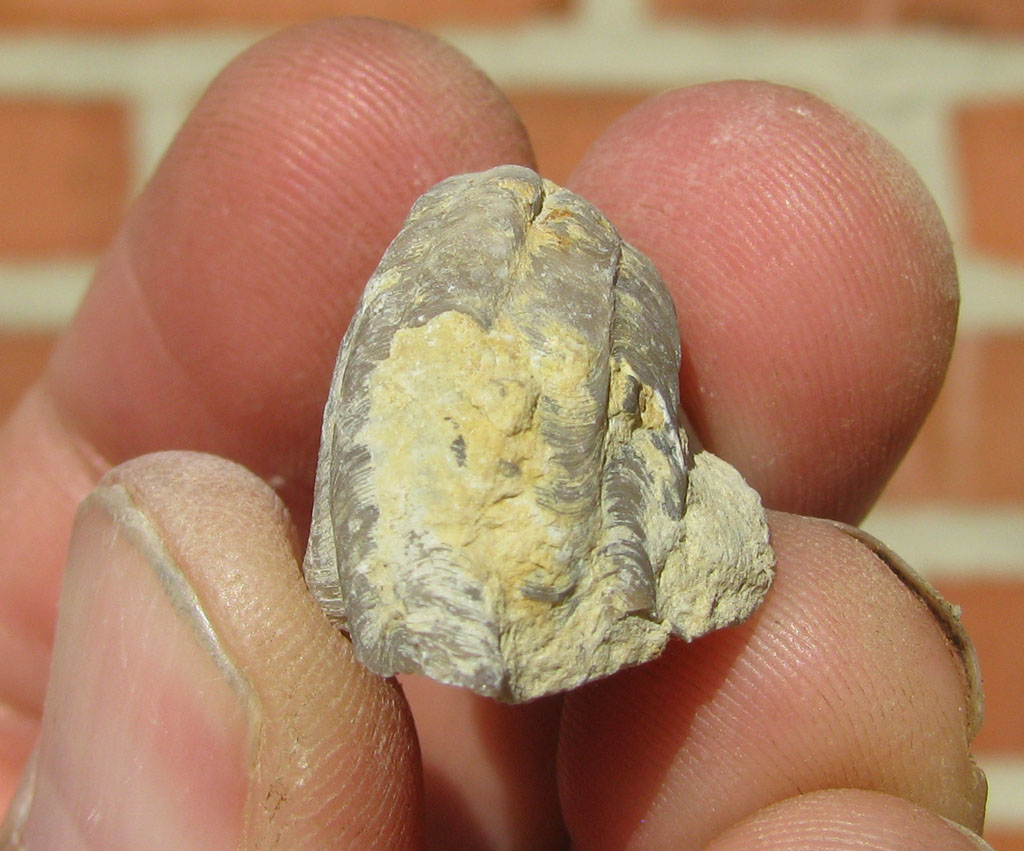
Here are two single valves from a Rhipdomelloides oblata that I found and photographed after I had written up the blog post which featured articulated specimens. These show the interior details of each valve. I think they are from two separate individuals though.


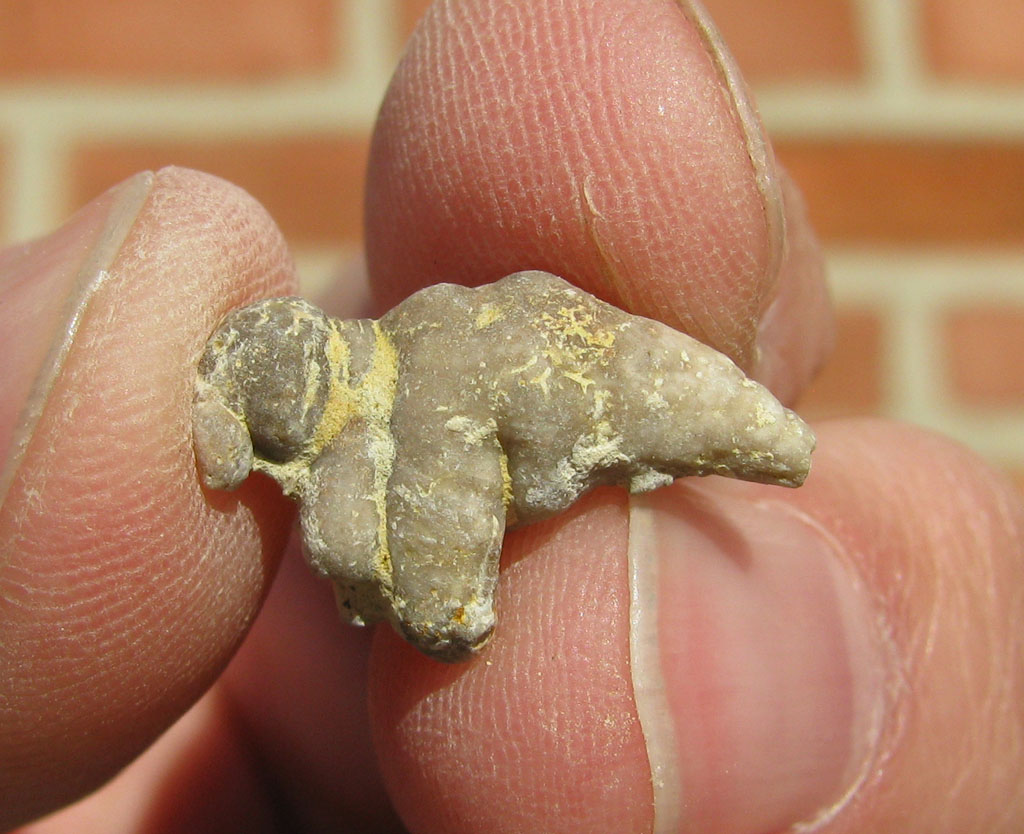
And finally we have this odd crinoid holdfast that are often called "Chicken Feet" by the local collectors. This specimen is "curled up" but I saw other specimens in the field (on large rocks I could not bring back with me) that really did appear to resemble bird feet.


Whew! That was a long series of blog posts for a single locality. The Bois D'Arc formation is profusely fossiliferous and has a very wide variety of preserved animals. I'm pretty sure I found all the common species and a number of the lesser common ones too. While I didn't find many of the showy trilobites, I made out pretty well for surface collecting. I'm itching to go back again and trying to figure out how to fit in another visit between my other vacations.

I found the specimens shown on this page in the Bois d'Arc formation (Cravatt member) near Clarita, OK which is Devonian in age (Lockhovian stage). The Bois d'Arc and Haragan formations interfinger with each other and are roughly the same age (Devonian, Lockhovian stage). They are both roughly correlative to the Helderberg fauna of New York and thus are contemporaneous with the Coyemans, Kalkberg and New Scotland formations.

Saturday, April 23, 2016

Huntoniatonia sp. trilobite from the Bois D'Arc formation of Oklahoma

From my experience collecting in the Bois D'Arc formation, I think that Huntoniatonia sp. (also sometimes called Huntonia) trilobites are possibly the most common trilobite to be found. I'm referring to the isolated parts of the trilobite not whole specimens. While there were a large number of whole Paciphacops sp. and Kaniops sp. fossils that I found I think I came across more detached pygidiums and cephalopns of Huntoniatonia sp. than anything else.

I did find a few whole specimens but none are in really good condition. This one is slightly enrolled and little warped.

Here is one still in the matrix (it was about two inches long) but it was lying exposed to the elements and thus has some missing shell.

Another one in the matrix that is partially enrolled. The pygidium and thorax are visible on the one side while the other side shows the front edge of the cephalon and a Phacopid trilobite.


Then I have some cephalon and pygidium pieces like this one from a Huntoniatonia huntonensis based on the shape of the spine extending from the cephalic margin.

A view of the eyes of the specimen.

This is a completely different specimen half embedded in the rock with just one eye poking out.


Finally we have a couple of pygidiums from two different specimens that show the size differences. Some of the Huntoniatonia got really big!


George Hansen's wonderful website indicates that there are at least three species of Huntoniatonia that are found in the Haragan and Bois D'Arc formations.  The main differences are the size and length of the spines that extend from the tip of the pygidium and cephalon.

Thursday, April 21, 2016

Kettneraspis sp. trilobite from the Bois D'Arc formation of Oklahoma

One of the spinier trilobites that can be found in the Bois D'Arc formation is Kettneraspis sp. it is usually a small fossil and it is best if you find it just peeking out from the rock. I found two nearly complete specimens while searching last August and some disarticulated pieces as well.

This is the first articulated specimen. It is about 75% there but the delicate spines are all weathered away and the left free cheek of the cephalon is missing. It's not bad for a surface find as most of the really nice prepped specimens are found by splitting the rock and looking for the outline.


Here is an isolated free cheek which shows the short spines that are on the lateral border of the cephalon.


I did find one really nice specimen but the rock it was on was very fractured and I didn't think I would be able to either get it home without further damage or repair it. Lucky for me Leon took a look at it and thought it could be saved. He wrapped it up in aluminum foil and took it back with him. A few weeks later he messaged me and told me that he'd been able to save it and it turned out to be a pretty nice specimen. Some of the spines are broken or missing and the cephalon has been compressed but it appears to be 95% complete.


The most common species found is  Kettneraspis williamsi but Leon told me that my fossil was an undescribed species. That may be because the specimen was incomplete or warped such that ID was difficult.

I found the specimens shown on this page in the Bois d'Arc formation (Cravatt member) near Clarita, OK which is Devonian in age (Lockhovian stage). The Bois d'Arc and Haragan formations interfinger with each other and are roughly the same age (Devonian, Lockhovian stage). They are both roughly correlative to the Helderberg fauna of New York and thus are contemporaneous with the Coyemans, Kalkberg and New Scotland formations.

Tuesday, April 19, 2016

Cordania falcata trilobite from the Bois D'Arc formation of Oklahoma

Cordania falcata is a small trilobite and is uncommon in the Bois D'Arc formation. I found two examples that were prone and mostly complete, but neither were attached to matrix. Below is the better specimen of the two. It is about 95% complete and is missing a portion of the right genal spine. The trilobite itself is nearly oval shaped with a large rounded cephalon that typically has long genal spines that extend nearly the length of the thorax and pygidium. There is a small glabella with one furrow. The eyes are small, holochroal and slightly raised. The specimen below need to have some prep work done to expose the rest of the trilobite but should make for a nice example.


I found the specimen shown on this page in the Bois d'Arc formation (Cravatt member) near Clarita, OK which is Devonian in age (Lockhovian stage). The Bois d'Arc and Haragan formations interfinger with each other and are roughly the same age (Devonian, Lockhovian stage). They are both roughly correlative to the Helderberg fauna of New York and thus are contemporaneous with the Coyemans, Kalkberg and New Scotland formations.

Reference: "Trilobites of the Haragan, Bois D'Arc and Frisco Formations (Early Devonian) Arbuckle Mountains Region, Oklahoma" 1977  K.S.W. Campbell, Oklahoma Geological Survey, Bulletin 123,  pg. 22, pl.5, fig 1-4

Saturday, April 16, 2016

Phacopid type trilobites from the Bois D'Arc formation of Oklahoma

Trilobites are very common in the Bois D'Arc formation and several species can be found. There are two or three different phacopid type trilobites that I am aware of but to ID them you need to examine the eyes and cephalon. A good resource for help is George P. Hanson's book, "Trilobites of Black Cat Mountain" available on his website.  Below are some of the specimens I've found that are still encased in matrix which makes identifying some of them a bit more difficult.

Specimen #1 - Partially enrolled but with most of the cephalon hidden.


Specimen #2 - Enrolled but one of the eyes is visible. I think this is a Kainops raymondi but I need to see more details to be certain.


Specimen #3 is mostly free of matrix but the glabella is still mostly obscured. One of the eyes is visible and leads me to believe that this is a Paciphacops campbelli.


Here are some nicely prepped specimens from the Haragan formation, which were labelled as Paciphacops logani, that I blogged about a couple of years ago.

I found the specimens shown on this page in the Bois d'Arc formation (Cravatt member) near Clarita, OK which is Devonian in age (Lockhovian stage). The Bois d'Arc and Haragan formations interfinger with each other and are roughly the same age (Devonian, Lockhovian stage). They are both roughly correlative to the Helderberg fauna of New York and thus are contemporaneous with the Coyemans, Kalkberg and New Scotland formations.

Thursday, April 14, 2016

Platyceras sp. gastropod from the Bois D'Arc formation of Oklahoma

As Platyceras sp. gastropods were abundant during the Devonian, it is no surprise to find one in the Bois D'Arc formation. This specimen has some added interest as there is a crinoid holdfast anchored to it.  The Platyceras shell is spiral shaped with a roughly rectangular cross section. The whorls are offset from the central axis and slightly angled. The exterior of the shell is decorated with wavy growth lines and some regular crenulations that follow the curve of the spiral. The crinoid hold fast is angled such that it could not have attached and grown while the snail was alive. It is likely that the snail was dead and the shell was lying upside down on or partially exposed from the substrate when the crinoid larvae first attached.


A couple of views of the crinoid holdfast


I found the specimens shown on this page in the Bois d'Arc formation (Cravatt member) near Clarita, OK which is Devonian in age (Lockhovian stage). The Bois d'Arc and Haragan formations interfinger with each other and are roughly the same age (Devonian, Lockhovian stage). They are both roughly correlative to the Helderberg fauna of New York and thus are contemporaneous with the Coyemans, Kalkberg and New Scotland formations.