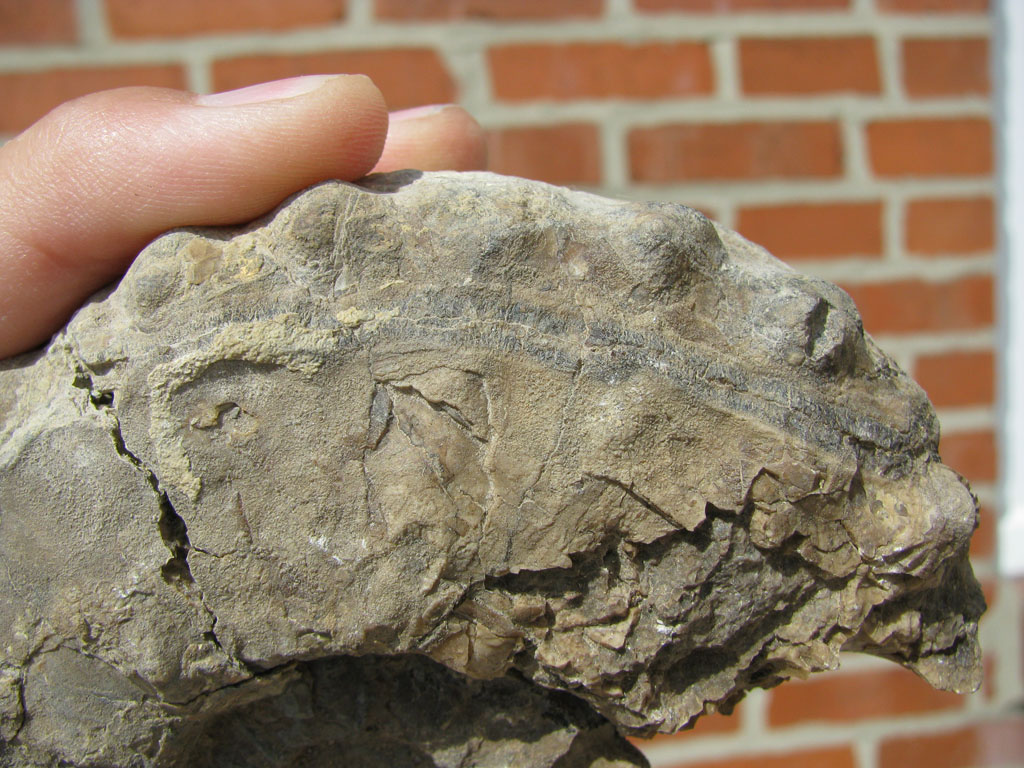
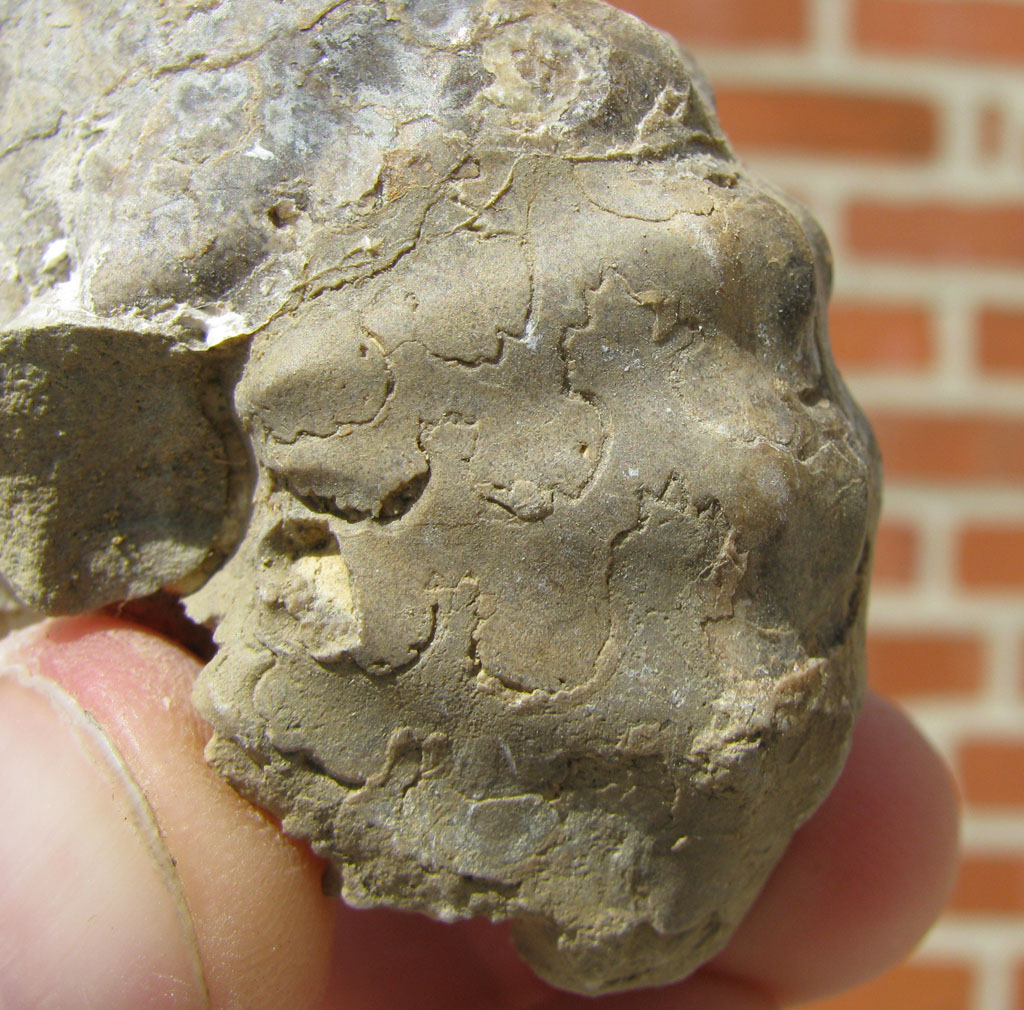
One last Ammonite from the Mancos Shale (Turonian stage of the Cretaceous) of Sandoval County, New Mexico: Placenticeras pseudoplacenta. This specimen is a little rough as it has fragments from several whorls attached. the left side is the most intact visibly and I may eventually try to remove the rest of the whorl pieces to make it look cleaner. By my estimations the full sized, intact specimen would have been 6-8" in diameter but only 3" of the current specimen is whole. P. pseudoplacenta is a narrow, flat, disc like shell with little ornamentation on the exterior of the shell. The suture pattern is very complex with a large number of nodes and lobes each with many smaller knobs.
Right side
Left side
Keel and cross section of a chamber
A closer view of the sutures
Thanks to Mike (PFooley on the Fossil Forum) for this fossil that he offered up as part of an auction to help defray some of the operating costs of the Fossil Forum website.
Showing posts with label Ammonite. Show all posts
Tuesday, August 16, 2016
Tuesday, August 2, 2016
Prionocyclus hyatti (robust form) from the Mancos Shale of New Mexico
These large, bumpy ammonites are the robust form of Prionocyclus hyatti from the Mancos Shale (Turonian stage of the Cretaceous) of Sandoval County, New Mexico. None of the sutures are visible but the form of the shell is what helps to ID it. The robust form of the shell is wider than the normal form and has distinct, knobby ribs. There is also a noticeable raised keel. The cross section of the chambers is roughly square.
Specimen #1 still has part of the nodule, that once surrounded it, still attached. Ammonites in the Mancos shale are often found in nodules. Sometimes they are septarianized as well.
Right side
Left side
Keel
Closer view of the right side
Specimen #2 is larger than the previous specimen and does show some septarian features.
Right side
Left side
View of the cross section of the last chamber
Keel
Part of the fossil shows septarian features like the "seam" seen below.
The fossil had broken while in transit which allows a view of the calcite filling the interior.
Thanks to Mike (PFooley on the Fossil Forum) for this fossil that he offered up as part of an auction to help defray some of the operating costs of the Fossil Forum website.
Specimen #1 still has part of the nodule, that once surrounded it, still attached. Ammonites in the Mancos shale are often found in nodules. Sometimes they are septarianized as well.
Right side
Left side
Keel
Closer view of the right side
Specimen #2 is larger than the previous specimen and does show some septarian features.
Right side
Left side
View of the cross section of the last chamber
Keel
Part of the fossil shows septarian features like the "seam" seen below.
The fossil had broken while in transit which allows a view of the calcite filling the interior.
Thanks to Mike (PFooley on the Fossil Forum) for this fossil that he offered up as part of an auction to help defray some of the operating costs of the Fossil Forum website.
Friday, July 29, 2016
Spathites puercoensis ammonite from the Mancos shale of New Mexico
Here are another couple of Ammonites from the Carlile shale member of the Mancos Shale (Turonian stage of the Cretaceous) of Sandoval County, New Mexico. They are specimens of Spathites puercoensis. This ammonite is small but somewhat robust with some obvious ribs near the keel. Each whorl overlaps the previous by about 95%. As these are steinkerns and no original shell is left, the suture pattern is easily visible and consists of a number of alternating "U" shapes, of differing depth, accented with some smaller zigzags.
Specimen #1
Right side
Left Side
Keel
A cross section view of the last suture chamber
Specimen #2
Left side
Right side (note the rock plug in the center which indicates there were likely more whorls that eroded away before the fossil was found)
Keel
Cross section view of the last suture.
A closer view of the suture pattern.
The publication "Contributions to Late Cretaceous Paleontology and Stratigraphy of New Mexico Part II". Bulletin 114. New Mexico Bureau of Mines and Mineral Resources. contains a paper by W. A. Cobban titled "The Late Cretaceous ammonite Spathites Kummel and Decker in New Mexico and Trans-Pecos Texas" from which this illustration of the suture patterns of S. puercoensis comes.
Thanks to Mike (PFooley on the Fossil Forum) for this fossil that he offered up as part of an auction to help defray some of the operating costs of the Fossil Forum website.
Specimen #1
Right side
Left Side
Keel
A cross section view of the last suture chamber
Specimen #2
Left side
Right side (note the rock plug in the center which indicates there were likely more whorls that eroded away before the fossil was found)
Keel
Cross section view of the last suture.
A closer view of the suture pattern.
The publication "Contributions to Late Cretaceous Paleontology and Stratigraphy of New Mexico Part II". Bulletin 114. New Mexico Bureau of Mines and Mineral Resources. contains a paper by W. A. Cobban titled "The Late Cretaceous ammonite Spathites Kummel and Decker in New Mexico and Trans-Pecos Texas" from which this illustration of the suture patterns of S. puercoensis comes.
Thanks to Mike (PFooley on the Fossil Forum) for this fossil that he offered up as part of an auction to help defray some of the operating costs of the Fossil Forum website.
Tuesday, July 26, 2016
Coilopoceras springeri ammonite from the Mancos Shale of New Mexico
Today I have an Ammonite from New Mexico to show you. It's a Coilopoceras springeri from the Carlile Shale member of the Mancos Shale (Turonian stage of the Cretaceous), Sandoval County, NM. The fossil is very thin in cross section, it reminds me of a frisbee, and has a very complex suture pattern. Each whorl overlaps the previous whorl by about 95%.
Right side
Left side
Keel
A closer detail of the keel from the side. I'm not sure if the segmentation that is shown is part of the shell or just an erosional feature.
Keel with a cross section view of the last suture chamber.
A closer view of the suture pattern.
I found a publication, "The Upper Cretaceous (Turonian) ammonite family Coilopoceratidae Hyatt in the Western Interior of the United States." W. A. Cobban and S. C. Hook. 1980. United States Geological Survey Professional Paper 1192:1-28, that has a good description of this species and this helpful drawing (figure 11, page 18) of a few typical suture patterns from C. springeri specimens.
Thanks to Mike (PFooley on the Fossil Forum) for this fossil that he offered up as part of an auction to help defray some of the operating costs of the Fossil Forum website.
Right side
Left side
Keel
A closer detail of the keel from the side. I'm not sure if the segmentation that is shown is part of the shell or just an erosional feature.
Keel with a cross section view of the last suture chamber.
A closer view of the suture pattern.
I found a publication, "The Upper Cretaceous (Turonian) ammonite family Coilopoceratidae Hyatt in the Western Interior of the United States." W. A. Cobban and S. C. Hook. 1980. United States Geological Survey Professional Paper 1192:1-28, that has a good description of this species and this helpful drawing (figure 11, page 18) of a few typical suture patterns from C. springeri specimens.
Thanks to Mike (PFooley on the Fossil Forum) for this fossil that he offered up as part of an auction to help defray some of the operating costs of the Fossil Forum website.
Saturday, May 14, 2016
Eopachydiscus sp. ammonite from the Duck Creek formation of Texas
I found another type of ammonite, in the north Texas creek bed I was exploring, called Eopachydiscus sp. I found a large number of them, in fact, but as many were sizable and heavy I only packed out one. I saw some that were well over 18" in diameter, approaching 24"! The specimen I chose to keep is about 8-9" in diameter, 3" thick and had some of it's sutures showing as well as oyster spats glommed onto it. What I don't know is if the oysters colonized the actual shell surface or if the original shell had already fossilized, dissolved away and left a steinkern as a base for them.
This specimen comes from the Duck Creek formation which is Cretaceous (Albian stage) in age.
Thursday, May 12, 2016
Mortoniceras sp. ammonite from the Duck Creek formation of Texas
Before I started on my adventure in Oklahoma I landed in Dallas and drove north to a site that a good friend had suggested I visit. It was a creek that exposed the Duck Creek formation (Cretaceous, Albian stage) in a couple of spots. Having never collected in Texas before, but seeing plenty of field reports from those who had, I knew the Duck Creek formation should produce some nice fossils. I was not wrong. I found four specimens of the ammonite Mortoniceras sp. washed out in the creek bed. Mortoniceras can be identified by the prominent ribbing along the shell and strong rostrum. There are a couple of species of Mortoniceras and I'm not good enough to tell them apart so I will keep these labelled as Mortoniceras sp.
Specimen #1
Specimen #2
Specimen #1
Specimen #2
Sunday, April 12, 2015
Amaltheus sp. ammonite from France
Here is another type of pyritized Ammonite that can be found in the Toarcian aged rocks (Jurassic) around Millau, Aveyron Dept., France. It's labelled as an Amaltheus sp. and is a small fossil. The whorls overlap about 25% of each previous volution. The external ornamentation is preserved well with the strong ribs that do not continue onto the keel. The keel is smooth except for a raised portion that has slight notches regularly space so that it looks like a braid from the side. Not enough of the internal sutures are visible to tell for sure, but this specimen looks very similar to one that I saw on the Steinkern.de forum, in this post, that was identified as Amaltheus margaritatus cf. forma subnodosus.
Thanks to Gery for sending me this fossil!
Friday, April 10, 2015
Pseudogrammoceras fallaciosum ammonite from France
Here I have a nice pyritized specimen of the ammonite Pseudogrammoceras fallaciosum. from the Toarcian aged rocks (Jurassic) near Millau, Aveyron Department, France. The gently curving external ribbing has been preserved as has the complex internal suture pattern. Each volution of the whorl covers approximately 60% of the previous. The specimen is missing the living chamber.
Another view of the complex sutures.
Thanks to Gery for sending me this fossil!
Another view of the complex sutures.
Thanks to Gery for sending me this fossil!
Subscribe to:
Posts (Atom)