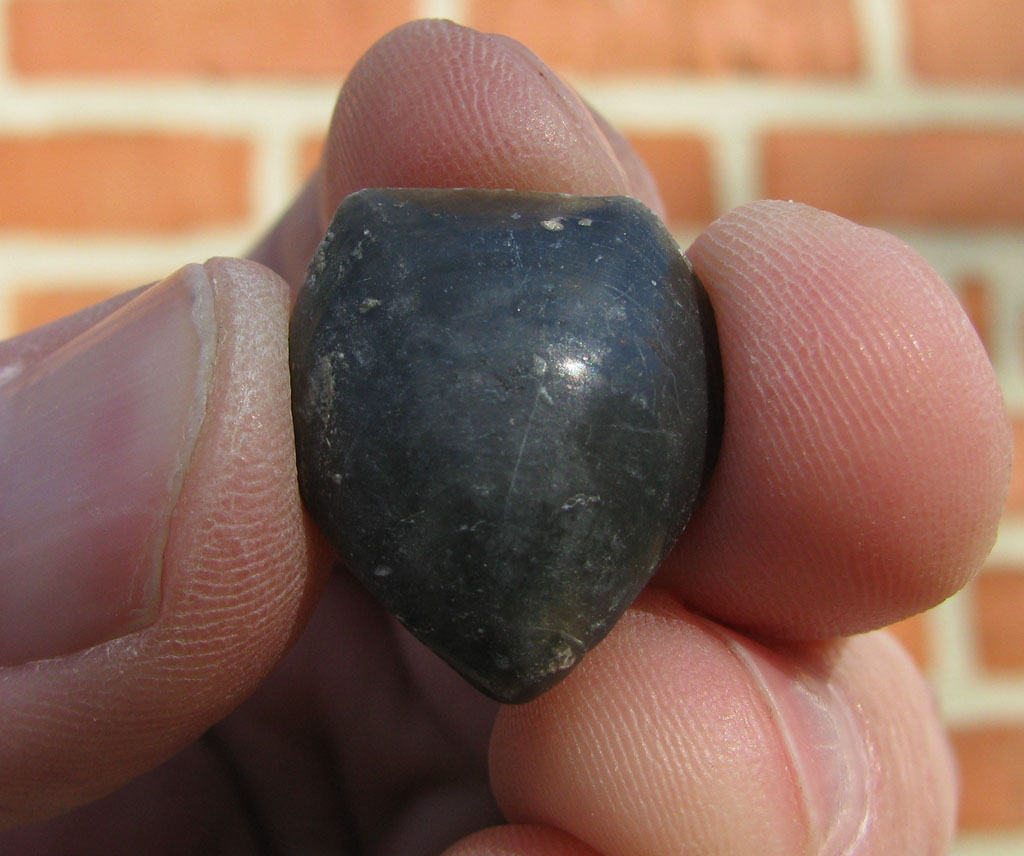
This internal mold of a brachiopod is Gibbirhynchia amaltei from the Marginatus zone of the lower Jurassic (Pliensbachian). It comes from a site near Tournadous in the Aveyron region of southern France. The fossil looks like a Limonite replacement (or maybe lining) of the shell interior and retains just a small amount of the calcitic shell. The fossil is broadly ovate with valves that are mildly convex. When viewed from the front or back it looks somewhat flat or squat. Both valves have numerous and regular plications with a gentle fold and sulcus that is most evident along the anterior margins.
Brachial valve
Anterior
Pedicle valve (note the cast of the channel where the pedicle muscle would have been)
Anterior
Profile
Showing posts with label France. Show all posts
Friday, August 19, 2016
Sunday, August 30, 2015
Sellithyris sella brachiopod from the Clape Massif of France
I really like the look of this next Brachiopod. It's a Sellithyris sella from the Aptian stage of the Cretaceous (found at the Clape Massif near Narbonne, France) that has part of the shell replaced by the "mineral" Beekite (which is a variety of Chalcedony, itself a variety of Quartz). That and the colors of the shell give it a lot of visual interest beyond the shell itself.
Sellithyris sella is a terebratulid brachiopod that is oval in shape when viewed from the top or bottom.It has a beak with a round foramen on the pedicle valve. Both valves are smooth and convex with a simple "w" shaped fold and sulcus structure on the anterior margin.
Pedicle valve
This fossil reminds me of another terebratulid brachiopod called Cererithyris arkelli but that species lived during the Bathonian stage of the Jurassic, about 50 million years apart.
Sellithyris sella is a terebratulid brachiopod that is oval in shape when viewed from the top or bottom.It has a beak with a round foramen on the pedicle valve. Both valves are smooth and convex with a simple "w" shaped fold and sulcus structure on the anterior margin.
Pedicle valve
This fossil reminds me of another terebratulid brachiopod called Cererithyris arkelli but that species lived during the Bathonian stage of the Jurassic, about 50 million years apart.
Tuesday, April 14, 2015
Digonella digona brachiopod from Ranville, France
I've featured the brachiopod Digonella digona on my blog previously, about four years ago, with specimens that came from Luc sur Mer, Calvados Department, France. The specimen below comes from a quarry near Ranville, which is inland and south from Luc sur Mer. The fossil is preserved with a black colored calcite compared to the tan and grey of the other specimens. It also comes from Bathonian aged sediments (Jurassic) and likely the same rock formation. The shell of the species is longer than wide with a flat anterior margin and no evidence of a sulcus. Typical of the Terebratulid order, there is a large, round foramen in the beak of the umbo on the pedicle valve.
Brachial valve
Anterior
Pedicle valve
Posterior
Profile
Thanks to Gery for sending me this fossil!
Brachial valve
Anterior
Pedicle valve
Posterior
Profile
Thanks to Gery for sending me this fossil!
Sunday, April 12, 2015
Amaltheus sp. ammonite from France
Here is another type of pyritized Ammonite that can be found in the Toarcian aged rocks (Jurassic) around Millau, Aveyron Dept., France. It's labelled as an Amaltheus sp. and is a small fossil. The whorls overlap about 25% of each previous volution. The external ornamentation is preserved well with the strong ribs that do not continue onto the keel. The keel is smooth except for a raised portion that has slight notches regularly space so that it looks like a braid from the side. Not enough of the internal sutures are visible to tell for sure, but this specimen looks very similar to one that I saw on the Steinkern.de forum, in this post, that was identified as Amaltheus margaritatus cf. forma subnodosus.
Thanks to Gery for sending me this fossil!
Friday, April 10, 2015
Pseudogrammoceras fallaciosum ammonite from France
Here I have a nice pyritized specimen of the ammonite Pseudogrammoceras fallaciosum. from the Toarcian aged rocks (Jurassic) near Millau, Aveyron Department, France. The gently curving external ribbing has been preserved as has the complex internal suture pattern. Each volution of the whorl covers approximately 60% of the previous. The specimen is missing the living chamber.
Another view of the complex sutures.
Thanks to Gery for sending me this fossil!
Another view of the complex sutures.
Thanks to Gery for sending me this fossil!
Wednesday, April 8, 2015
Leymeriella regularis ammonite from France
The fossil for today is Leymeriella regularis from the Albian stage (Jurassic) rocks near Bellegarde sur Valserine, Ain Department, France. The whorls are not overly wide but do cover approximately 90% of the previous generation. Moderate ribbing marks the sides of the whorls but does not continue completely across the keel of the shell. The cross section of the living chamber is square in shape.
Specimen #1
Specimen #2
Thanks to Gery for the specimens!
Specimen #1
Specimen #2
Thanks to Gery for the specimens!
Monday, April 6, 2015
Dorsoplicathoris dorsoplicata brachiopod from France
This is Dorsoplicathoris dorsoplicata from the Coronatum zone of the Callovian stage of the Jurassic, from near Villequiers, Cher department, France. It has a typical terebratulid shape and features, oval and with a large foramen on the umbo. The anterior margin of the shell is only slightly curved, meeting the side margins at an obtuse angle. That meet point is expressed as a shallow ridge along the surface of the valves pointing back towards the foramen.
Brachial valve
Anterior
Pedicle valve
Posterior
Profile
Thanks to Gery for the fossil!
Brachial valve
Anterior
Pedicle valve
Posterior
Profile
Thanks to Gery for the fossil!
Saturday, April 4, 2015
Lissoceratoides erato ammonite from France
Here is another ammonite from near Poitiers, Vienne Department, France. It's Lissoceratoides erato and is from Oxfordian aged rocks (Jurassic).
The whorls are wide and overlap each other quite a bit so that there is
just a small area in the center that gives evidence of previous shell. It is a fairly flat shell in cross section.
Here is a closeup of the shell and the visible sutures...
..and an image of the pattern lain flat.
Suture pattern image taken from "Renz O, Imlay R, Lancelot Y, Ryan WBF (1975)
Ammonite rich Oxfordian limestones from the base of the continental slope
off Northwest Africa. Eclogae geol Helv Vol 68 /2: 431–448"
Thanks to Gery for the fossil!
Here is a closeup of the shell and the visible sutures...
..and an image of the pattern lain flat.
Thanks to Gery for the fossil!
Thursday, April 2, 2015
Trimarginites trimarginatus ammonite from France
I apologize for the darker than usual photos of this specimen but I must have taken them on a cloudy day. they are of an ammonite called Trimarginites trimarginatus that comes from the Oxfordian stage sediments (Jurassic) near Poitiers, Vienne Department, France. The whorls are wide and overlap each other quite a bit so that there is just a small area in the center that gives evidence of previous shell. The cross section of the shell is flat.
The sutures are very complex. Here is a closeup of the shell and the visible sutures...
..and an image of the pattern lain flat.
Suture pattern image taken from "Renz O, Imlay R, Lancelot Y, Ryan WBF (1975) Ammonite rich Oxfordian limestones from the base of the continental slope off Northwest Africa. Eclogae geol Helv Vol 68 /2: 431–448"
The Ammonites.fr website has a page on this species that can be found here. Thanks to Gery for the fossil!
The sutures are very complex. Here is a closeup of the shell and the visible sutures...
..and an image of the pattern lain flat.
Suture pattern image taken from "Renz O, Imlay R, Lancelot Y, Ryan WBF (1975) Ammonite rich Oxfordian limestones from the base of the continental slope off Northwest Africa. Eclogae geol Helv Vol 68 /2: 431–448"
The Ammonites.fr website has a page on this species that can be found here. Thanks to Gery for the fossil!
Tuesday, March 31, 2015
Postepithyris cincta brachiopod from France
I always like large brachiopods and these specimens of Postepithryis cincta certainly meet that standard. The specimens below are roughly 1.5" long (4cm) by 1.25" wide (3cm). They come from rocks dated to the Oxfordian stage (Jurassic) near Bourges in the department of Cher, France.
P. cincta is a Terebratulid type brachiopod, oval shaped and with a large foramen (round hole) in the umbo (beak like extension of the shell) where the pedicle muscle once extended. The only other distinguishing feature is the gentle, sine wave like shape to the anterior margin where the two shell halves meet.
Specimen #1
Pedicle valve
Anterior
Brachial valve
Posterior
Profile
Specimen #2
Pedicle valve
Anterior
Brachial valve
Posterior
Profile
Thanks to Gery for these fossils!
P. cincta is a Terebratulid type brachiopod, oval shaped and with a large foramen (round hole) in the umbo (beak like extension of the shell) where the pedicle muscle once extended. The only other distinguishing feature is the gentle, sine wave like shape to the anterior margin where the two shell halves meet.
Specimen #1
Pedicle valve
Anterior
Brachial valve
Posterior
Profile
Specimen #2
Pedicle valve
Anterior
Brachial valve
Posterior
Profile
Thanks to Gery for these fossils!
Subscribe to:
Posts (Atom)