Showing posts with label Hungry Hollow member. Show all posts
Saturday, July 11, 2020
Philhedra crenistriata brachiopod from the Widder formation
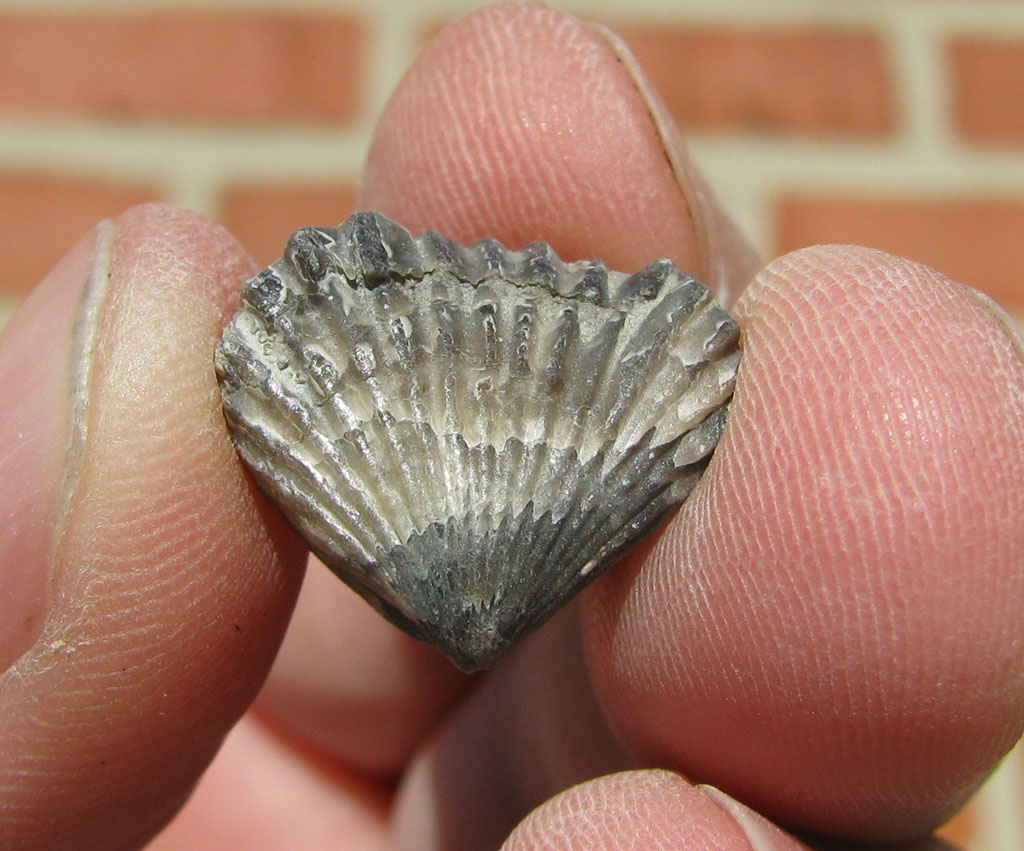
Adding another Brachiopod species to my collection from the Hungry Hollow member of the Widder formation at Hungry Hollow, Ontario is Philhedra crenistriata. This is an inarticulate brachiopod and uncommon to find from this location. Inarticulate brachiopods are animals that hold their shells together using their muscles as opposed to Articulate brachiopods who have a hinge and teeth system to hold the shell together.
In this case, Philhedra crenistriata is a type of Inarticulate brachiopod which cements one valve of it's shell to a hard substrate (typically another brachiopod, mollusk, or coral) while the other valve lifts like an umbrealla. Philhedra is a simple genus to ID in the field by the flat rounded shell with a central raised "beak" that is surrounded by radiating ribs. The specimen below should be both valves with the top, or dorsal valve, visible. The ventral valve is beneath the dorsal valve and is cemented to the shell beneath.
I collected this specimen from the Hungry Hollow member of the Widder formation which is Devonian in age, Givetian stage.
Sunday, July 5, 2020
Small sponge from the Widder formation
On a trip to the exposures of the Widder formation along the Credit river in Hungry Hollow, Ontario, I found this cluster of sponge spicules. It is not uncommon to find individual spicules like this within the Hungry Hollow member of the Widder formation, but a large cluster like this is less common. I checked the "Check List of Fossil Invertebrates Described from the Middle Devonian Rocks of the Thedford-Arkona Region of Southwestern Ontario" by Stumm and Wright (1958) and they list one sponge known from the Widder formation: Astraeospongia hamiltonensis. I am familiar with that genus from the upper Silurian where it is known as Astraeospongia meniscus from the Brownsport formation. The spicules in my specimen look very similar to those earlier species so I think I will stick with the name Astraeospongia hamiltonensis.
I collected this specimen from the Hungry Hollow member of the Widder formation which is Devonian in age, Givetian stage.
Monday, March 9, 2020
Eldredgeops iowensis southworthi trilobite from the Widder formation
I don't often have luck finding trilobites as I am usually distracted by brachiopods and corals. However a couple of years ago I managed to find the fossil shown below while searching near Arkona, Ontario. It's a rare example of an enrolled Eldredgeops iowensis southworthi.
Pics of the specimen as it was found, before cleaning.
It comes from the Hungry Hollow member of the Widder formation and the trilobites are often crushed like this one is. It still retains some 3D detail but the cephalon is all mushed up. I wasn't even really looking for anything when I found this. I was talking to a friend and he joked that I should go find a trilobite. I glanced down at his feet and I saw this fossil sitting right on the surface.
I gave the specimen to a friend of mine, M.T., who did a superb job of cleaning off the excess mud and matrix.
High contrast pictures
I collected this specimen from the Hungry Hollow member of the Widder formation which is Devonian is age, Givetian stage.
Saturday, August 27, 2016
Lichenalia (Pinacotrypa?) stella bryozoan from the Hungry Hollow member at Arkona
The specimen today comes from the Hungry Hollow member of the Widder formation near Arkona, Canada (Devonian, Givetian stage). It's a bryozoan but I am not terribly sure of the name. It is a very detailed specimen with large mound like monticules and some star like features on the surface. Overall the individual zooids are small pin pricks but as a colony they look impressive.
Here is the specimen itself, Dorsal surface...
...Ventral surface. You can see that it covers both sides of the piece and in life may have been a vertical wall like feature.
Now some closer views of the surface...
As I am not an expert on Bryozoans I posted these photos to a group on Facebook that specializes in fossils from the Arkona region. One of the members of the group is Michael Topor, who is very familar with fossils from the Widder and Arkona formations (since he spent much of his collecting career excavating and studying specimens from those rocks) said:
As much as I dislike Facebook in general, it does allow a place for amateurs and experts alike to exchange and share information. Much like the Fossil Forum website!
Here is the specimen itself, Dorsal surface...
...Ventral surface. You can see that it covers both sides of the piece and in life may have been a vertical wall like feature.
Now some closer views of the surface...
As I am not an expert on Bryozoans I posted these photos to a group on Facebook that specializes in fossils from the Arkona region. One of the members of the group is Michael Topor, who is very familar with fossils from the Widder and Arkona formations (since he spent much of his collecting career excavating and studying specimens from those rocks) said:
"Could be Lichenalia stellata. Not sure if that genus is still used."Another local expert, Darrell Ellis, remarked:
"I believe Bassler placed Lichenalia stellata in the genus Pinacotrypa... though I'm not certain he had the final word on the matter. I've collected Pinacotrypa/Lichenalia from the top of the Encrinal Limestone. By appearance I believe your specimen is from there as well."So I'm going with the experts and will label this as Lichenalia (Pinacotrypa?) stella.
As much as I dislike Facebook in general, it does allow a place for amateurs and experts alike to exchange and share information. Much like the Fossil Forum website!
Sunday, May 1, 2016
Ptilopora bryozoan from the Hungry Hollow member at Arkona
One one of my regular trips up to Arkona, Canada I found this small scrap of fossil and hung onto to it as it reminded me of something. Well that something turns out to be a piece of a Bryozoan called Ptilopora striata (sometimes spelled Ptylipora). This bryozoan is typified by a single, strong, central "mast" with branches angling off at 45 degrees along the length. The individual branches sometimes have cross supports with neighboring branches as well. Overall the fossil has a herringbone like pattern. This is unlike similar fossils like Fenestella sp. or Polypora sp. who lack the central "mast". This specimen comes from the Hungry Hollow member of the Widder formation.
The reverse side of the fragment does not show any detail as it was overgrown by a colony of another bryozoan called Leioclema sp. I'm not sure what the fragmentary remains on top of the Leioclema are.
I wrote about another example of this rare bryozoan that I found in the Mahantango fm. and originally misidentified as the hydrozoan Plumalina plumaria.
Wednesday, March 11, 2015
Syringopora sp. coral from the Hungry Hollow Mbr. at Arkona
Syringopora is a small, narrow tabulate coral that grows in loose colonies with the individual corallites separated by a 5-10mm in most cases. Here is a specimen that I found last fall at Arkona that comes from the Hungry Hollow mbr. of the Widder formation. Note the close spacing of the corallites to one another which reminds me of the growth pattern of some rugose corals, such as Eridophyllum subcaespitosum. The former coral's coralites have a much wider diameter than those of Syringopora.
These are views of the rock from different angles which show how the individual corallites grew upwards as new mud and debris piled up around them.
One could make the case that these are Aulocystis sp. corals but I don't think they are. Aulocystis has a more tapered look and they bud off regularly without much vertical growth.
These are views of the bottom of the piece. The coral here seems to parallel the bottom of the rock which either indicates that it started to grow vertically and then was knocked over or grew horizontally until the bottom sediments started to pile up.
Monday, December 15, 2014
Cupularostrum prolificum brachiopod from Arkona
Today's fossil was found by accident after a practical joke my a friend I was collecting with. We had been collecting for several hours and been disappointed by the lack of Trilobites. One member of the group suddenly called out to us that he'd made the "find of the trip" which of course got us all scrambling over to see what it was. When we got there it turned out to be a piece of a shoe and was not at all worth the effort. While I was admonishing the perpetrator of the prank I noticed a fossil sitting on an eroded pedistal that caught my eye. A closer inspection revealed it to be an articulated Rhynchonellid brachiopod and one that I think is a Cupularostrum prolificum similar to that which is found in the Silica Shale.
Brachial valve
Anterior
Pedicle valve
Posterior
Profile
This fossil was found among debris that was exposed from a cliff fall along the Ausable river near Arkona, Ontario. I believe it came from the Widder formation, Hungry Hollow member (Devonian, Givetian stage).
Brachial valve
Anterior
Pedicle valve
Posterior
Profile
This fossil was found among debris that was exposed from a cliff fall along the Ausable river near Arkona, Ontario. I believe it came from the Widder formation, Hungry Hollow member (Devonian, Givetian stage).
Monday, June 16, 2014
Spinocyrtia granulosus brachiopod from Arkona
This is a partial pedicle valve of Spinocyrtia granulosus that I found at Hungry Hollow near Arkona, ON recently. It's very large and is the only specimen that I have of this species from the Hungry Hollow member of the Widder formation (Devonian, Givetian stage).
Note the bryozoan holdfast
Sunday, November 11, 2012
Large colony of Fistulipora (?) from Arkona
I'd forgotten about this next piece until I was organizing my finds from Arkona. It's a very large portion of a bryozoan colony that came from the Hungry Hollow member of the Widder formation.
Trying to determine the species would require thin sectioning of a portion so that the internal structures could be studied. Based on the "Check List of Fossil Invertebrates Described from the Middle Devonian Rocks of the Thedford-Arkona Region of Southwestern Ontario", There are three species described from the Hungry Hollow member: F. huronensis, F. incrassata and F. vesiculata with the former two being the most common.
These are common fossils but I don't find many large colonies like this. The Hungry Hollow member of the Widder formation is middle Devonian (Givetian stage) in age.
Here are some Fistuliporoid colonies that I found in the Silica Shale.
Wednesday, November 7, 2012
Crushed Devonoblastus from the Widder Fm.
I have another Blastoid to add to my collection from Arkona. It's a partially crushed specimen of what I think is Devonoblastus whiteavesi. I took some pictures of the 9.5mm long specimen with my Zorb microscope camera.
Crushed base of the specimen
Side views
View of the crushed side
To give you an idea of scale, here is the specimen held in my fingers.
Some close ups
The specimen was collected from the Hungry Hollow member of the Widder formation near Arkona, Ontario, Canada. The Widder formation is middle Devonian in age (Givetian) with the Hungry Hollow member being equivalent to the Centerfield member of the Ludlowville formation in New York, USA.
Subscribe to:
Posts (Atom)