Thursday, January 9, 2014

Atactotoechus furcatus bryozoan from the Windom Shale

I spent an hour or so putting some bryozoan fragments back together and got two nice branching colonies of Atactotoechus furcatus.

A plate of matrix with both shown in position.

The piece on the lower right detaches from it's spot and can be viewed in three dimensions. For purposes of conversation, this is the anterior side.

And this is the posterior side.

A close up of one of the branches shows some of the individual zooids where the animals lived.

This is the other branch which is affixed to the matrix still. I have no intention of removing it and glued other pieces back into place to further stabilize it.


I originally found them while excavating in the shale layer (possibly the Bay View Coral bed) at the Penn Dixie site. They were highly fragmented so I gathered as many pieces as I could find and brought them home. Projects like this are fun because it's like putting a puzzle back together. These specimens were found in the Windom shale member of the Moscow formation (Givetian stage of the middle Devonian) in Blasdell, NY.

Special thanks to Karl Wilson for helping to ID these specimens. He pointed out a similar specimen that he had on one of his New York Paleontology web pages.

Tuesday, January 7, 2014

Orbiculoidea media brachiopod from the Windom shale at Penn Dixie

Some inarticulate brachiopod fossils are uncommon because the shell was made of phosphate instead of Calcite and thus they break apart more quickly. When you do find them they are obvious for the black color of the shell. Here are some Orbiculoidea media specimens that I found at the Penn Dixie site near Blasdell, NY.

Specimen #1


Specimen #2, wet to show detail a little better.

Both specimens came from the Windom shale mbr. of the Moscow Formation (Devonian, Givetian stage).

Sunday, January 5, 2014

Cupularostrum sappho brachiopod from Lake Erie

This is a specimen of what I know is a Cupularostrum and I think is a C. sappho. I found it while splitting some harder limestone nodules that are found in the Wanakah shale along the Lake Erie shoreline near Buffalo, NY. I'm quite pleased to see that it's an articulated specimen and not crushed. It can be difficult to extract good specimens from the harder nodules as often the fossils wind up being split or otherwise damaged.

Pedicle valve
Profile
Posterior

This was found along the shoreline of Lake Erie near 18 Mile Creek in the Wanakah shale, Ludlowville formation. The Ludlowville formation is Devonian (Givetian stage).

Friday, January 3, 2014

Mediospirifer audaculus brachiopod from the Moscow formation

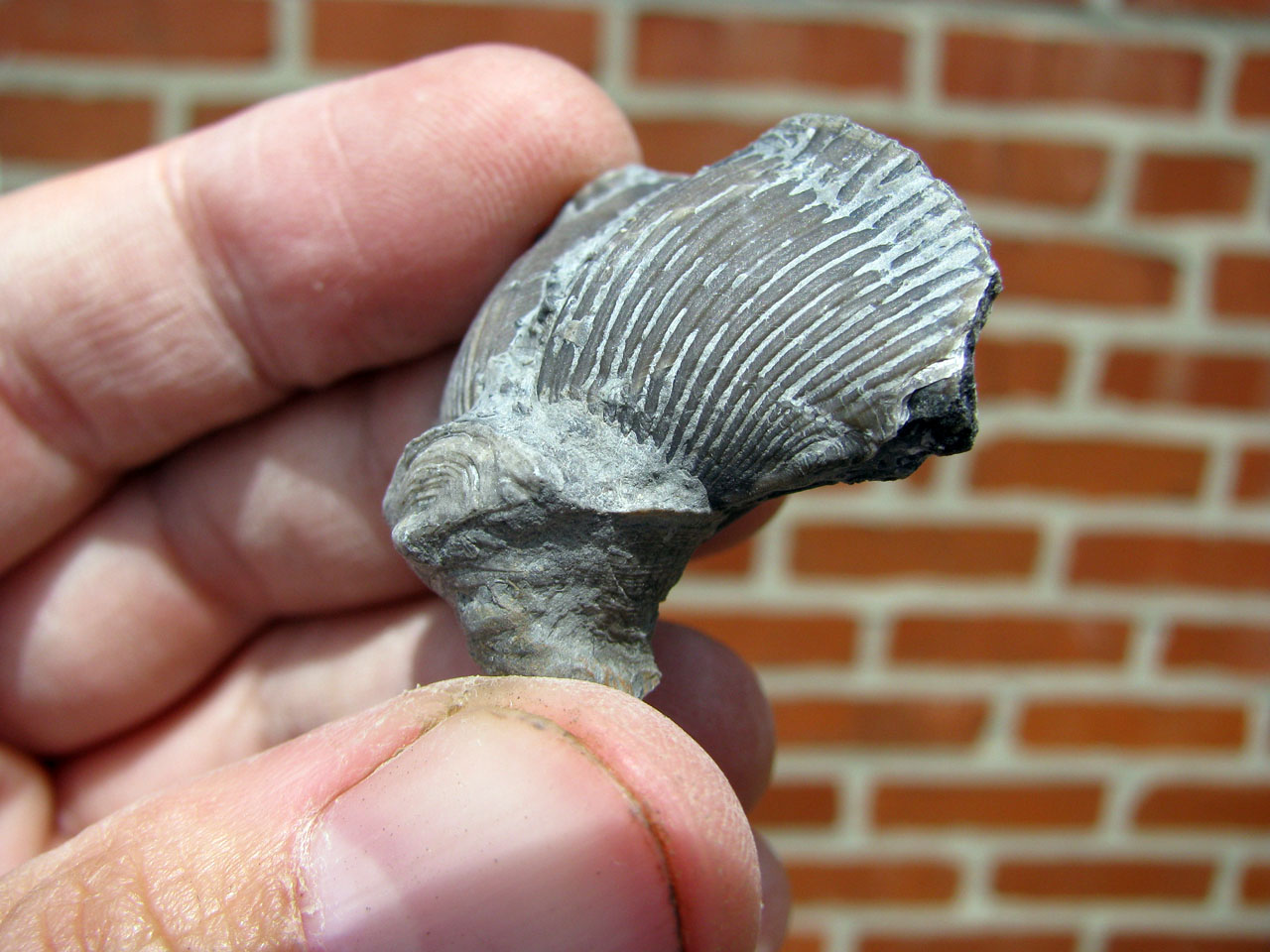
Mediospirifer audaculus is a common fossil from the Middle Devonian but its large shell is sometimes hard to find intact.

Typically this is how I find them as fossils when I collect at the Penn Dixie site in Basdell, NY.  Individual valves, in this case the pedicle, that are never articulated.

Alternately I will find an articulated specimen but usually the brachial valve is crushed...


Or the whole thing is distorted.


This specimen, also from the Penn Dixie site, is an exception in that it is articulated and is rounder than the "classic" Mediospirifer sp. form.


Finally I found some classic Mediospirifer audaculus fossils while collecting with my friend Mikey in Livingston County, NY.  Here is a good example:


This specimen was found with which almost looks like the Brachiopod used a horn coral as a "tee".


I don't think that the Brachiopod ever was actually attached to the coral but it makes for an interesting specimen. All the above specimens came from the Moscow formation which is dated to the latest Givetian stage of the Devonian Period.

Wednesday, January 1, 2014

Lingula fossils from the Moscow formation

I'm back from my hiatus and am going through material that I've found in the last few years. With the new set up in the attic it is easier for me to go through what I've collected and sort what I've found.  I have at least a months worth of postings in the queue right now and will try to keep a regular schedule. Thank you for your patience.

On a trip I made this spring I was able to meet up with my friend Mikey from the Fossil Forum. He took me to a creek that he collects at to show me some of his stomping grounds. Among the finds we made was this Lingula sp. brachiopod.


It's a good 3cm in length and you can see the original shell material has been preserved (or at least replaced) well so that you can see growth lines and color variations. It also has both valves present although one is overlapping the other. I would interpret that to indicate the animal had died and the shell was disturbed by the water currents. Muscles that helped keep the shell closed had decayed and so the two valves were able to rotate slightly before being reburied. This specimen was found in Livingston County, NY in the Moscow formation which is Devonian (Givetian stage) in age.