Here is a very large Greenops sp. pygidium that I found in the Bay View Coral bed of the Windom shale (Moscow Formation, Givetian stage of the Devonian). It's remarkable for me due to the size of the specimen and the preservation of the "tail feathers" (as I like to call them).
Showing posts with label Blasdell. Show all posts
Saturday, August 9, 2014
Thursday, August 7, 2014
A few recent mollusks from the Windom Shale
My spring visit to the Penn Dixie site near Blasdell, NY yielded some new mollusk fossils for me that I'd not found at the site previously.
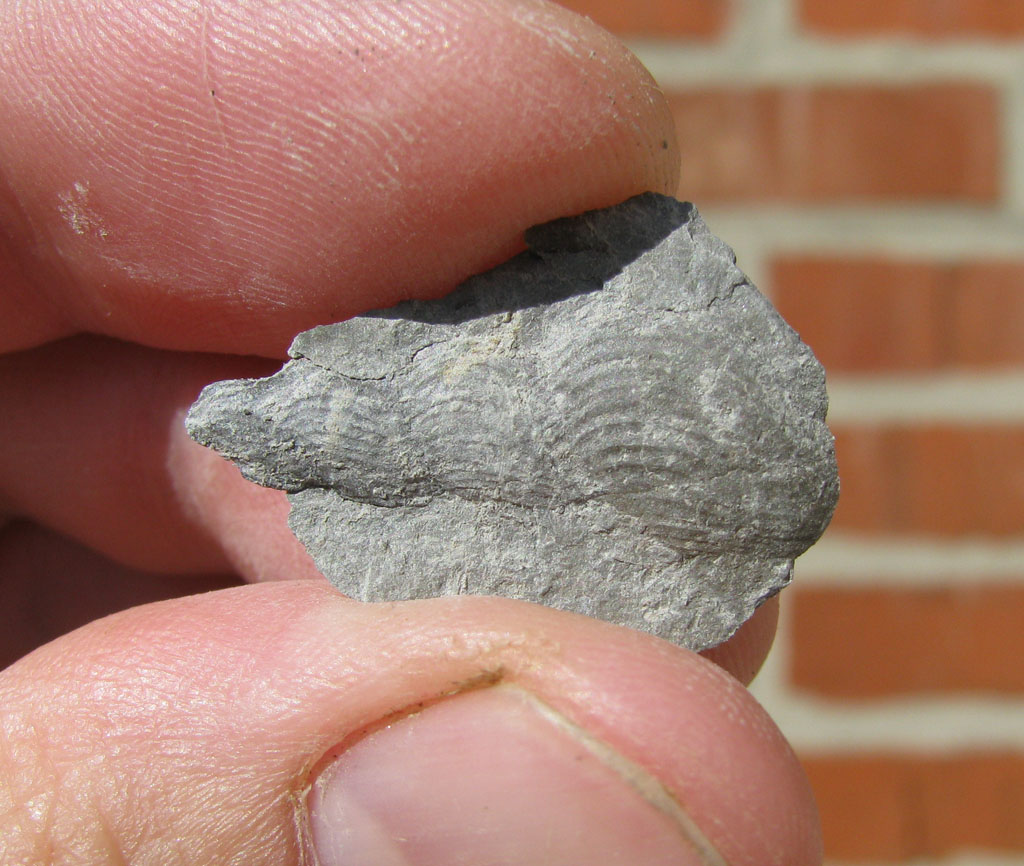
First is this very delicate Paleozygopleura sp. gastropod. It's preserved on both sides of a very thin shale chip. the curved growth lines that can be seen are the tell tale sign of what this is.
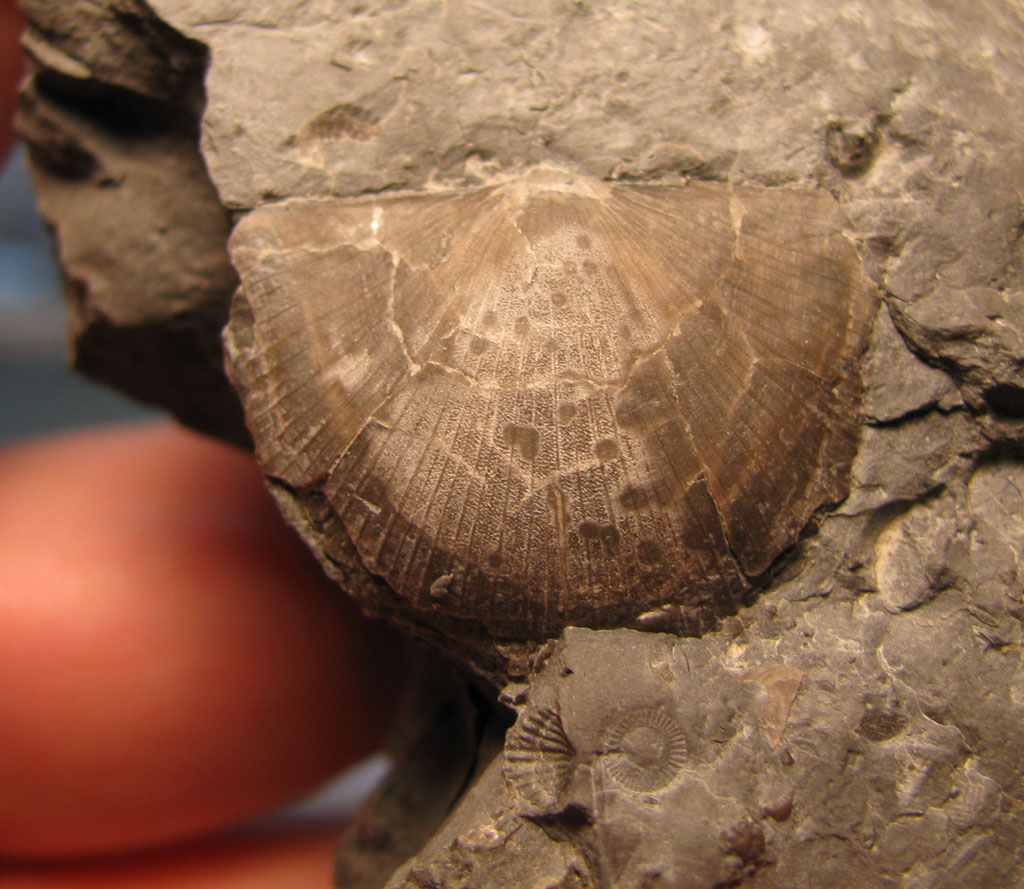
Next up is a Paleoneilo emarginata next to a Rhipidomella penelope brachiopod
Lastly are these Nuculoidea corbuliformis
All three specimens came from the Bay View Coral bed in the Windom shale member of the Moscow Formation (Devonian, Givetian stage).
First is this very delicate Paleozygopleura sp. gastropod. It's preserved on both sides of a very thin shale chip. the curved growth lines that can be seen are the tell tale sign of what this is.
Next up is a Paleoneilo emarginata next to a Rhipidomella penelope brachiopod
Lastly are these Nuculoidea corbuliformis
All three specimens came from the Bay View Coral bed in the Windom shale member of the Moscow Formation (Devonian, Givetian stage).
Monday, June 30, 2014
Rhipidomella penelope brachiopod from the Windom Shale
The other common species of Rhipidomella is R. penelope. It tends to grow larger and have a rounder shell than R. vanuxemi. The specimen below came from the Bay View Coral Bed within the Windom Shale at the Penn Dixie site near Blasdell, NY. It's rare to find a fully inflated specimen and even this one is only partially inflated.
Pedicle valve
Anterior
Pedicle valve
Posterior
Profile
The Windom shale is part of the Moscow Formation which is part of the Givetian stage of the Upper Devonian.
Pedicle valve
Anterior
Pedicle valve
Posterior
Profile
The Windom shale is part of the Moscow Formation which is part of the Givetian stage of the Upper Devonian.
Friday, June 20, 2014
Strophodonta demissa from Penn Dixie
A few specimens of Strophodonta demissa from the Windom Shale (Bay View Coral Bed) as found at the Penn Dixie Site near Blasdell, NY. These are smaller than the specimen I found along Lake Erie and those from Sylvania, OH, but are about the size of those I've found at Arkona.
Specimen #1 (wet because I'd just washed off some light mud)
Specimen #2 (this one is completely dry)
The Windom shale is part of the Moscow Formation which is middle Deovnian (Givetian stage) in age.
Specimen #1 (wet because I'd just washed off some light mud)
Specimen #2 (this one is completely dry)
The Windom shale is part of the Moscow Formation which is middle Deovnian (Givetian stage) in age.
Labels:
Blasdell,
Brachiopod,
Devonian,
New York,
Penn Dixie
Wednesday, June 18, 2014
Dipleura dekayi pygidium from the Windom Shale
At the Penn Dixie site, near Blasdell NY, it is very common to find Phacops rana trilobites and sometimes Greenops sp. trilobites. One of the more rare trilboites to be found there is Dipleura and when you do find them it's often just isolated pieces. Such is the case with the specimen below of a pygidium from a Dipleura dekayi. The fossil is very smooth despite all the dots that you can see on the surface. I'm used to finding specimens of D. dekayi in my local Mahantango formation that don't have any shell material left and the dots are preserved as small columns. This indicates that they served some purpose in life, perhaps as sensory organs?
This specimen was found in the Bay View Coral Bed in the Windom Shale of the Moscow Formation (Devonian, Givetian stage).
Thursday, June 12, 2014
Spirifer consobrinus from the Windom Shale
Spirifer consobrinus is a fossil that is confined to a specific strata within the Windom shale at Penn Dixie and 18 Mile Creek in New York. It's a small brachiopod that resembles Mucrospirifer but has a much shorter hinge line and a larger interarea on the pedicle valve. The pedicle valve's "beak" is also recurved more strongly. It has taken me a few years to really figure this out and I only have a handful of decent specimens.
Specimen #1
Specimen #2
Spirifer consobrinus is well documented in Amadeus Grabau's book "Geology and Paleontology of 18 Mile Creek". It's lends it's name to a zone (layer or bed) within the Windom Shale. The zone is found "two to five feet above the Encrinal Layer" (the Encrinal Layer is now called the Tichenor Limestone). The Windom shale is part of the Moscow Formation and is Devonian (Givetian stage) in age.
Specimen #1
Specimen #2
Spirifer consobrinus is well documented in Amadeus Grabau's book "Geology and Paleontology of 18 Mile Creek". It's lends it's name to a zone (layer or bed) within the Windom Shale. The zone is found "two to five feet above the Encrinal Layer" (the Encrinal Layer is now called the Tichenor Limestone). The Windom shale is part of the Moscow Formation and is Devonian (Givetian stage) in age.
Thursday, February 6, 2014
Favosites hamiltoniae coral from the Tichenor Limestone
Here is a partial specimen from a larger coral head of Favosites hamiltoniae. It's from the Tichenor Limestone member of the Moscow formation and was recovered from the Penn Dixie site at Blasdell, NY. It's not too uncommon to find these at the site as they are regularly turned up when they excavate drainage trenches on the site. The coral heads can reach several feet in size and indicated that the water they grew in was clear and relatively free of sediment (otherwise they would be buried by sediment influx).
This is a side view of the specimen that shows the individual corallites side by side in columns. The regular horizontal platforms were made by the animal as it grew upwards. Every now and again it would lift it's body and make a new shelf below it for support. Each colony increased clonally by budding off the side of a corallite as well as sexually by releasing eggs and sperm into the water. You can see how the central corallites grow more vertically while those that budded later are angled towards the side of the head.
Some of the cells are filled with Chert (white), Calcite (grey) or Dolomite (orange).
This is the top of the piece which still have some shale coating on it that obscures the honeycomb like pattern of the individual corallites.
The Tichenor Limestone is the basal member of the Moscow formation lying directly on top of the Wanakah shale of the Ludlowville formation. It is Devonian period, Givetian stage.
This is a side view of the specimen that shows the individual corallites side by side in columns. The regular horizontal platforms were made by the animal as it grew upwards. Every now and again it would lift it's body and make a new shelf below it for support. Each colony increased clonally by budding off the side of a corallite as well as sexually by releasing eggs and sperm into the water. You can see how the central corallites grow more vertically while those that budded later are angled towards the side of the head.
Some of the cells are filled with Chert (white), Calcite (grey) or Dolomite (orange).
This is the top of the piece which still have some shale coating on it that obscures the honeycomb like pattern of the individual corallites.
The Tichenor Limestone is the basal member of the Moscow formation lying directly on top of the Wanakah shale of the Ludlowville formation. It is Devonian period, Givetian stage.
Saturday, January 11, 2014
Atactotoechus fruticosus bryozoan from the Wanakah Shale
These next two specimens I was sure were a new genus for me but Karl Wilson corrected me and said they were Atactotoechus fruticosus. So they are the same genus as the prior specimens I showed you but these are a different species (with very similar sounding names, thanks Science!). Apparently the difference is the size and height of the monticules (the little mound like shapes that pattern the surface of the colony).
Specimen #1
A nice cross section of the colony.
Specimen #2 needs some cleaning to reveal the detail of the colony.
Karl also pointed out that Atactotoechus used to be part of the genus Monotrypa.
Both specimens were found in the Wanakah shale, Ludlowville Fm. (Givetian stage of the Middle Devonian) along the shore line of Lake Erie near Lake View, NY.
Specimen #1
A nice cross section of the colony.
Specimen #2 needs some cleaning to reveal the detail of the colony.
Karl also pointed out that Atactotoechus used to be part of the genus Monotrypa.
Both specimens were found in the Wanakah shale, Ludlowville Fm. (Givetian stage of the Middle Devonian) along the shore line of Lake Erie near Lake View, NY.
Thursday, January 9, 2014
Atactotoechus furcatus bryozoan from the Windom Shale
I spent an hour or so putting some bryozoan fragments back together and got two nice branching colonies of Atactotoechus furcatus.
A plate of matrix with both shown in position.
The piece on the lower right detaches from it's spot and can be viewed in three dimensions. For purposes of conversation, this is the anterior side.
And this is the posterior side.
A close up of one of the branches shows some of the individual zooids where the animals lived.
This is the other branch which is affixed to the matrix still. I have no intention of removing it and glued other pieces back into place to further stabilize it.
I originally found them while excavating in the shale layer (possibly the Bay View Coral bed) at the Penn Dixie site. They were highly fragmented so I gathered as many pieces as I could find and brought them home. Projects like this are fun because it's like putting a puzzle back together. These specimens were found in the Windom shale member of the Moscow formation (Givetian stage of the middle Devonian) in Blasdell, NY.
Special thanks to Karl Wilson for helping to ID these specimens. He pointed out a similar specimen that he had on one of his New York Paleontology web pages.
A plate of matrix with both shown in position.
The piece on the lower right detaches from it's spot and can be viewed in three dimensions. For purposes of conversation, this is the anterior side.
And this is the posterior side.
A close up of one of the branches shows some of the individual zooids where the animals lived.
This is the other branch which is affixed to the matrix still. I have no intention of removing it and glued other pieces back into place to further stabilize it.
I originally found them while excavating in the shale layer (possibly the Bay View Coral bed) at the Penn Dixie site. They were highly fragmented so I gathered as many pieces as I could find and brought them home. Projects like this are fun because it's like putting a puzzle back together. These specimens were found in the Windom shale member of the Moscow formation (Givetian stage of the middle Devonian) in Blasdell, NY.
Special thanks to Karl Wilson for helping to ID these specimens. He pointed out a similar specimen that he had on one of his New York Paleontology web pages.
Subscribe to:
Posts (Atom)