I've blogged before about Protodouvillina inaequistriata specimens from the Centerfield member of the Ludlowville formation in New York in a prior post. Today I'm showing off a silicified specimen that I found in the dissolved remains of some limestone from the same locality. It is in great condition, has both valves and an interesting color pattern. I think the pattern is related to how much of the original shell was actually replaced with quartz. The shell also has some very nice looking "Beekite" rings
Pedicle valve
Anterior
Brachial valve
Posterior
Profile
As I mentioned above, this specimen has been replaced with quartz and I dissolved it from a limestone block using dilute Hydrochloric Acid. It comes from the Centerfield member of the Ludlowville formation (Devonian, Givetian stage) near East Bethany, NY.
Showing posts with label Ludlowville Formation. Show all posts
Monday, May 30, 2016
Sunday, March 15, 2015
Delthyris sculptilis brachiopod from the Centerfield Fm.
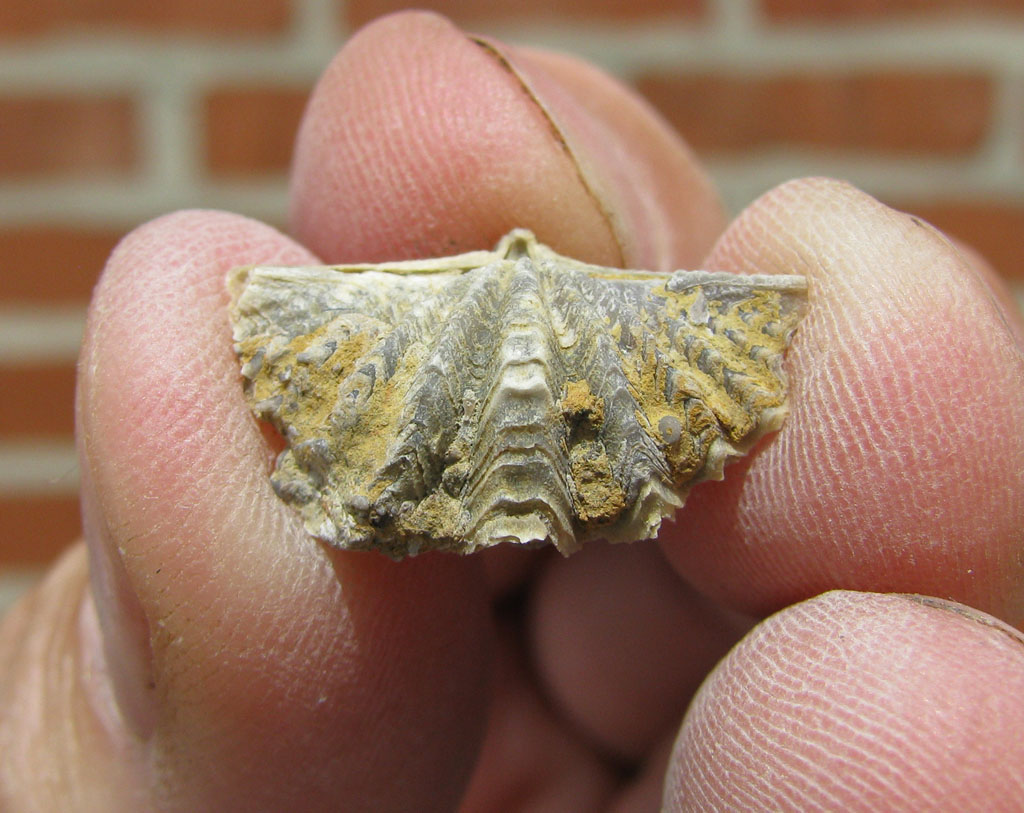
Today's fossil is Delthyris sculptilis which is an appropriate name due to the high relief and heavy decoration on the shell. D. sculptilis has a long hinge line connecting the pedicle and brachial valves. Each valve is deeply incised by plications to the point that there does not appear to be a lot of room for the body. The shell has very obvious growth lines that help decorate the shell and perhaps prevented predators or parasites from gaining a foothold.
Brachial valve
Anterior
Pedicle valve
Posterior
Profile
This specimen came from the Centerfield mbr. of the Ludlowville formation (Devonian, Givetian stage) near East Bethany NY. I've posted before about this species from the Hungry Hollow mbr. of the Widder formation (Contemporaneous with the Centerfield mbr.) and a similar species from the Irondequoit limestone. Delthyis is also similar to Kozlowskiellina velata from the Haragan formation of Oklahoma.
Brachial valve
Anterior
Pedicle valve
Posterior
Profile
This specimen came from the Centerfield mbr. of the Ludlowville formation (Devonian, Givetian stage) near East Bethany NY. I've posted before about this species from the Hungry Hollow mbr. of the Widder formation (Contemporaneous with the Centerfield mbr.) and a similar species from the Irondequoit limestone. Delthyis is also similar to Kozlowskiellina velata from the Haragan formation of Oklahoma.
Tuesday, February 3, 2015
Devonochonetes scitulus brachiopod from the Ludlowville formation
As I mentioned in my last post, Chonetid type brachiopods are tough to get a good ID on unless you have the delicate spines that emerge from the valve hinge line preserved. I was pleased to find one of the shells I'd found from the Geer Rd. locality (Upper Ludlowville formation, Devonian, Givetian stage) was a Longispina mucronata and so went back through my other findings to see if I could find any more. Lucky for me there was another specimen with spines present.
On this chunk of rock are a few stray Chonetid brachiopods but the well preserved specimen in the center right has a spine or two preserved.
A closer view with my camera reveals a single spine on the right side of the shells hinge line that is poking out at an angle.
Like with the Longispina mucronata specimen, I took this one up to my microscope to get a better picture. There is a single well preserved spine and what looks like the base of another just to the left of it. Based on the angle and location of the spine I would say that this specimen is a Devononchonetes scitulus (which has three to six spines extending from the hinge line, at an angle away from the shell), my first truly confirmed specimen of this species!
Specimens, such as these from the Arkona and Widder formations, have a similar shell size and ornamentation, and I've referred to them as D. scitulus, but I've not found any with spines that would confirm my theory.
On this chunk of rock are a few stray Chonetid brachiopods but the well preserved specimen in the center right has a spine or two preserved.
A closer view with my camera reveals a single spine on the right side of the shells hinge line that is poking out at an angle.
Like with the Longispina mucronata specimen, I took this one up to my microscope to get a better picture. There is a single well preserved spine and what looks like the base of another just to the left of it. Based on the angle and location of the spine I would say that this specimen is a Devononchonetes scitulus (which has three to six spines extending from the hinge line, at an angle away from the shell), my first truly confirmed specimen of this species!
Specimens, such as these from the Arkona and Widder formations, have a similar shell size and ornamentation, and I've referred to them as D. scitulus, but I've not found any with spines that would confirm my theory.
Sunday, February 1, 2015
Longispina mucronata brachiopod from the Ludlowville formation
I picked up this slab of chonetid type brachiopods while visiting a small quarry off Geer Rd. in Madison County, NY. The rock found there is a portion of the Upper Ludlowville formation (Devonian, Givetian stage) which has these zones of shell "pavement". Most of the shells I can't really identify beyond "Chonetid type" because to distinguish between the genra you'd need to see if they had spines growing off the hinge line. As the spines are delicate they often get broken off before the shell gets buried.
I was happy enough with the slab as is but, as I looked at some of the individual shells more closely, I found one that appeared to have spines preserved. I always do a happy dance when this happens but especially so in this case because I was able to determine that the species is Longispina mucronata.
The slab
A close up view of the shell. You can see the horizontal spine poking out of the left side of the hinge line.
Not satisfied with just a close view from my camera I took the piece up to my microscope and took a picture there. Here is a much closer view of the spine and I was pleased to see two more parallel to it coming from points farther in along the hinge line.
I've annotated this version of the above picture with what I interpret are the spines in white and the shell outline in red.
I have found a shell that I've called Longispina before in the Mahantango Formation (Devonian, Givetian stage) of PA, but this specimen looks a little different.
I also have a specimen that is labelled as Longispina lissohybus from the Silica Shale (Devonian, Givetian stage) of OH, but there are no spines preserved on that specimen.
I was happy enough with the slab as is but, as I looked at some of the individual shells more closely, I found one that appeared to have spines preserved. I always do a happy dance when this happens but especially so in this case because I was able to determine that the species is Longispina mucronata.
The slab
A close up view of the shell. You can see the horizontal spine poking out of the left side of the hinge line.
Not satisfied with just a close view from my camera I took the piece up to my microscope and took a picture there. Here is a much closer view of the spine and I was pleased to see two more parallel to it coming from points farther in along the hinge line.
I've annotated this version of the above picture with what I interpret are the spines in white and the shell outline in red.
I have found a shell that I've called Longispina before in the Mahantango Formation (Devonian, Givetian stage) of PA, but this specimen looks a little different.
I also have a specimen that is labelled as Longispina lissohybus from the Silica Shale (Devonian, Givetian stage) of OH, but there are no spines preserved on that specimen.
Thursday, January 22, 2015
Possible Monoplacophoran fossil from the Ludlowville formation
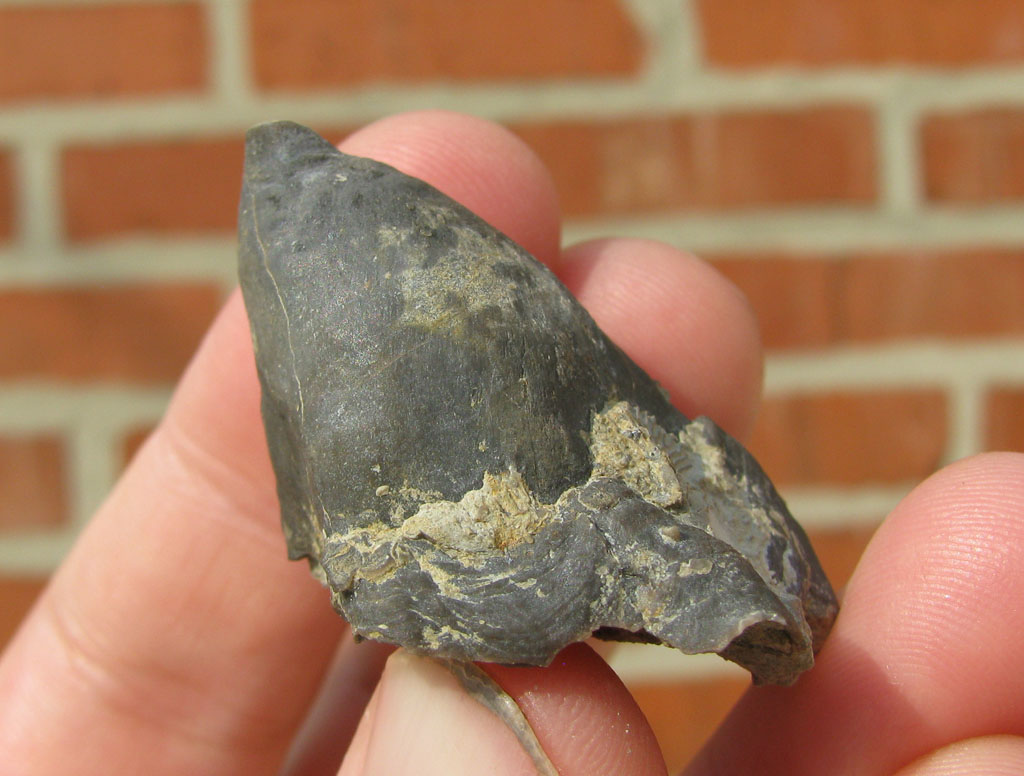
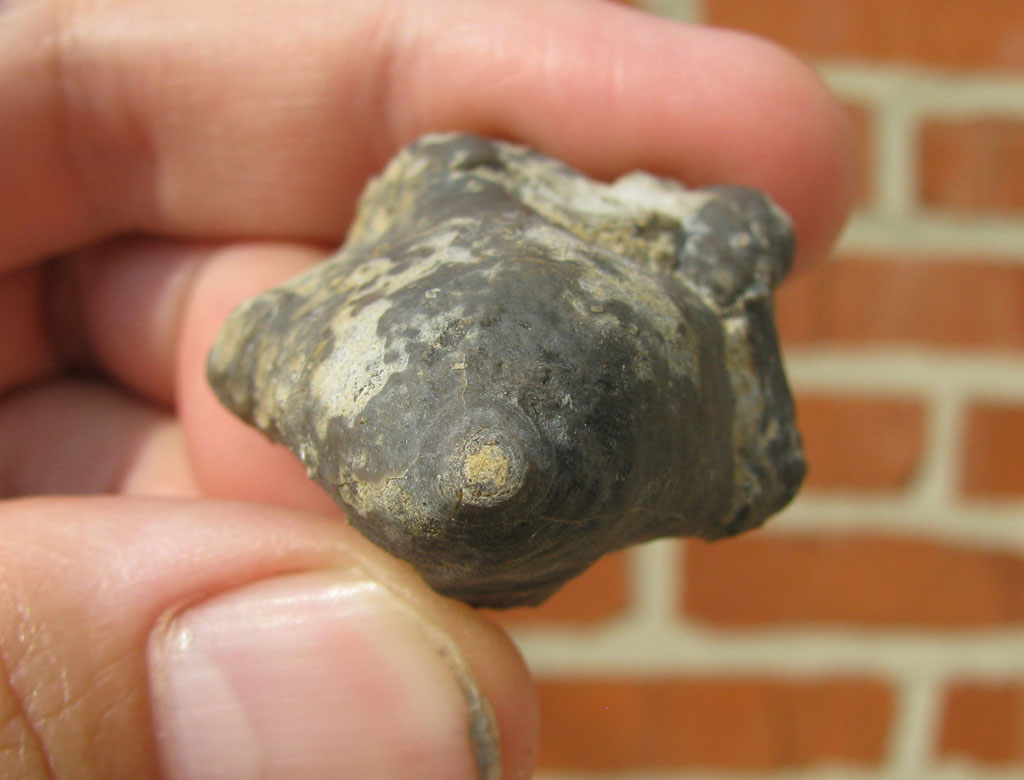
Sometimes you make good finds not in the field but at home when you are sorting through your finds. The fossil below is such an example.When I picked it up I probably thought it was an inarticulate brachiopod but as I cleaned it up and looked more closely it seems to me that it might be something different. When you look at it in profile the very tip of the shell appears to point backwards rather than straight up. If this were an inarticulate brachiopod I would expect the tip to be straight or very muted. There also appears to be a hole in the tip of the shell which could indicate that the tip broke off or maybe it is supposed to be that way (anal opening?). My instincts are telling me this could be a Monoplacophoran which is a mollusk similar to a gastropod or snail but different enough to not be included with them. Still I am unsure as I can not find any information on Monoplacophorans being found within the Hamilton group.
I have found Monoplacophorans before but they came from the Ordovician of the Verulam formation.
Sunday, January 18, 2015
Nucula bellistriata pelecypod from the Ludlowville Fm.
It's rare to find whole Peleycpod shells with no distortion so I was quite pleased to find this Nucula bellistriata fossil. It comes from the upper Ludlowville Formation (Devonian, Givetain stage) at Geer Rd. Quarry in Madison County, NY. Both valves are present and it even appears that one valve may still be preserved with shell material. It would be nice if the hinge line were better exposed but there is a stubborn piece of rock still clinging to that section of the fossil.
Right valve
Anterior
Left valve
Left profile
Right profile
Posterior
The Devonian rocks of Madison county are closer in composition to those of my local Devonian rock, the Mahantango formation. I've found this same genera in the Mahantango with both valves but it is preserved as a internal steinkern (cast) with no external features.
Right valve
Anterior
Left valve
Left profile
Right profile
Posterior
The Devonian rocks of Madison county are closer in composition to those of my local Devonian rock, the Mahantango formation. I've found this same genera in the Mahantango with both valves but it is preserved as a internal steinkern (cast) with no external features.
Friday, December 5, 2014
Lindstroemella sp. brachiopod from the Centerfield Mbr.
The partial shell below is likely from an inarticulate brachiopod called Lindstoemella sp. It came from the Centerfield mbr. of the Ludlowville Fm. near Fayette, NY. This would have been the top valve of the animal since the bottom valve was likely cemented to a hard surface.
It is interesting to note the differences in the rock type of the Centerfield member between two geographically distant locations. Normally I collect fossils from this rock unit that are eroding out of a grey limestone near East Bethany, NY. This fossil came from Fayette, NY, which is 66 miles due east, and is more argillaceous (has more clay minerals). This is significant in that it shows different depositional environments occurring at roughly the same time intervals which leads to thoughts of why that would happen.
The theory is that an ocean basin that existed in the Devonian over much of western and central New York, was slowly being filled in from the east by rivers eroding the rising Appalachian Mountains as continents were coming together to form Pangea. Rocks with a higher clay content are generally found closer to shore while limestone is a clean, open water rock. So the open sea was in the western part of the state and the shoreline was progressively moving east to west as sediments were carried from the land.
It is interesting to note the differences in the rock type of the Centerfield member between two geographically distant locations. Normally I collect fossils from this rock unit that are eroding out of a grey limestone near East Bethany, NY. This fossil came from Fayette, NY, which is 66 miles due east, and is more argillaceous (has more clay minerals). This is significant in that it shows different depositional environments occurring at roughly the same time intervals which leads to thoughts of why that would happen.
The theory is that an ocean basin that existed in the Devonian over much of western and central New York, was slowly being filled in from the east by rivers eroding the rising Appalachian Mountains as continents were coming together to form Pangea. Rocks with a higher clay content are generally found closer to shore while limestone is a clean, open water rock. So the open sea was in the western part of the state and the shoreline was progressively moving east to west as sediments were carried from the land.
Saturday, November 29, 2014
Platyceras conicum from the Centerfield member
Among my recent finds from the Centerfield member of the Ludlowville formation is this specimen of Platycers conicum. As you can see it has a very vertical profile with little to no curving of the shell. As it is well known that some species of Platyceras were parasites of Crinoids, by stationing themselves directly above the anal pore so as to get free meals, perhaps this conical shape was adapted towards a specific Crinoid species?
I've found similar examples in the Hungry Hollow member of the Widder formation in Canada.
Saturday, September 6, 2014
Aulocystis auloporidea coral from the Centerfield limestone
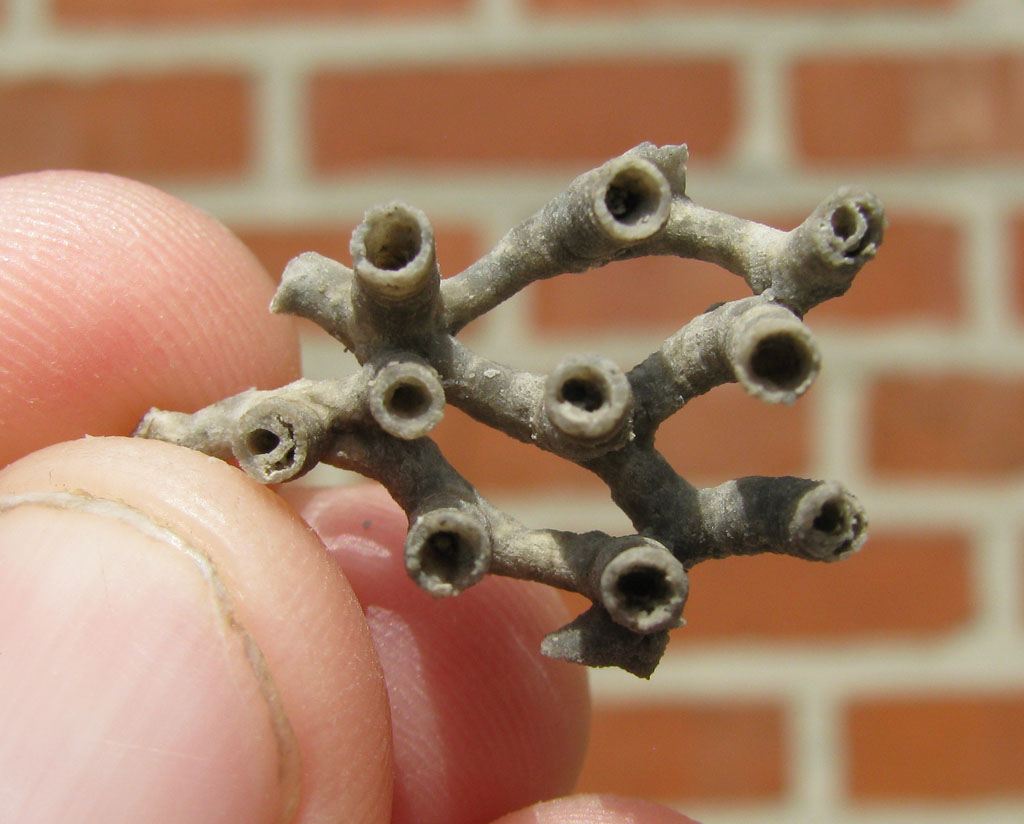
One of the sites I visit, that exposes the Centerfield limestone, has chunks of limestone in which the fossils contained within are partially replaced by Quartz. The easiest way to expose these fossils is by dissolving the surrounding limestone with acid. The specimen below is from the residue of such a piece of limestone. It is an interconnected series of coral calices that I believe is Aulocystis auloporideas. I made the ID after visiting this page at the Falls of Ohio website, but it seems to disagree with a specimen that I have from the Silica Shale. So I will keep the label as is for now in hopes of getting a more accurate ID in the future.
The specimen above came from limestone that belonged to the Centerfield member of the Ludlowville formation (Devonian, Givetian stage) near East Bethany, NY.
Saturday, June 28, 2014
Rhipidomella vanuxemi brachiopod from the Centerfield member
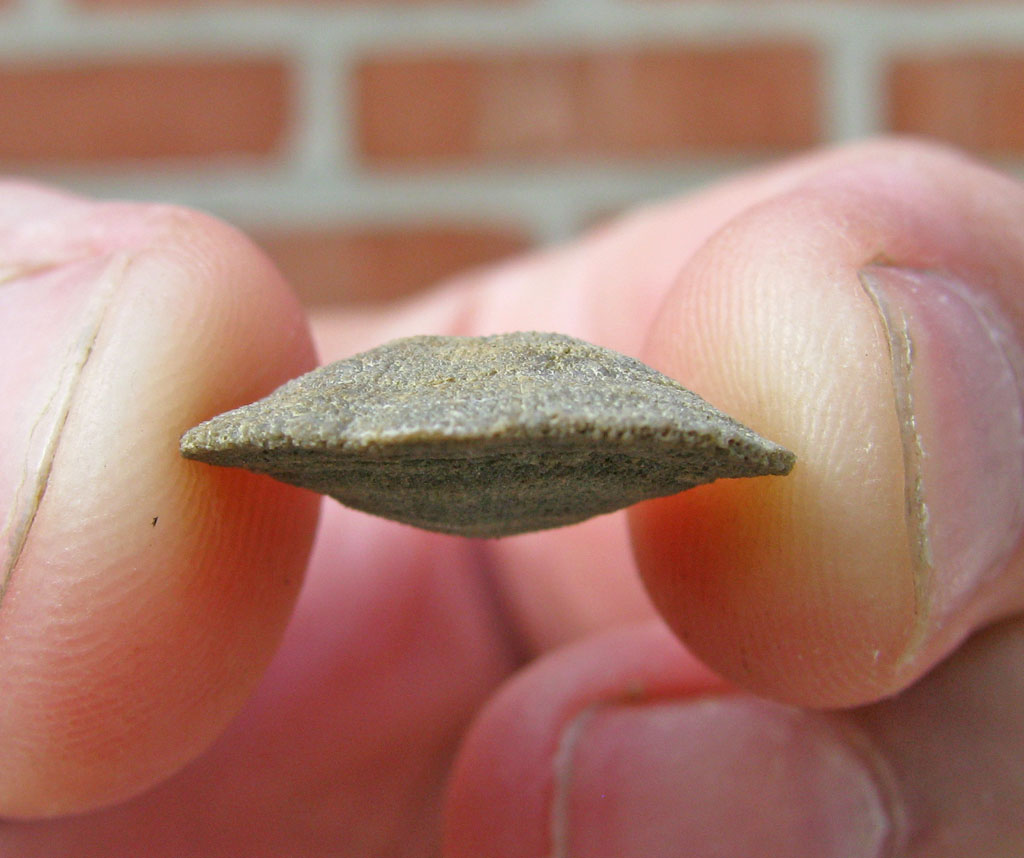
One of the two main species of the Rhipidomella genus found in the middle Devonian is Rhipidomella vanuxemi. It's fairly common and can be distinguished from the similar species R. penelope as it is typically smaller in size and the shape of the shell is less ovate. The fossil below is partially replaced by Quartz which is why the shell has some gray (Calcite) and white (Quartz) patches. It was found in the Centerfield member of the Ludlowville formation and is fairly common.
Brachial valve
Anterior
Pedicle valve
Posterior
Profile
Here is a second specimen which has a rare predation hole in the pedicle valve.
Brachial valve
Anterior
Pedicle valve
Closer view of the hole
Posterior
Profile
The Centerfield mbr. of the Ludlowville formation records a portion of the Givetian stage of the Devonian period.
Brachial valve
Anterior
Pedicle valve
Posterior
Profile
Here is a second specimen which has a rare predation hole in the pedicle valve.
Brachial valve
Anterior
Pedicle valve
Closer view of the hole
Posterior
Profile
The Centerfield mbr. of the Ludlowville formation records a portion of the Givetian stage of the Devonian period.
Subscribe to:
Posts (Atom)