Showing posts with label Oligocene. Show all posts

Saturday, March 7, 2020

Poebrotherium sp. jaw section from the Brule formation

Back during the Oligocene period there were lots of weird mammals running around that would evetually evolve into the modern forms we know today. One of these was Poebrotherium sp. which roamed the plains of the upper Midwest US. It's remains are found in the Brule formation which is a sub-unit of the famous White River formation.  Poebrotherium sp. was about the size of sheep but was more closely related to camels and llamas. According to Wikipedia, Poebrotherium sp. was a grass eater and was the equivalent of the modern gazelle or deer. The specimen below was one that I purchased primarily for the color of the jaw bone which looks like a nice piece of marble.


The Brule formation is a sub unit within the White River formation and was deposited roughly 32 mya during the Oligocene (Rupelian stage). This specimen was found on private land in Nebraska.

Friday, February 28, 2020

Carcharocles angustidens teeth from the Belgrade/River Bend formation

In a bag of fossil shark teeth that I purchased I found a number of these triangular shaped teeth. The bag was labelled "Belgrade Quarry" with no other information. I spent a hour or so looking for fossil shark tooth pictures on Google Images that matched what I had and the closest were Carcharocles angustidens. A quick posting to the Fossil Forum website confirmed that these were indeed C. angustidens teeth and that they could be found at the Belgrade quarry.

More web searches ultimately led me to Wikipedia and to the follow logic: These fossils come from the Belgrade quarry in North Carolina. Rocks exposed in that quarry range from the Eocene to the Miocene epochs. C. angustidens existed in the late Oligocene and early Miocene (33-22 mya, Rupelian stage to Aquitanian stage).  That narrows the formations they could have been found in to the River Bend formation (Late Oligocene) and the Belgrade formation (Early Miocene). Both of those formations at one point or another were considered part of the Trent marl which was originally dated to the Eocene epoch. Oh yeah, and C. angustidens was an relative of the Megalodon (no biggie) 1,2,3.

It's nice to have a little bit more information on these fossils as they are a species I did not have in my collection previously. Three of the specimens below would have been found on the front of the shark's jaw while the last one has a little bit more of a curve in it so likely came from along the side or back of the jaw.

Specimen 1


Specimen 2


Specimen 3


Specimen 4


These teeth were found at the Belgrade Quarry near Maysville, in North Carolina in the Belgrade /River Bend formations.

1. Wikipedia - Carcharocles angustidens article
2. Wikipedia - Belgrade formation article
3. Wikipedia - River Bend formation article

Saturday, October 18, 2014

Rhyncholampas gouldii echinoid from Florida

Here we have a Rhyncholampas gouldii echinoid from FL. It was found in the Oligocene aged Suwannee Limestone southeast of Tallahassee. It is very similar in appearance to the genus Hardouinia (Cretaceous) but is found much later in the geologic column.

Adapical surface (top)
Anterior
Right profile
Posterior
Left profile
Adoral surface (underside or bottom)

The label that was originally included with this specimen listed it as Rhynchopygus but that genus is only valid in the late Cretaceous of Europe.

Sunday, February 3, 2013

Clypeaster rogersi echinoid from Alabama

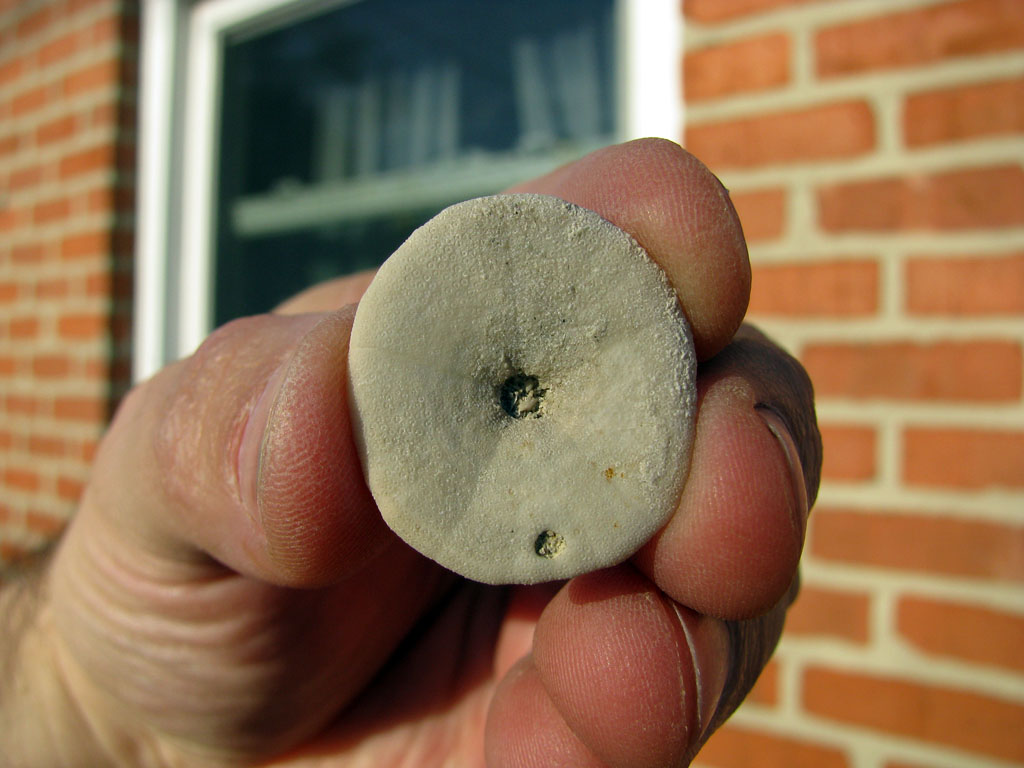
Compared to the last Clypeaster that I featured on my blog, Clypeaster rogersi is much much smaller. It still has the typical features of the genera, namely a central mound shape in the center on the top (adapical) surface and an overall round shape to the test (exoskeleton). The size is not determinative of the species as there are specimens in the 7cm range known from Georgia.

Adapical (top) surface
Anterior (side the farthest from the anal pore)

Adoral (bottom or underside)
Side profile


This specimen comes from the early Oligocene (Rupelian stage) aged Mariana formation of Mississippi.

Here is a general write up of the species and how to differentiate it from another common species found in the same aged rocks.

This site has an official description of the species including some typical occurrence areas in the US, Cuba and Mexico.

Friday, August 12, 2011

Mummified walnut and misc plant debris

Today I want to show you a couple of interesting fossils from France. The first is a walnut (Juglans bergomensis) seed. This fossil was found in the Alsace region of France and can also be found in the Netherlands and Germany within Pliocene aged lignite that was once deposited by ancient rivers. These fossils are often called Mummified due to their dessicated look. They have been preserved and partially silicified by the muddy river sediments.


This next specimen is of some reedy plant debris that came from a lacustrine (freshwater lake) deposit near Cereste in the south of France. The sediments have been dated to the Oligocene epoch of the Tertiary period. While the plant remains are not easy to identify, there is a small Planorbis snail near the bottom left hand side. This is an index fossil that can be used to tell if the sediments were deposited in fresh or salt water as it can only be found within lake and river deposits.


Thanks you to Gery for sending me these specimens.