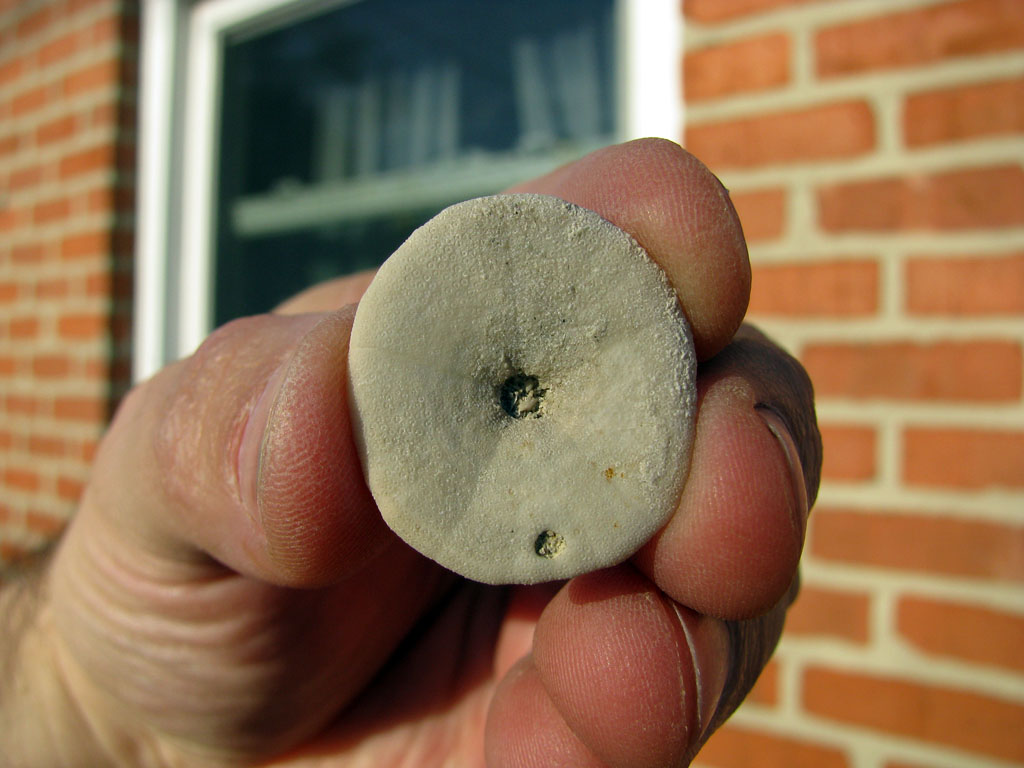
Blastoids are a favorite fossil group of mine, possibly because I find so few and they are so strange. Here is a Cryptoblastus melo from the Burlington Limestone near Sedalia, Missouri. It's still embedded in the matrix but sticks up a little to make for a nice presentation.
The Burlington Limestone is dated to the Osagen stage (N American series) or the Tournaisian to Visean stages (ICS series) of the Mississippian (Lower Carboniferous).
Showing posts with label Mississippi. Show all posts
Tuesday, July 9, 2013
Sunday, February 3, 2013
Clypeaster rogersi echinoid from Alabama
Compared to the last Clypeaster that I featured on my blog, Clypeaster rogersi is much much smaller. It still has the typical features of the genera, namely a central mound shape in the center on the top (adapical) surface and an overall round shape to the test (exoskeleton). The size is not determinative of the species as there are specimens in the 7cm range known from Georgia.
Adapical (top) surface
Anterior (side the farthest from the anal pore)
Adoral (bottom or underside)
Side profile
This specimen comes from the early Oligocene (Rupelian stage) aged Mariana formation of Mississippi.
Here is a general write up of the species and how to differentiate it from another common species found in the same aged rocks.
This site has an official description of the species including some typical occurrence areas in the US, Cuba and Mexico.
Adapical (top) surface
Anterior (side the farthest from the anal pore)
Adoral (bottom or underside)
Side profile
This specimen comes from the early Oligocene (Rupelian stage) aged Mariana formation of Mississippi.
Here is a general write up of the species and how to differentiate it from another common species found in the same aged rocks.
This site has an official description of the species including some typical occurrence areas in the US, Cuba and Mexico.
Subscribe to:
Posts (Atom)