From time to time one can find evidence of the growing forests that were spreading during the middle Devonian. Below is an example of what I believe to be a branch from an ancient tree that was washed out to sea and buried in the mud. There are no real diagnostic features that can tell me what it used to belong to but the fossils' linear growth and a 90 degree turn on part of it rules out that it could be a trace fossil from a burrowing animal. If this were a trace fossil the 90 degree turn would blend in better with the rest of the fossil and not look like a separate branching structure. Besides, most natural burrows or trace fossils do not make 90 degree bends parallel to the rest of the trace. It could have belonged to one of the fossil trees known from this era: Cladoxylopsids or Archaeopteris.
Check out the article about the oldest known fossil forest being found in New York near Cairo which is south and east of the locality where I found this fossil.
Specimen #1
Specimen #2
I've also found evidence of fossil branches washed out to sea in the Mahantango formation of Pennsylvania which is contemporaneous to the Moscow formation.
These specimens were found at a borrow pit on Deep Springs Road in Madison County, NY which exposes the Windom shale member of
the Moscow formation (middle Devonian in age, Givetian stage.)
Showing posts with label Plants. Show all posts
Wednesday, April 22, 2020
Sunday, March 15, 2020
Salix sp. leaf from the Green River formation
This long, narrow leaf is most likely from a member of the Willow family, Salix sp. and comes from the Parachute Creek member of the Green River formation (Eocene, Lutetian stage). It was found in Bonanza, Utah and I purchased it because it came with an ID. I am hoping that I can use this and other identified specimens that I purchase to help ID fossils that I have found in the field. There are not many resources easily accessible that show pictures and names for plant and insect fossils from the Green River formation. I know I have found other examples of Salix sp. that are larger and more recognizable than this specimen but I need to go through my findings and locate it.
Labels:
Bonanza,
Eocene,
Green River Formation,
Plants,
Utah
Friday, March 13, 2020
Cardiospermum coloradensis leaf from the Green River formation
Soapberry plants are typically found in the tropics and their presence in a northerly latitude like where NE Utah is indicates that the climate used to be much warmer than it is now. Below is a leaf from the Soapberry family, called Cardiospermum coloradensis, that is also called "Balloon Vine". Fossils of these leaves are somewhat common in the Parachute Creek member of the Green River formation (Eocene, Lutetian stage), but most of what I have found are smaller. I purchased this piece because of the good preservation and size of the leaf. I identified it based on this image from James St. John's Flickr page.
Labels:
Bonanza,
Eocene,
Green River Formation,
Plants,
Utah
Wednesday, March 11, 2020
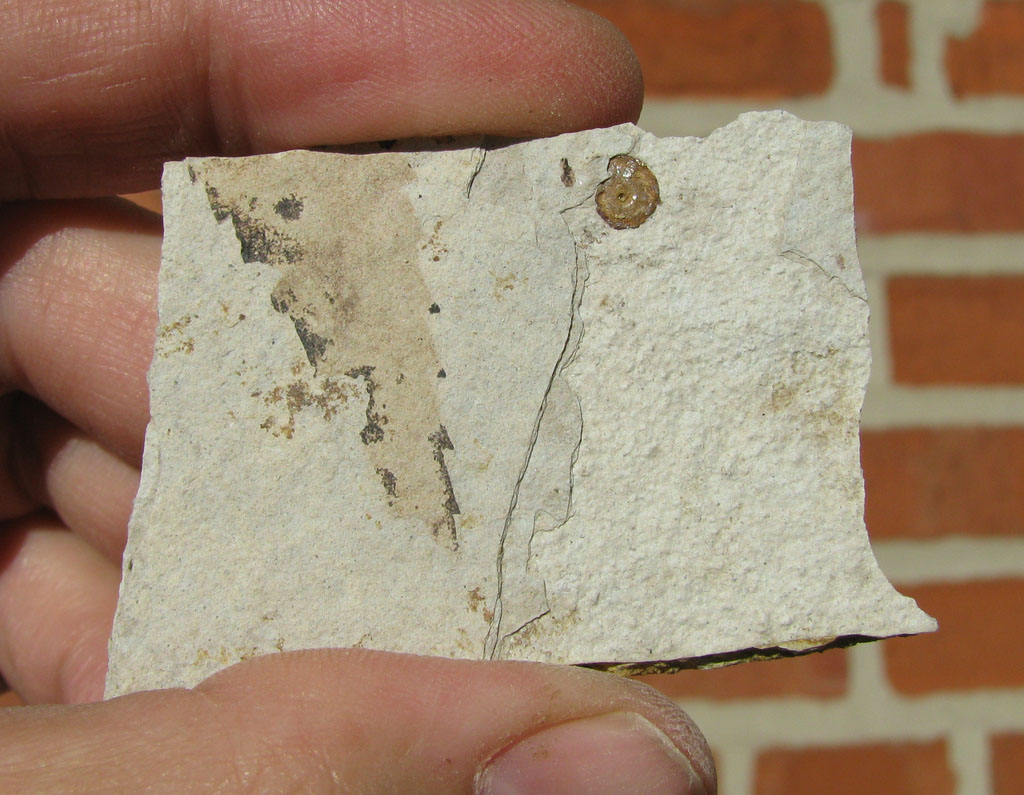
Caesalpinites sp. leaf from the Green River formation
Here is another fossil leaf from the Parachute Creek member of the Green River formation (Eocene, Lutetian stage) that I purchased because it came with an ID. It's a leaf called Caesalpinites sp. The fossil is small and somewhat faint against the rock but you can make out the central vein and overall shape of the leaf. This specimen comes from a site near Bonanza, Utah. I'm having a hard time finding any more info about this genus to try and narrow down the species. I've seen other leaves labelled as Caesalpinites falcata from the same area but they look different than my specimen. It could be a different species or maybe the plant had different shaped leaves on different areas.
Labels:
Bonanza,
Eocene,
Green River Formation,
Plants,
Utah
Wednesday, February 26, 2020
Dinophyton spinosus Plant fossil from the Stockton formation
Dinophyton spinosus is an odd plant that is found in the late Triassic of rocks across the US. It's often found as a small branch or sprig of tiny rounded leaves. Paleontologists have been trying to figure out how it fits within the evolution of plants but have so far been frustrated. What research I have found (Source 1, Source 2, Source 3)says that it is a gymnosperm (it's seeds are not protected by a fruit) which puts it close to conifers, Ginko's and cycads. The specimens below come from the late Triassic aged Stockton formation near Phoenixville, PA. This is practically in my back yard and I'd never heard, let alone seen anything like these before.
During the late Triassic, Southeastern PA was a rift zone as Pangea split up. The Stockton formation was deposited on a level plain during drier, savanna like conditions. It inter-tongues with the Lockatong formation which represents lake sediments that would wax and wane as the climate changed. The specimens below were probably preserved in small, temporary ponds.
Sample 1 - Just a small leaf cluster on this piece.
Sample 2 - This piece has a few more sprigs of Dinophyton spinosus.
Previously, I blogged about some Conchostracans that I found from the Lockatong formation.
The Stockton formation is dated to the Triassic, roughly Carnian stage. I purchased these fossils in 2018.
Tuesday, May 24, 2016
Results from a short visit to the Florissant Fossil Quarry
As part of my vacation last fall I had an hour or so to kill in my schedule and happened to be passing near Florissant, Co. The town is well known for the Florissant Fossil Beds National Monument which preserves an ancient lake bed from the Eocene that was near a field of volcanoes. The volcanoes would erupt with lots of ash and this would rain onto the lake and the surrounding environment. As the ash settled it would cover anything that happened to be floating on or above the lake surface. The ash layers deposited as thin films and millions of years later have been compressed into "paper" shale (so called because each layer is as thin as a sheet of paper). Splitting the shale is easy but also hard. You have to use a very thin, sharp blade (a razor blade is perfect) to split the fine layers. If you are lucky you will find an insect or plant trace from long ago.
Outside of the park boundaries is a fee quarry, on private land, that allows you to split some of the paper thin shale and keep the fossils you find. It's called the Florissant Fossil Quarry and I've been to this site several times over the years. You can see some of the other fossils I've collected by clicking here, here, here, or here. This trip only allowed me a hour but I found a few interesting specimens.
This is a small snail with a partial leaf. The shell has been crushed but you can still see some of the shiny nacre.
A beech or elm type leaf
A seed of some sort, although it looks like the seed itself is missing and only the surrounding "wings" are left. This looks similar to slippery elm seeds.
Lastly, a fly or bee (wasp?) of some sort. The preservation is not the best and it looks better from a distance than up close.
The Florissant fossil beds are called the Florissant formation and are dated to the latest Eocene epoch (Priabonian stage) of the Paleogene.
Outside of the park boundaries is a fee quarry, on private land, that allows you to split some of the paper thin shale and keep the fossils you find. It's called the Florissant Fossil Quarry and I've been to this site several times over the years. You can see some of the other fossils I've collected by clicking here, here, here, or here. This trip only allowed me a hour but I found a few interesting specimens.
This is a small snail with a partial leaf. The shell has been crushed but you can still see some of the shiny nacre.
A beech or elm type leaf
A seed of some sort, although it looks like the seed itself is missing and only the surrounding "wings" are left. This looks similar to slippery elm seeds.
Lastly, a fly or bee (wasp?) of some sort. The preservation is not the best and it looks better from a distance than up close.
The Florissant fossil beds are called the Florissant formation and are dated to the latest Eocene epoch (Priabonian stage) of the Paleogene.
Friday, March 13, 2015
Paleocene fossils from the Sentinel Butte formation
The fossils that are found in the Sentinel Butte Formation of North Dakota always grab my eye when the I see them. Usually I see a piece of brown-tan shale with a Ginkgo leaf impression on it and I'm immediately drawn in.The Sentinel Butte formation was deposited as part of a large basin called the Williston Basin during the late Paleocene period (Thanetian stage). The portion of the formation that contains the fossils I am most interested in comes from isolated clay lenses deposited in abandoned channels which were then later enriched with iron and silica.(1) The silica is key as that is what helps to preserve the amazing detail of the plant fossils that are found within.
One of the pieces I have is somewhat thick and you can see some interesting sedimentary structures when viewing a section that was cut.
Here are some of the fossils from the Sentinel Butte formation that are in my collection:
A maple seed with the thin veins from along the "wing" preserved in nice detail.
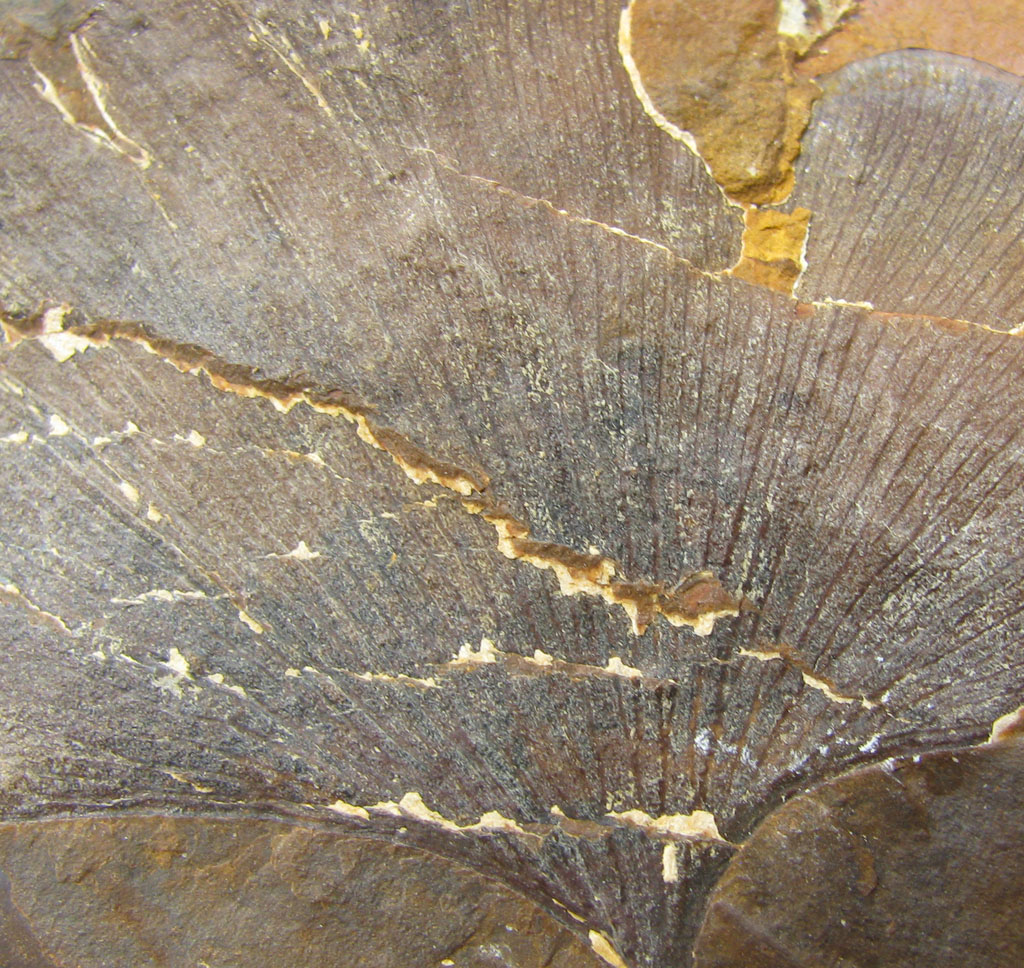
A ginkgo leaf, likely Ginkgo adiantoides. I have a couple of Ginkgo leaves from the Sentinel Butte formation since they are my favorite tree. Another one of my specimens was part of an early post on my blog.
This piece has two distinct plant fossils on it.
The first is a seed from a Cyclocarya brownii tree. This species, related to walnuts, has modern relatives living in China but is no longer found naturally in North America (just like Gingkos!).
The other fossil is of some kind of conifer, possibly a Metasequoia.
After reading the paper below, I know now that most of the fossils from the Sentinel Butte formation come from the Almont, North Dakota area although there was another site found near Beicegel creek, ND with similar preservation and flora.
1.) Pigg, Kathleen B., and MELANIE L. DeVore. "Floristic composition and variation in late Paleocene to early Eocene floras in North America." Bulletin of Geosciences 85.1 (2010): 135-152.
One of the pieces I have is somewhat thick and you can see some interesting sedimentary structures when viewing a section that was cut.
Here are some of the fossils from the Sentinel Butte formation that are in my collection:
A maple seed with the thin veins from along the "wing" preserved in nice detail.
A ginkgo leaf, likely Ginkgo adiantoides. I have a couple of Ginkgo leaves from the Sentinel Butte formation since they are my favorite tree. Another one of my specimens was part of an early post on my blog.
This piece has two distinct plant fossils on it.
The first is a seed from a Cyclocarya brownii tree. This species, related to walnuts, has modern relatives living in China but is no longer found naturally in North America (just like Gingkos!).
The other fossil is of some kind of conifer, possibly a Metasequoia.
After reading the paper below, I know now that most of the fossils from the Sentinel Butte formation come from the Almont, North Dakota area although there was another site found near Beicegel creek, ND with similar preservation and flora.
1.) Pigg, Kathleen B., and MELANIE L. DeVore. "Floristic composition and variation in late Paleocene to early Eocene floras in North America." Bulletin of Geosciences 85.1 (2010): 135-152.
Monday, December 1, 2014
Devonian fossil wood from the New Albany shale in Kentucky
I was going through some of my boxes of Devonian material the other day and came across some specimens of coalified wood that I'd found a few years back in Kentucky. The fossils were found at a location where some rock had been dumped as fill. I'd been alerted to the location by a member of the Fossil Forum who'd found a piece of fish bone at the same location. I didn't find any bone but these carbonized impressions were pretty cool so I picked up what I could find. I'd forgotten about them until I pulled this flat out of a box.
I have no idea what species of plant they came from but they sort of look like the Calamites stems I find in Pennsylvanian aged rocks. These fossils come from rock that I think belongs to the New Albany Shale which is upper Devonian in age. I do have a piece of petrified wood from the New Albany Shale that I blogged about here, but it does not look quite the same as what I collected.
Here is a panoramic view of the collecting locality as it existed in 2009.
I have no idea what species of plant they came from but they sort of look like the Calamites stems I find in Pennsylvanian aged rocks. These fossils come from rock that I think belongs to the New Albany Shale which is upper Devonian in age. I do have a piece of petrified wood from the New Albany Shale that I blogged about here, but it does not look quite the same as what I collected.
Here is a panoramic view of the collecting locality as it existed in 2009.
Friday, November 14, 2014
Fossil Paleosol with root impressions
While exploring an old coal strip mine in Gilberton, PA I noticed that
there was an exposed wall of rock that used to be covered in overburden.
The wall was relatively smooth but had some grooves in it. Upon closer
inspection, the grooves turned out to be the impressions of tree roots
called Stigmaria. Since these are roots, and they appear to have been preserved in situ, makes
me think that the exposed rock is a Paleosol or fossil soil horizon.
I encourage you to click on the photos to examine the detail.
Above is one section of an exposed Stigmaria with a length over six feet. It actually is exposed a little more as it heads right but it dives under some rock and is less visible.
Here is the wall from father away.
And I took a bunch of photos to make a panorama of a closer view of the wall was well.
What is preserved in this wall is a glimpse of a forest from long ago. Sure, it may not have lots of leaf or bark impressions but the fact that there are so many long, spindly roots preserved gives an indication about how crowded the forest must have been.
I encourage you to click on the photos to examine the detail.
Above is one section of an exposed Stigmaria with a length over six feet. It actually is exposed a little more as it heads right but it dives under some rock and is less visible.
Here is the wall from father away.
And I took a bunch of photos to make a panorama of a closer view of the wall was well.
What is preserved in this wall is a glimpse of a forest from long ago. Sure, it may not have lots of leaf or bark impressions but the fact that there are so many long, spindly roots preserved gives an indication about how crowded the forest must have been.
Monday, November 10, 2014
Results of a recent hunt in some old Coal tailings
I've been very busy these last few weeks going collecting and that has caused me to be a little backed up on the blog. Once the weather turns cold I will have more time to focus on writing entries. In the meantime, posts may be a little more sporadic and focused on what I'm finding in the field. Today is just such a post and I'm showing off some Lepidodendron bark impressions that I found this past weekend near Gilberton, PA. They were collected from some old coal mine tailings piles. The coal mines in Schuylkill County, where Gilberton is located, exploited the anthracite coal seams of the Llwellyn formation which is Upper Carboniferous in age (Kasimovian-Gzhelian stage of the ICS or Upper Westphalian to Stephanian stage in Europe).
I first found this hunk of sandstone with a very nice bark impression. The sandstone is normally grey but is stained yellow-orange by iron deposits.
Next I found this larger piece which is in shale. It is damaged some but I brought home a couple of pieces with better definition.
Then I found this branch impression of what I think in Sigillaria. It's hard to see from the photo but there is curvature to the fossil. It was too delicate to remove so it was left in place.
Lastly I found this partial log (or stump?) partially buried in the pile. Once I excavated it I found that it was about 20" wide, 18" tall and 8" thick. No detail remained on the cast so I couldn't tell what kind of tree it was.
Unfortunately the piece was too heavy for me to try and haul back to my car, let alone lift it into the trunk. It must have weighed more than 100 lbs! It would have looked nice in my yard but I left it behind for some other, more enterprising collector to find.
I first found this hunk of sandstone with a very nice bark impression. The sandstone is normally grey but is stained yellow-orange by iron deposits.
Next I found this larger piece which is in shale. It is damaged some but I brought home a couple of pieces with better definition.
Then I found this branch impression of what I think in Sigillaria. It's hard to see from the photo but there is curvature to the fossil. It was too delicate to remove so it was left in place.
Lastly I found this partial log (or stump?) partially buried in the pile. Once I excavated it I found that it was about 20" wide, 18" tall and 8" thick. No detail remained on the cast so I couldn't tell what kind of tree it was.
Unfortunately the piece was too heavy for me to try and haul back to my car, let alone lift it into the trunk. It must have weighed more than 100 lbs! It would have looked nice in my yard but I left it behind for some other, more enterprising collector to find.
Subscribe to:
Posts (Atom)