Friday, September 9, 2011

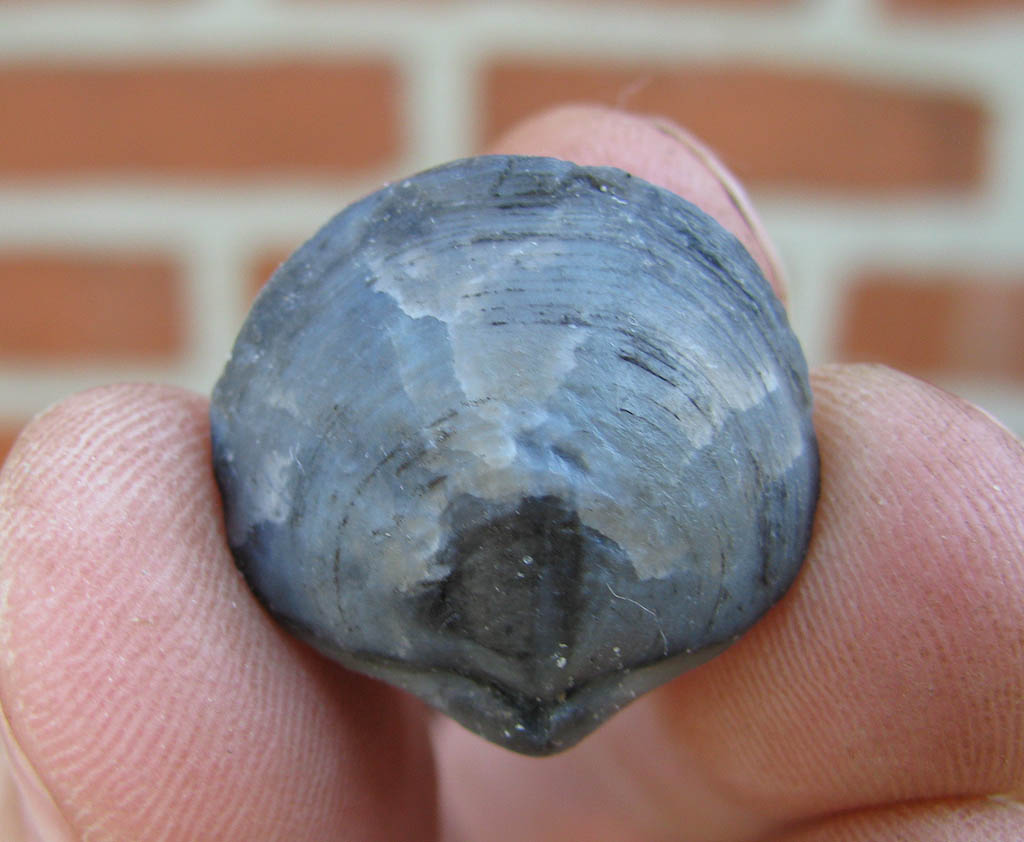
Athyris vittata brachiopod from Michigan

Athyris vittata is a species that is found within the Glenshaw formation at Alpena, Michigan. It's middle Devonian in age (Givetian) and the specimen below comes from the so called "Blue Beds". I haven't been able to find much documentation on why the layer is called that but I suspect it has something to do with Hydrocarbons.When examining the specimens closely I can see a thin film of some black substance. It's not shale or some other rock and I've seen similar coatings referred to in the past as bitumen, tar or oil.


This species can be distinguished from the more common Athyris spiriferoides by the lack strong concentric growth lines.

Wednesday, September 7, 2011

Evactinopora

I present to you one of the strangest fossil Bryozoan species I've ever seen: Evactinopora radiata. It is known primarily from the Fern Glen limestone, where this specimen is from, but can be found in other formations that are from the very earliest Mississippian (Tournaisian). From the base (bottom) or top it looks like a starfish. Studies have shown that there are pores in the sides of the rays and that is where the individual Byrozoan polyps lived. Unfortunately none are exposed on this specimen.


 There are many questions brought up when studying the specimen: Why did it grow this way, why is it (seemingly) limited to the North American continent and why didn't it radiate into new species?


Here is a nice page that discusses Evactinopora in depth.


Thanks to Joe K. for the specimen.

Monday, September 5, 2011

Coolinia subplana from the Osgood Shale

While examining some pieces of the Waldron Osgood Shale that I brought back from Indiana I found a couple of specimens of Fardenia Coolinia subplana. It is within the class Strophomenata (straight hinge line) and order Orthotetida.


I identified these based on this link to the Indiana State Museum's online collection.
I've since had to change my ID on this specimen as I realised that I collected it from the Osgood Shale and not the Waldron Shale. As such, Coolinia is the more likely genus. I based this on the paper "Caradocian-Gedinnian echinoderm associations of Central and Eastern North America" Frest, Brett and Witzke published in the compendium "Paleocommunities - a case study from the Silurian and Lower Devonian", book 2, page 729. The Osgood shale is Silurian in age (Telychian to Sheinwoodian stage).


Saturday, September 3, 2011

Alveolites from Louisville, KY

Of all the pieces of fossilized coral that I picked up while in Louisville this is the only specimen of Alveolites that I found. When I picked it up there was mud coating that obscured the upper surface and I couldn't tell what it was. It kind of looked like a "rotten" or heavily eroded coral but the bottom surface looked like some Favosite type corals I'd seen in Arkona, Ontario. Once I washed it I was able to recognize the elongated, overlapping corallites that are typical of the genera.


Since it can be difficult to determine the species of corals (and bryozoans), once I determine the genera I will often label it with the species that is most commonly found within the formation. Generally this would be Alveolites goldfussi (a Middle Devonian species) but since this was found at a site that had mixed rocks from both the Devonian Jeffersonville Ls. and Silurian Louisville Ls., it could also be Alveolites louisvillensis.

For comparison, check out my post on Alveolites goldfussi from Arkona, Ontario.

Thursday, September 1, 2011

Hindia sp. from the Louisville Limestone

When out collecting you often pick up a lot of stuff. Once you get home and clean your findings some of it turns out to not be as nice as you wanted or is not a fossil at all. And then sometimes you get a mystery like the specimen below.

This piece was collected from a mixed exposure of Middle Silurian aged Louisville Limestone and lower Devonian aged Jeffersonville Limestone near Louisville, KY. It was found loose within the heavily eroded red clay that often fills gaps within the limestone. The fact that it was loose and rounded made me think it could be a sponge or algae of some sort. Though it could just as easily be a rounded blob of quartz replaced limestone.

Thanks to the comment below, I looked at the specimen again and believe it to be an example of the sponge Hindia sp.