Showing posts with label Silurian. Show all posts

Saturday, August 22, 2020

Possible Atrypidae type brachiopod from the Louisville formation

The single specimen below is the only one I have found from the sediments near Louisville. I believe that it is an member of the family Atrypidae and may in fact be a member of the genera Atrypa. It looks very similar with a rounded outline to the shell, a more deeply curved brachial valve than pedicle valve, and has radial ribs that look typical. However the anterior margin has a sulcus that is confined to the forward 1/3 of the two valves. It does not continue all the way to the beak on the pedicle valve.  I have seen examples of Atrypa with a similar feature but generally the pedicle valve is much flatter than in this specimen.

Brachial Valve
Anterior
Pedicle valve (the broken section does not help with the ID)
Posterior
Left profile
Right profile

This specimen was found in an area that had mixed residual soils from the Jeffersonville limestone (Devonian) and Louisville limestone (Silurian) formations near Louisville, KY.  Based on my experience with the preservation styles of the two formations, I think this came from the Lousiville limestone (Homerian to Gorstian stage of the Silurian).

Friday, August 7, 2020

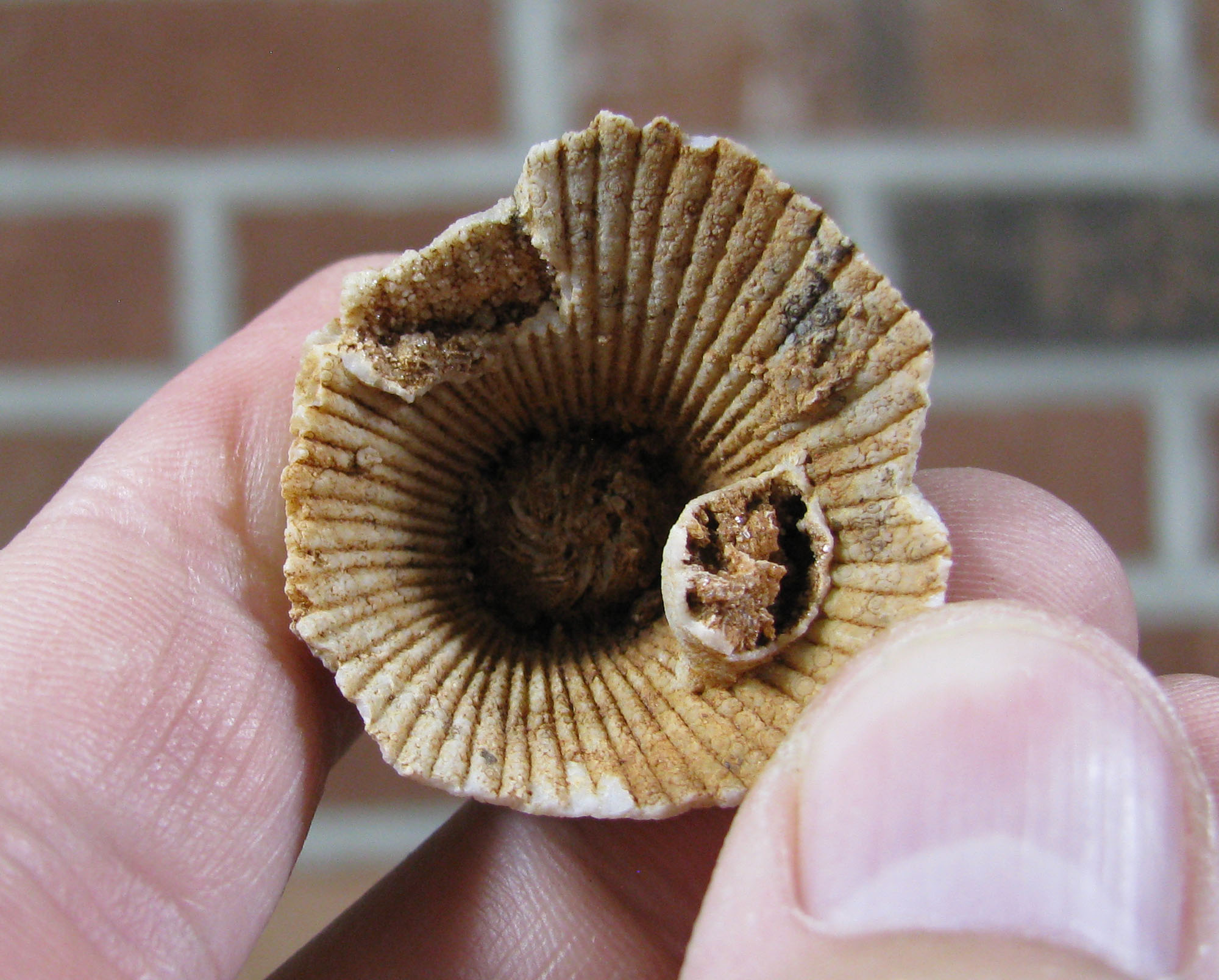
Schlotheimophyllum sp. coral from the Lousiville Limestone

I had some help with the ID of these next two specimens. They are both the coral Schlotheimophyllum sp.  from the Louisville limestone near Louisville, Kentucky.  The first specimen came to me from Mike P. who runs the excellent "Louisville Fossils and Beyond" blog.

Specimen #1 - top view of calice

Angled view of the calice

Side views of the corallum with each subsequent picture showing the side rotated 90 degrees from the prior picture.


Bottom of the corallum

The second specimen shown below I found myself in the field near Louisville, KY.  I wanted to make sure it was the same genera as the above specimen from Mike P. so I referred to the book by Erwin Charles Stumm; "Silurian and Devonian Corals of the Falls of the Ohio". to help ID and found a possible match on page 25, plate 25, fig. 1-8. Stumm has several species listed but they all have a somewhat flat to funnel shaped calice with thick septa. The specimen below appears similar to that description and to the specimen above, so I am comfortable labeling it as Schlotheimophyllum sp. as well.

Specimen #2 - view of the top of the calice

Angled view of the calcie (I don't know what the foreign attachment is as there is little detail preserved. Perhaps a brachiopod or another coral established itself prior to buiral?)

Side views of the corallum with each subsequent picture showing the side rotated 90 degrees from the prior picture.


A view of the bottom of the corallum

These specimens come from the Lousiville Limestone near Louisville, KY and are dated to the Silurian period (Homerian to Gorstian stage).

References: Stumm, E. C. (1964). Silurian and Devonian corals of the falls of the Ohio. New York: Geological Society of America.

Wednesday, August 5, 2020

Tryplasma prava from the Lousiville Limestone

This next coral comes from the Lousiville Limestone near Louisville, KY. It was found at a site of mixed eroded material from both the aforementioned formation and the Jeffersonville Limestone. It's a small coral with a distinct looking calice that is flat near the edge but very straight and deep.

I used the book by Erwin Charles Stumm; "Silurian and Devonian Corals of the Falls of the Ohio". to help ID and found a possible match with Tryplasma prava on page 51, plate 6, fig. 1, 3, 7-8.  In his description Stumm says "Exterior typically very closely annulated with superposed former (calice) margins 0.5-3mm apart." and "(Calice) walls steeply sloping to vertical with shallowly inwardly sloping margin in some specimens."

Those descriptions match this specimen very well as it does have what appear to be multiple calice growths (perhaps a sign of rejuvenation or just the growth habit of the coral) as well as having steep walls in the calice itself.

This and the next two pictures are the sides of the specimen as seen rotated 120 degrees from the prior picture.


A view of the calice at an angle to show the steep walls.

Top view of the calice showing how the walls are straight to slightly sloping inward.


I believe this specimen comes from the Lousiville Limestone near Louisville, KY and is dated to the Silurian period (Homerian to Gorstian stage).

References: Stumm, E. C. (1964). Silurian and Devonian corals of the falls of the Ohio. New York: Geological Society of America.

Monday, August 3, 2020

Strombodes shumari coral from the Louisville Limestone

Below are two specimens that look similar but have some differences which could mean they are not the same species. I am working from partial pieces of larger corals so the best I have been able to ID these specimens is that they are Strombodes shumari from the Louisville Limestone.  I found them at a site near Louisville, KY a number of years ago and only got around to identifying them now.  I used the book by Erwin Charles Stumm; "Silurian and Devonian Corals of the Falls of the Ohio". to help ID and found a possible match on page 47, plate 22, fig. 1-8.

The preservation of the specimens is incomplete and so I can't find all the diagnostic details to truly confirm the ID. What makes me think I may be correct that these are Strombodes shumari is the pattern of rejuvenation of the calice. This is seen in the specimens as a reduction of the calice diameter via continuous growth over a short horizontal and vertical distance, only to renew vertical growth. The repeated growth pattern is the key to identify this species.

Specimen #1 - This and the next three pictures are the sides of the specimen as seen rotated 90 degrees from the prior picture.


Specimen #1 - A closer view of the calice where the rejuvenation surface is shown.

Specimen #2 - This and the next photo are of the side of the specimen and then turned 90 degrees. Note that this specimen only has one cycle of regrowth and has evidence of a more significant calcie size difference than the prior specimen. Perhaps this is a different genus or species, or perhaps similar evidence was not preserved as well in the prior specimen?


Specimen #2 - A closer view of the calice where the rejuvenation surface is shown.

A view of the partially preserved cross section of the calice.


I believe these specimens come from the Lousiville Limestone near Louisville, KY and are dated to the Silurian period (Homerian to Gorstian stage).

References: Stumm, E. C. (1964). Silurian and Devonian corals of the falls of the Ohio. New York: Geological Society of America.

Friday, March 27, 2020

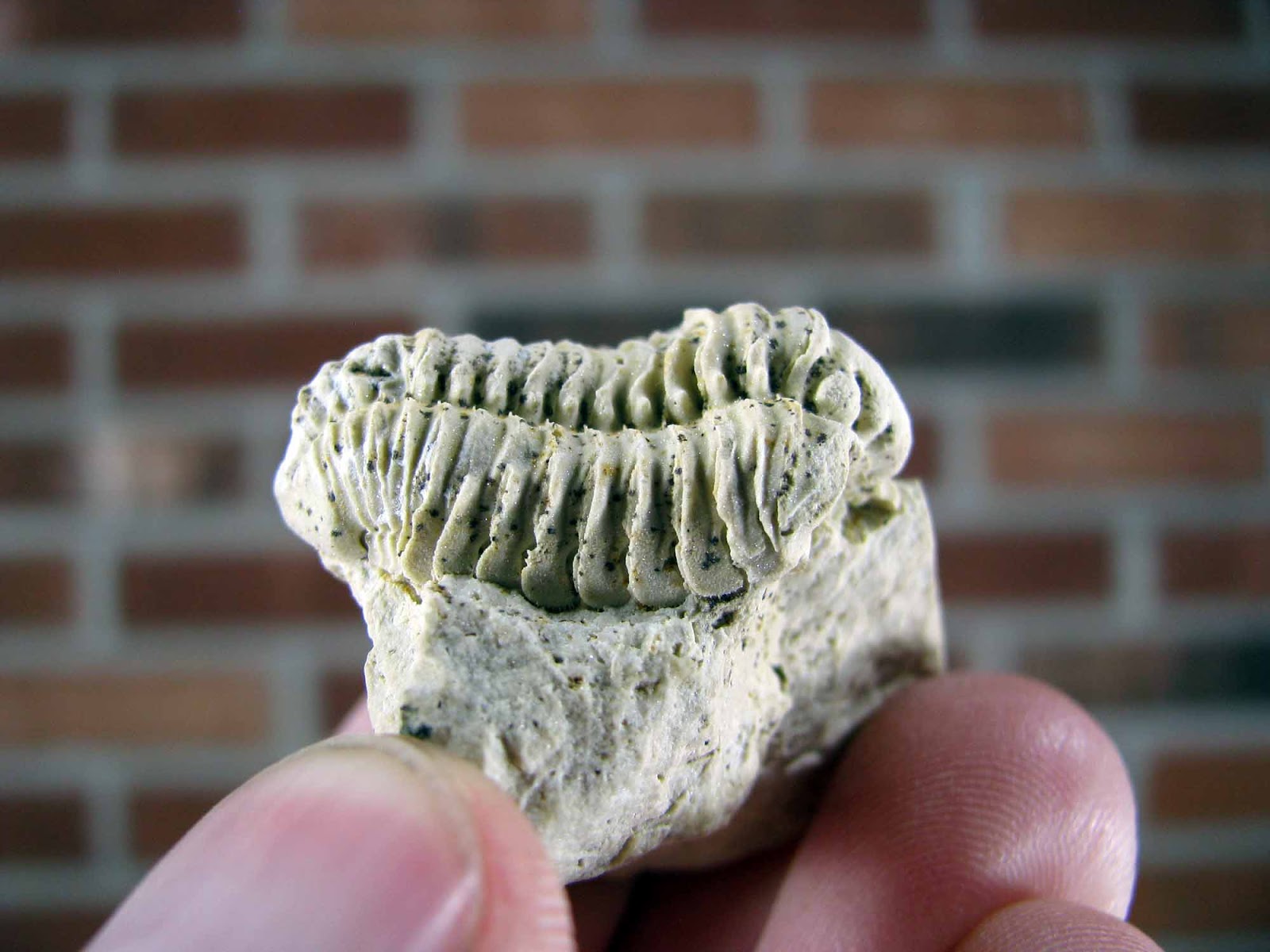
Calymene celebra Trilobite from the Joliet formation

Calymene celebra is the state fossil of Wisconsin and a somewhat common fossil in the white/light grey/tan Silurian aged dolostones that can be found across a number of midwest states. Rocks like this stretch from Wisconsin and Iowa down through Illinois and Indiana into Kentucky.  Below is a specimen of  Calymene celebra from the Joliet formation near Grafton Illinois. It was likely found in a quarry as productive exposures of the Joliet formation are not easy to find. 

This fossil is a cast of the interior of the trilobite exoskeleton so it's missing some of the details one would normally see.  I like this specimen due to the presence of black specks that are present. It kind of reminds me of a Dalmation dog's coat.  I think the black spots are oxidized Pyrite or Marcasite.


I've been fortunate enough to find one specimen of Calymene celebra myself. It comes from a breakwater along Lake Michigan in Milwaukee, Wisconsin where I spotted it among the rocks being used to stabilize the shoreline. It was in a small flat slab so I didn't have to smash anything to collect the specimen. You can see that it was exposed for a time as one side is smooth and some of the fossil detail has been lost.  Since the rocks had been moved from their original location, I am not sure what formation this fossil comes from.


These fossils come from the Silurian period, Llandovery stage (roughly 438-436 mya) which corresponds to the basal Niagaran series in the old N. American chronostratigraphy.

Friday, March 6, 2015

Pristeroceras timidum cephalopod from the Bertie Formation

This is one of the oddest fossils I've found in the Bertie limestone, it's a cephalopod called Pristeroceras timidum. It appears to have possessed a very thin shell or maybe one that was not permineralized like other cephalopods.  Pristeroceras timidum is considered a breviconic type of Cephalopod in that it did not form a long conical shell but instead opted for a subovoid shape. In the Bertie formation the shell is often very compressed and so fossils do not present many details.

This is the specimen as found in the field. Note the light colored pattern on the darker colored shell.
The other side of the enclosing limestone broke into a number of smaller pieces that I've glued back together.
The cast of the fossil popped off the matrix and allows me to see both side. Here is the impression of the side that was hidden from view in the first picture.
A closer view of the top limestone later

Here is the body fossil itself. The pattern that is evident on the shell is the opening where the animals head and tentacles emerged.
The back side of the fossil shows a wrinkled pattern due to the compression.

I got some of the info for this post, including the image below, from the following paper:
"A Restudy of the Silurian Nautiloid Genus Pristeroceras Ruedemann"by Walter C. Sweet and Willard P. Leutze,Journal of Paleontology, Vol. 30, No. 5 (Sep., 1956), pp. 1159-1164