Showing posts with label Graptolite. Show all posts

Tuesday, February 18, 2020

Climacograptus typicalis graptolite from the Whitby formation

As Climacograptus typicalis is the most common graptolite found at Bowmanville, and in my experience everywhere in the upper Ordovician, I should not be surprised to find it in the Collingswood member of the Whitby formation. I have only found one specimen so far and it is super hard to get a good photo of the black carbonaceous film on black shale. But in the second photo below you can see the square shape of the thecae where the animals lived.


The Whitby formation is Ordovician in age (late Ordovician, Katian/Mohawkian stage).
These fossils were collected from the St. Mary's Limestone Quarry in Bowmanville, Ontario. I used William Hessin's book "South Central Ontario Fossils", 2009, Self Published, pg. 263 to help identify these fossils.

Saturday, January 11, 2020

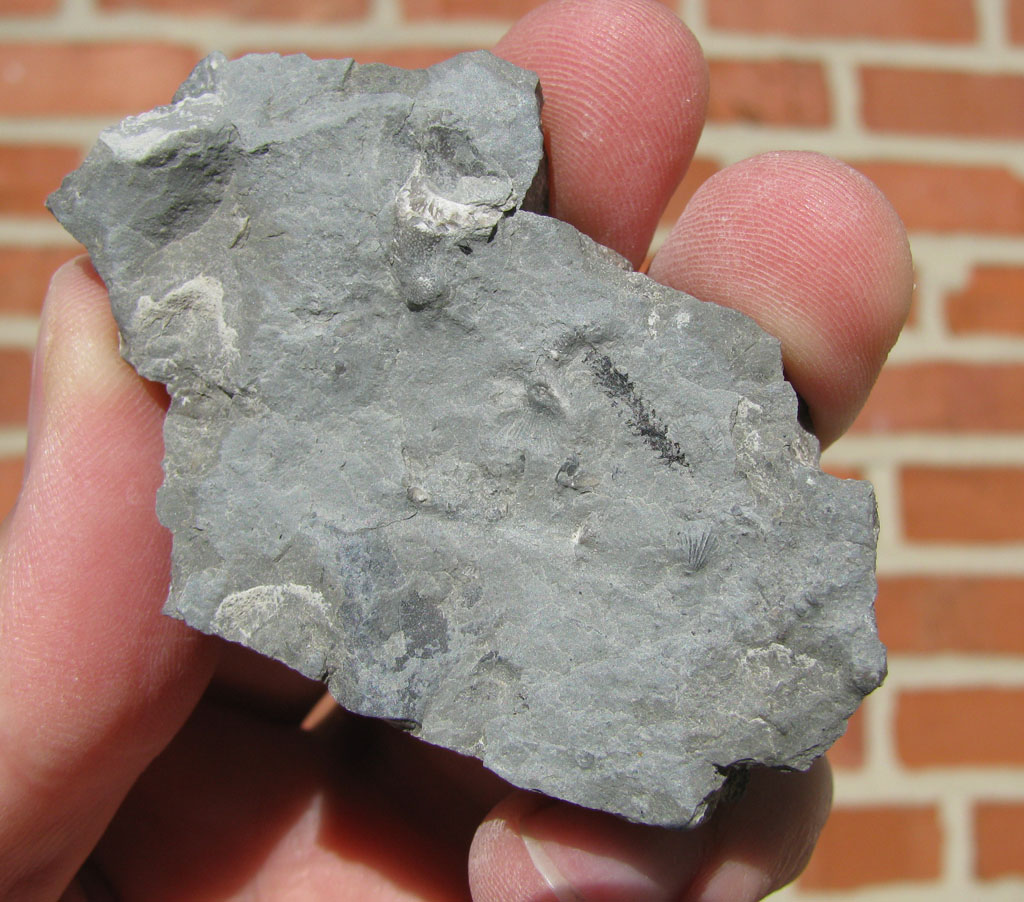
Dictyonema sp. graptolite from the Coburg Formation

The second the three Graptolites species that I've found in the Coburg formation is Dictyonema sp.  It appears as a net like carbon coating on the rock face. Mostly you find them on small fragments of rock but occasionally you will get a big slab where you can get a feel for how big some of the colonies could get. Dictyonema is a genus that is extant from the Ordovician all the way thru to the Devonian but it is hard to get a species because most fossils are not preserved well enough.

On this sample, there is also some Melanostrophus sp. Graptolites.


Here is a link to the Baltic fossil ID website, FOSSIILID.info which has some more examples of this Graptolite.

Here are other examples of this Genus that I've collected in the Silurian aged Rochester shale, and Devonian aged Windom shale.

The Coburg formation is Ordovician in age (late Ordovician, Katian/Mohawkian stage).
These fossils were collected from the St. Mary's Limestone Quarry in Bowmanville, Ontario. I used William Hessin's book "South Central Ontario Fossils", 2009, Self Published, pg. 130 to help identify these fossils.

Thursday, January 9, 2020

Melanostrophus sp. graptolite from the Coburg Formation

Graptolites are mysterious lifeforms that lived primarily in the early Paleozoic era. They often formed colonial structures that floated in the water column. Melanostrophus sp. is an odd member of the group in that it does not form straight, segmented colonies. Instead they have curved or wavy structures. According to William Hessin's book "South Central Ontario Fossils", some paleontologists have considered Melanostrophus sp as a type of annelid worm. Whatever the case, this fossil is somewhat common in the upper layers of the Coburg formation and appears as a black carbonaceous coating on limestone surfaces.


The Coburg formation is Ordovician in age (late Ordovician, Katian/Mohawkian stage).
This fossil was collected from the St. Mary's Limestone Quarry in Bowmanville, Ontario. I used William Hessin's book "South Central Ontario Fossils", 2009, Self Published, pg. 264 to help identify it.

Thursday, January 8, 2015

Geniculograptus typicalis graptolite from the Utica Shale

Among all the Triarthrus eatoni fossils that are found in the Utica shale (Ordovician, Darriwillian stage) at Little Falls, NY there are also many species of graptolite. The only species that I found was Geniculograptus typicalis but it occurred in profusion in places.


Some had really good detail preserved while others were just carbon films


 Sometimes they were also associated with Triarthus eatoni remains.


Monday, December 29, 2014

Geniculograptus typicalis graptolite from the Verulam formation

Of the two Graptolites that are common in the Verulam formation (middle Ordovician, Katian/Mohawkian stage)of Ontario, Climacograptus typicalis Geniculograptus typicalis is by far the most common. I've found several pieces of it during my many visits but none are very well preserved. Climacograptus Geniculograptus typicalis can be distinguished from the similar looking Diplograptus by the upturned "teeth" along the sides of the colony.

Specimen #1


Specimen #2


I found some better preserved examples of this species near Lusters Gate in Virginia.

Edit 1/4/15 - It has come to my attention that the species Climacograptus typicalis has since been renamed to Geniculograptus typicalis, Thanks to the person who runs the "Dry Dredgers" handle on Facebook. They also provided the following: "Mitchell (1987, p. 381; PDF here: http://www.palass-pubs.org/.../pdf/Vol30/Pages%20353-405.pdfused *Climacograptus typicalis* Hall, 1865 as the type species of his new genus *Geniculograptus*. Subsequent authors have supported the validity of *Geniculograptus* and it's been used in graptolite publications as recent as one or two years ago (e.g. Cooper et al 2012; PDF here: http://www.researchgate.net/.../file/3deec527ea87992c1f.pdf

Saturday, December 27, 2014

Diplograptus amplexicaulis graptolite from the Verulam formation

Graptolites are a colonial organism similar to Corals and Bryozoans and they are also important index fossils used to help date the rocks they are found in. In the Verulam formation (middle Ordovician, Katian/Mohawkian stage) of Ontario, Canada they are found as black carbon films on the grey limestone rock. Below is Diplograptus amplexicaulis, one of two species that is known from the formation. It formed straight, needle like colonies with edges that look like a saw tooth. Each of the "teeth" was an individual animals home and the colony grew by budding at the tip to make the whole group longer. Because the fossils are preserved only as carbon films it is hard to get good clear examples as they flake or rub off very easily.

Specimen #1


Specimen #2


Saturday, June 14, 2014

Dictyonema hamiltoniae graptolite from the Windom Shale

Graptolites are extinct creatures that were similar to coral or bryozoans in that they filtered the water for food particles and lived colonially. Below are some Graptolites from the Devonian aged Windom Shale (part of the Moscow Formation and Givetian stage) of New York that I recently found. I've only found graptolites before in Ordovician aged rocks and was very surprised when I was splitting shale and found these. They are a species called Dictyonema hamiltoniae and were found in the same beds that commonly produce Trilobites.

Specimen #1 - This specimen has both the part and counterpart with the Graptolite. 
Part

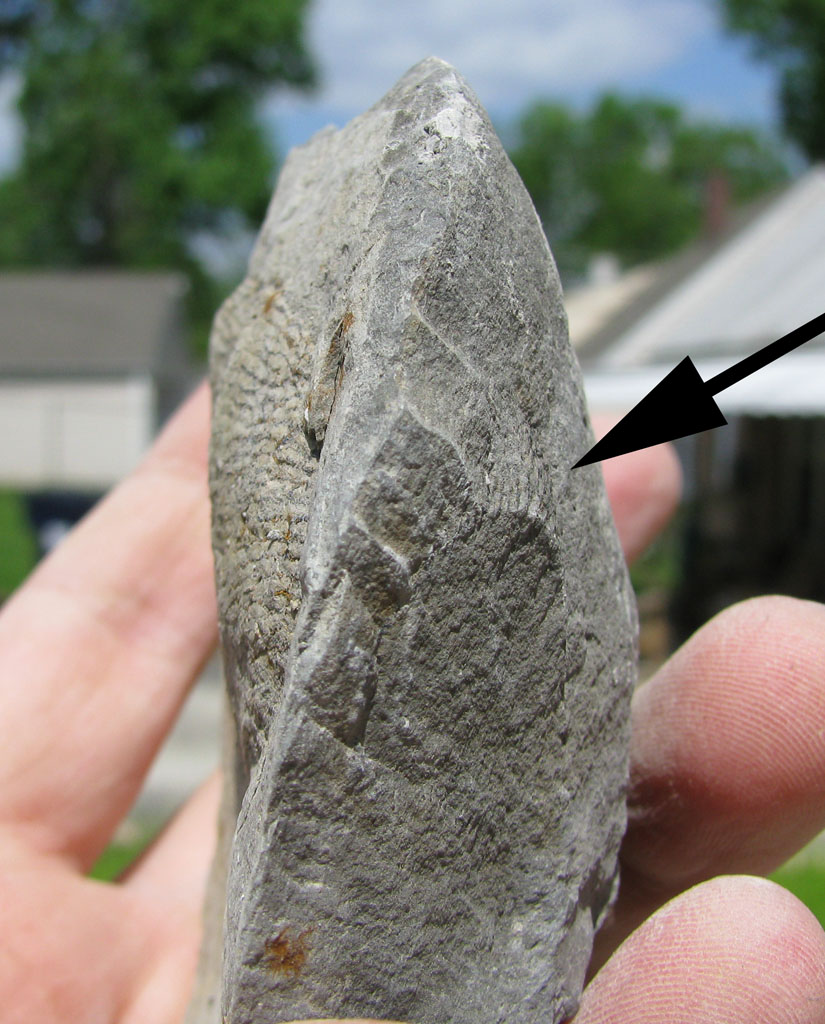
A view at the bottom of the Part piece that shows the graptolite is preserved in three dimensions. The arrow in the picture below is pointing to a partially exposed piece of the graptolite that I believe is part of the same colony as the front side.
Counterpart
Closer view of the graptolite. Unfortunately there is not a whole lot of detail to be observed. Most times graptolites are just carbon films on the surface of the rock. This is what sets them apart from corals and bryozoans who use calcium carbonate (CaCO3) to construct their colonies
Specimen #2


Both specimens were found in Fall Brook near Geneseo, NY.

Friday, September 27, 2013

Odds and ends fossils from St. Petersburg, Russia

This is the last of my posts regarding fossils from the Ordovician rocks near St. Petersburg, Russia for now. The fossils I'm showing today are partials and lesser examples that don't merit a full blog entry.

First up is this odd looking piece which I believe is the interior of a pedicle valve from a strophomenid type brachiopod.It has the characteristic half-moon shape and I think that the relief seen near the one side of the fossil represents some muscle scars.


Next is this Graptolite which may only be a part of a larger colony. The rounded end does look like it is supposed to naturally occur like that but the other end seems to have extended farther at one time.


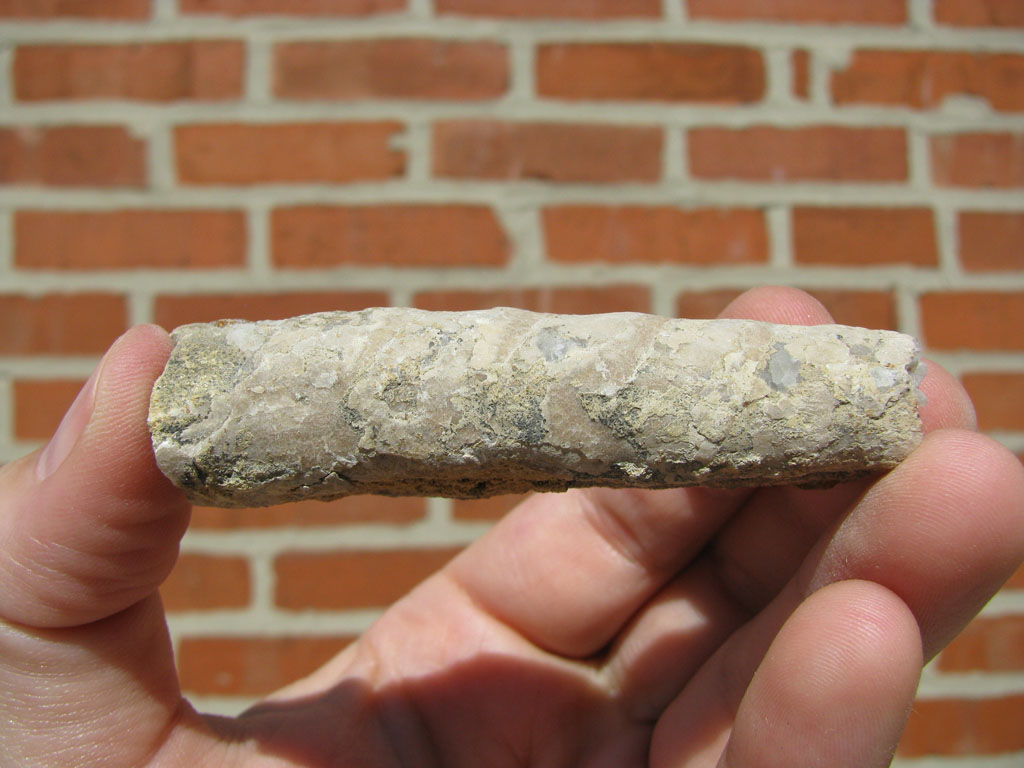
Lastly is this cast of a cephalopod. It is interesting because of the slanted or spiral like pattern. This could be an impression of the exterior decoration of the shell rather than the usual internal vertical chambers. Three sides are preserved with the fouth filled with Calcite.


Hopefully I'll get some more fossils from the St. Petersburg region in the future. I don't have enough to really compare to those that I've found in here in the US or Canada.

Tuesday, August 14, 2012

Fossils from Lusters Gate, VA.

This past April I took a trip through Virginia and West Virginia exploring some sites that were listed in the book "Fossil Collecting in the Mid-Atlantic States" by Jasper Burns. One of the sites came with a recommendation from a couple of friends on the Fossil Forum. It is a roadcut northeast of Blackburg, VA near the village of Lusters Gate. Below is a view of the roadcut which you can see is very overgrown.


This shows the most obvious exposure of shale and also evidence of collecting by others. I spent about half a hour picking at the rocks looking for any of the trilobites that are known to be found here.

I didn't have much luck with the Trilobites but I did find some Climatograptus sp. graptolites on some of the bedding planes. Graptolites are primite animals that formed colonial structures similar to coral and bryozoan but they often floated in the currents rather than cement themselves to a substrate. They are found primarily in the lower Paleozoic but survived until the middle carboniferous.


This rock is interesting in that it has a large number of the graptolite fossils but also some stringy looking traces. Perhaps they were part of a large colony that was held together by the "strings".


Graptolites are hemichordates which means they have a primitive tube with nerves for part of their lives. It's thought that they are a connection between vertebrates and invertebrates (more specifically echinoderms) and came from a similar common ancestor. (Wikipedia)

The above specimens came from a roadcut along Route 785 near Lusters Gate, Montgomery county, Virginia. The cut is listed as site #2 in the book "Fossil Collecting in the Mid-Atlantic States" by Jasper Burns. The Liberty Hall formation is dated to the middle Ordovician Mohawkian stage and is roughly equivalent to the Shippensburg and Chambersburg Limestones in PA. It is below the Lexington Limestone of Kentucky and is considered a part of the Black River-Trenton group in NY and Ontario.