Saturday, March 16, 2013

Random Fossil Post

I have lots of fossils from my younger collecting days that have no label or sparse information. Some are among my favorites but with little info they get relegated to Random Fossil Posts.

Today we have this Collignoniceras sp. ammonite from the Cretaceous (Cenomarian) of Wyoming. It's a beautiful little ammonite with one of the chamber walls visible near the end of the sprial.


Next are a couple of fossils from the Mazon Creek flora of Illinois. This flora, named after the locality where they were first found, is preserved in ironstone (Siderite) nodules. I have this Macroneuropteris leaf....


and some annularia.

Thursday, March 14, 2013

Cyclothyris vespertilio brachiopod from France

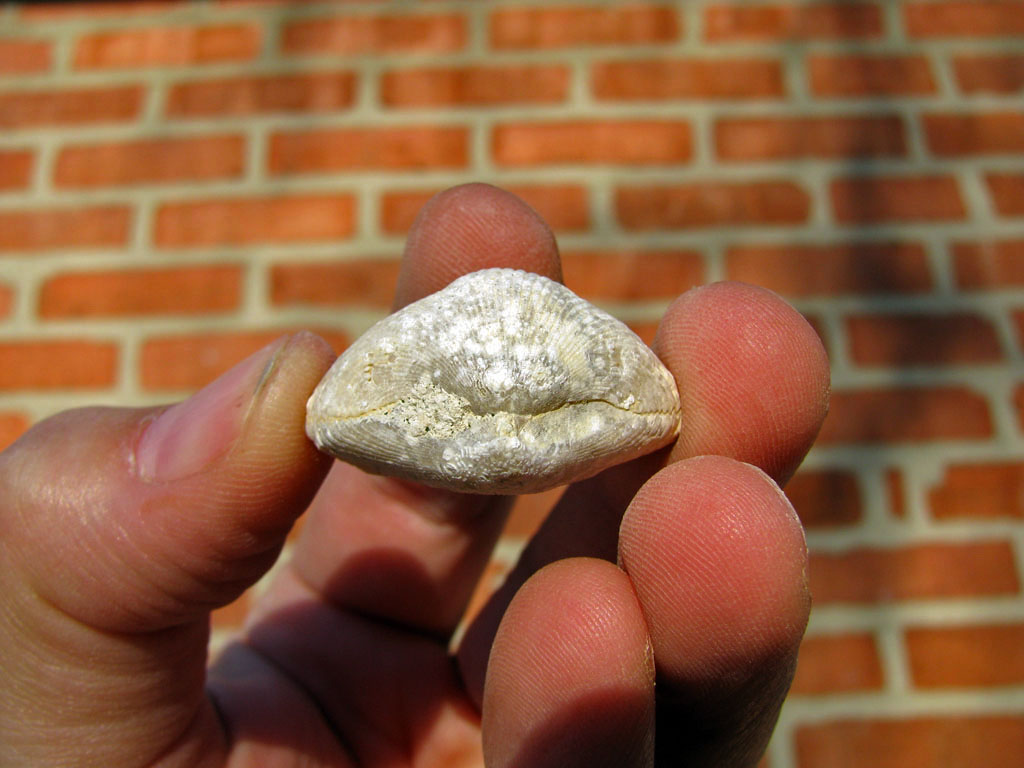
Among the many beautiful fossils that I have received from my friend Gery in France are these Cyclothyris vespertilio from near Sarthe, France. I like them because they show evidence of Beekite (a microcystalline form of quartz similar to Chalcedony) replacement of the original shell. The small circular shapes that you see embedded in the shells are the result of the Beekite replacement.

Specimen #1
Pedicle valve
 Anterior
 Brachial valve
 Posterior
 Profile

Specimen #2
Pedicle valve
 Anterior
 Brachial valve with some matrix
 Posterior
 Profile

Both specimens are from the Santonian stage of the upper Cretaceous. The shell gets it's species name from the shape which reminded the original describer of a bat so he used the extant genus name Vespertilio. Thanks to Gery for these cool fossils!

Tuesday, March 12, 2013

Unknown crinoid species #2 from Bolivia

In the last few years there have been some interesting Devonian aged fossils coming out of Bolivia. I have mostly been purchasing mine from this seller on E-bay. Among the fossils I have acquired are some unnamed crinoids.

This is the third (and possibly fourth?) species that I have in my collection from Bolivia.

This species has long arms covered in hair like pinnules that act like cilia to catch passing particles of food. Not much of the calyx has been preserved on this specimen so I don't have much else to go on.
The arms really lay out in three dimensions within the rock.
One of the arm tips even curls around a little
This is another crinoid mold that is on one side of the fossil and looks like an example of the crinoids I posted about yesterday.

This is the final specimen that I have. It features two crinoids (possibly the same species?). One is sprawled out on the face of the rock while the second is laying sideways giving more of a profile view.
Were it not for the pinnules attached to the arms I would almost say this fossil looks like the first set of crinoids I blogged about here.


These specimens come from the Belen formation (Devonian, Emsian stage) south of the capitol of Boliva, La Paz.

Sunday, March 10, 2013

Unknown crinoid species #1 from Bolivia

In the last few years there have been some interesting Devonian aged fossils coming out of Bolivia. I have mostly been purchasing mine from this seller on E-bay. Among the fossils I have acquired are some unnamed crinoids.
These specimens come from the Belen formation (Devonian, Eifelian stage) south of the capitol of Bolivia, La Paz.

This is the second of (at least) three species that I have in my collection from Bolivia.

Specimen 1

The species is small with long, smooth arms that branch repeatedly.
This species does not appear to have any fine pinnules (small cillia like extensions) on it's arms.
The stem of the crinoid shows evidence of cirri which were grasping appendages that the crinoid would use to anchor itself to the seafloor.

Specimen #2


These specimens come from the Belen formation (Devonian, Emsian stage) south of the capitol of Bolivia, La Paz.

Friday, March 8, 2013

Ctenocrinus branisai crinoid from Bolivia

In the last few years there have been some interesting Devonian aged fossils coming out of Bolivia. I have mostly been purchasing mine from this seller on E-bay. Among the fossils I have acquired are some unnamed crinoids. Update: A paper was recently published in the Journal of Paleontology by Jeffrey R. Thompson, William I. Ausich and Legrand Smith titled "Echinoderms from the Lower Devonian (Emsian) of Bolivia (Malvinokaffric Realm)". Based on the descriptions and plates in the paper I believe the specimens below are Ctenocrinus branisai.

This is the first of (at least) three species that I have in my collection from Bolivia.

Specimen 1

This species has a larger, ornate calyx with more plates.
The arms seem to be composed of a large thick central member with smaller branches coming off the sides. Again, no small pinnules seem to be present.


Specimen 2

This piece shows the crinoid in profile and has an anal tube preserved.

Though it is smaller than specimen #1, I think this is the same species because the arms look similar with a thick central member and smaller branches at regular intervals.


These specimens come from the Belen formation (Devonian, Emsian stage) south of the capitol of Bolivia, La Paz.