Showing posts with label Illinois. Show all posts

Friday, March 27, 2020

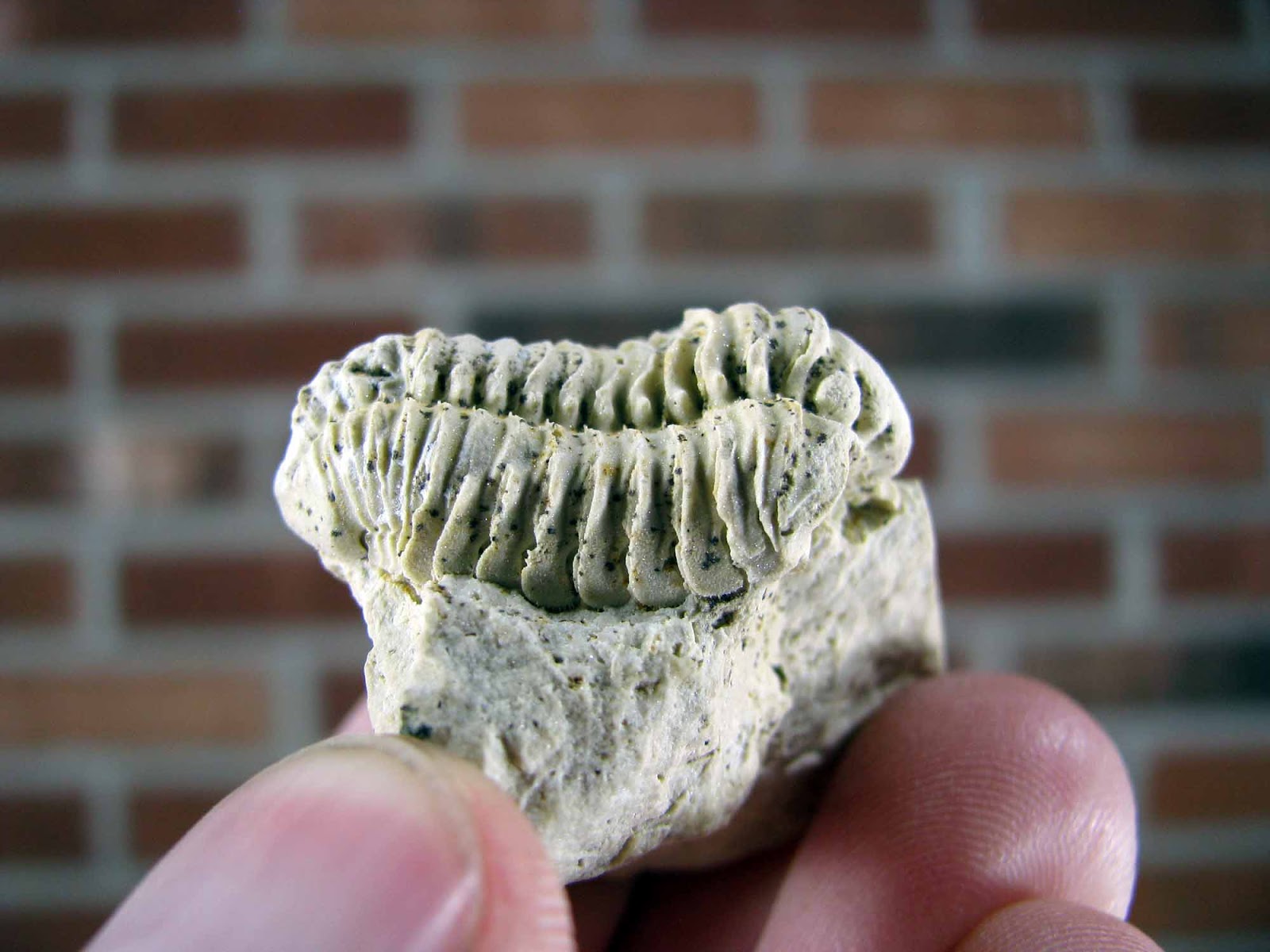
Calymene celebra Trilobite from the Joliet formation

Calymene celebra is the state fossil of Wisconsin and a somewhat common fossil in the white/light grey/tan Silurian aged dolostones that can be found across a number of midwest states. Rocks like this stretch from Wisconsin and Iowa down through Illinois and Indiana into Kentucky.  Below is a specimen of  Calymene celebra from the Joliet formation near Grafton Illinois. It was likely found in a quarry as productive exposures of the Joliet formation are not easy to find. 

This fossil is a cast of the interior of the trilobite exoskeleton so it's missing some of the details one would normally see.  I like this specimen due to the presence of black specks that are present. It kind of reminds me of a Dalmation dog's coat.  I think the black spots are oxidized Pyrite or Marcasite.


I've been fortunate enough to find one specimen of Calymene celebra myself. It comes from a breakwater along Lake Michigan in Milwaukee, Wisconsin where I spotted it among the rocks being used to stabilize the shoreline. It was in a small flat slab so I didn't have to smash anything to collect the specimen. You can see that it was exposed for a time as one side is smooth and some of the fossil detail has been lost.  Since the rocks had been moved from their original location, I am not sure what formation this fossil comes from.


These fossils come from the Silurian period, Llandovery stage (roughly 438-436 mya) which corresponds to the basal Niagaran series in the old N. American chronostratigraphy.

Wednesday, May 7, 2014

Edestus heinrichi tooth and jaw section from Illinois

Below are pictures of a rare shark tooth and jaw section from a bizarre shark called Edestus heinrichi. It was called the "Scissor tooth" shark because reconstructions of it have long jaws sticking out from the face of the shark with teeth lining them. Envision them like a large pair of pinking shears on the body of a shark where the mouth would be. The jaws of these odd group of fish never shed their teeth and just continued to grow outward. Each tooth was rooted in a chunk of cartilage and would stack on the previous piece of cartilage. In this way the shark had a mouth full of teeth at all times.

Edestus was related to a group of sharks that have modern representatives in the Ratfish (Chimaera) and are better represented by the whorl tooth possessing Helicoprion. Both Edestus and Helicoprion lived during the end of the Carboniferous period (upper Pennsylvanian stage). The fossil below was among many found by coal miners in Illinois. Why was it found in a coal mine when it was shark that lived in water? Edestus lived and died in brackish waters in between growth of the coal swamps. As the coal was removed in the mine these non coal bearing rocks were exposed with some of them being marine in origin.


The specimen I own has just a single tooth in a piece of the jaw. There are some terrific examples of more complete jaw sections on the web like this group of pictures from the Illinois state Museum.  This thread on the Fossil Forum has pictures of some nice specimens in other people's collections.

Saturday, March 16, 2013

Random Fossil Post

I have lots of fossils from my younger collecting days that have no label or sparse information. Some are among my favorites but with little info they get relegated to Random Fossil Posts.

Today we have this Collignoniceras sp. ammonite from the Cretaceous (Cenomarian) of Wyoming. It's a beautiful little ammonite with one of the chamber walls visible near the end of the sprial.


Next are a couple of fossils from the Mazon Creek flora of Illinois. This flora, named after the locality where they were first found, is preserved in ironstone (Siderite) nodules. I have this Macroneuropteris leaf....


and some annularia.