Friday, November 9, 2012

Stuff found on the undersides of Microcyclus from Arkona

Microcyclus sp. are solitary corals that lived on the muddy bottoms of the Devonian sea 389mya and were preserved as part of the Arkona formation. The seafloor that they lived in was only periodically oxygenated enough for life to sustain itself and so Microcyclus is found primarily in a thin horizon within the formation. Since the seafloor was soft and muddy the corals needed some hard surface to attach to as polyps in order to grow, otherwise they would be smothered by the sediment.

This Microcyclus grew on a small Chonetes sp. brachiopod shell.

This specimen grew on a Tentaculites or Crinoid stem.

Ostracods are sometimes found under the bases. This one was along the edge of the Microcyclus and so was likely not the initial attachment point for the base. I think this might be Ponderodictya punctulifera.


Here is another species of Ostracod, called Dizygopleura trisinuata but again it was not the initial germination spot and may be just a piece of debris that got caught under the coral as it grew.

Finally we see this coral that grew on an accumulation of Ostracod and other shelly debris.

My ID's for the above Ostracods are based on the book "Ostracods of the Middle Devonian Silica Formation" by Robert V. Kesling and Ruth B. Chilman, 1978, Papers on Paleontology No. 18, University of Michigan Museum of Paleontology.

All the above specimens came from the Arkona formation (Devonian, Givetian stage) near Arkona, Ontario, Canada. They came from a particular horizon that a friend of mine (Darrell) pointed out to me. Thanks to his tip I found four dozen different specimens of Microcyclus including those pictured above.

Wednesday, November 7, 2012

Crushed Devonoblastus from the Widder Fm.

I have another Blastoid to add to my collection from Arkona. It's a partially crushed specimen of what I think is Devonoblastus whiteavesi. I took some pictures of the 9.5mm long specimen with my Zorb microscope camera.

Crushed base of the specimen

Side views


View of the crushed side

To give you an idea of scale, here is the specimen held in my fingers.

Some close ups

The specimen was collected from the Hungry Hollow member of the Widder formation near Arkona, Ontario, Canada. The Widder formation is middle Devonian in age (Givetian) with the Hungry Hollow member being equivalent to the Centerfield member of the Ludlowville formation in New York, USA.

Monday, November 5, 2012

Arcogenia prolifera(?) Bryozoan from the Widder Fm.

While going through my findings from a recent trip to Arkona I came across this thin sliver of Bryozoan.


Closeups from both sides of the base


Closeups from both sides of the rest of the colony


I think it's a part of a species called Acrogenia prolifera (Hall), based on Amadeus Grabau's "Geology and Paleontology of Eighteen Mile Creek" (pg 175) and James Hall's "Paleontology of New York" Vol iv (pages 267-269; plate 63, fig 7-15), but it's not listed in the checklist of fossils found at Arkona. Has anyone else found Acrogenia prolifera at Arkona or anywhere else?

The base matches what is shown "Paleontology of New York" Vol iv (pages 267-269; plate 63, fig 7-15) See below:

Full plate
 Detail

Saturday, November 3, 2012

Starfish Traces from France

What looks like a starfish fossil is, in fact, a trace fossil. It represents where a starfish burrowed into the sediment to hide and rest or in search of prey. This fossil comes from the middle Jurassic (Callovian stage) from La Voulte-sur-Rhône in France. This site is considered a Lagerstatte due to the fine preservation of echinoderms like starfish, brittlestars, crinoids etc. along with many other animals where the soft tissues have been preserved by pyrite or phosphate.


This fossil was sent to me by my friend Gery in France.

Here's a link to the Wikipedia page about the locality.

This website has some of the actual starfish fossils for sale.

Thursday, November 1, 2012

Scutella faujasi from France

Here is a fine irregular echiniod that many would recognize as a sand dollar. It's Scutella faujasi from the Falun deposits near Tours in France. The Flauns are a group of rocks which, from what I gather from translations, is similar to a coquina or a rock formation formed mostly from the shells of sea animals with little sediment. It's generally Miocene in age (Helvétien or Serravalian and Langhian stage).

Adapical (top) surface
Posterior (rear)
Adoral (bottom or underside) Note that the anal pore is close to the edge of the shell and the mouth is located at the center.
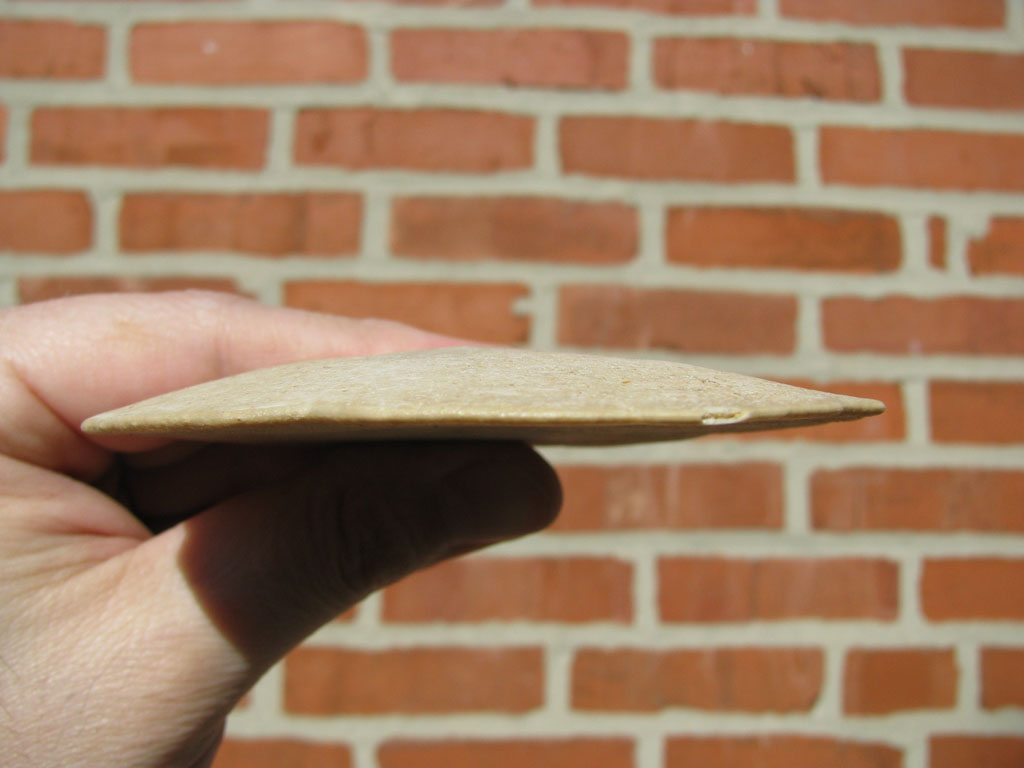
Side profile

Sand dollars are so flat that it's pretty much useless to take a bunch of photos from the sides as it all looks very similar. This particular specimen was sent to me by my friend Christian.