Tuesday, January 21, 2020

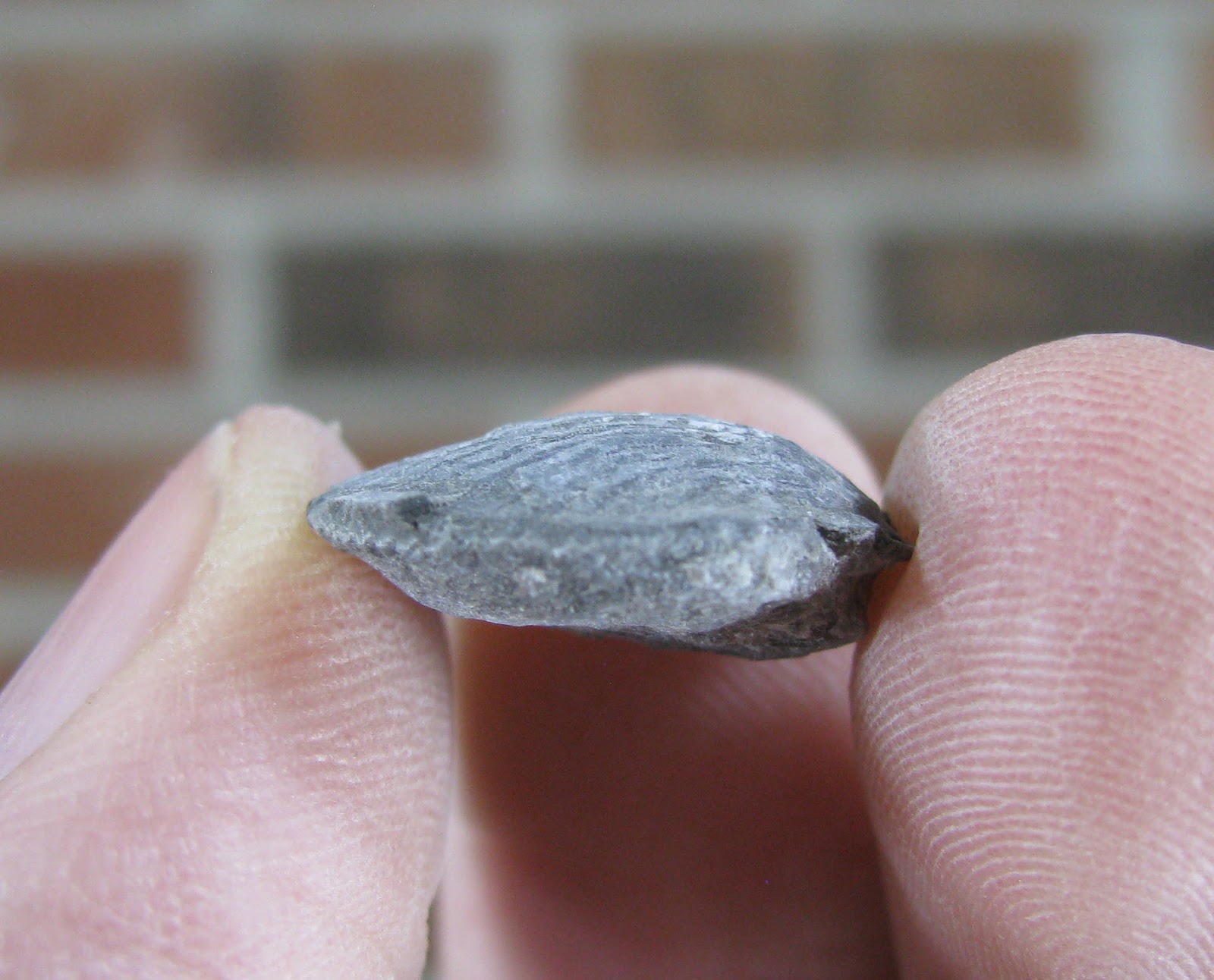
Hindia sp. sponge from the Coburg fm.

When you see a small rounded pebble looking thing on the ground, you often think it is just a water worn pebble. However, when you find it in a limestone quarry among freshly blasted rock, it might just be a small sponge called Hindia sp.  I've found one example of this at the St. Mary's Cement Quarry and I believe it is from the Coburg formation (as that is 90% of the exposed and quarried rock). However, William Hessin's book, "South Central Ontario Fossils", only mentions it being present in the Verulam formation.  It could either be that Hinda sp. is rare in the Coburn,  I picked this up from a part of the Verulam formation, or it got transported during a blast.  In any case, I don't have any that I know of from the Verulam either so this is still a win for me.

Hessin reports that there are two species of Hinda known from the Verulam formation but that they differ in the size and arrangement of the surface pores. I have not yet had a chance to view this specimen under a microscope so I am sticking with Hinda sp. for now.


I have found this genera also in the Lower Devonian of Oklahoma and the Lower Devonian of New York.


The Coburg formation is Ordovician in age (late Ordovician, Katian/Mohawkian stage).
This fossil was collected from the St. Mary's Limestone Quarry in Bowmanville, Ontario. I used William Hessin's book "South Central Ontario Fossils", 2009, Self Published, pg. 58 to help identify this fossil.


Sunday, January 19, 2020

Ectenocrinus canadensis crinoid from the Coburg formation

I'm told by fellow collectors that Ectenocrinus canadensis is the most common crinoid that is found in the Coburg formation. I've managed to find one or two examples but the genus is very small and easily overlooked. Below is the best example that I have found but is only a calyx with partial arms that has been squished flat. E. canadensis has a very small calyx and almost seems to be composed primarily of arms.  Ectenocrinus sp. is also very common in certain layers of the Fairview and Kope formations in Kentucky. I'll show some of those specimens in a later post.


The Coburg formation is Ordovician in age (late Ordovician, Katian/Mohawkian stage).
This fossil was collected from the St. Mary's Limestone Quarry in Bowmanville, Ontario. I used William Hessin's book "South Central Ontario Fossils", 2009, Self Published, pg. 232 to help identify this fossil.

Friday, January 17, 2020

Pseudogygites sp. Trilobite from the Coburg Fm.

By far the biggest attraction at the St. Mary's Cement quarry is the possibility of finding the trilobite Pseudogygites latimarginatus. In the Coburg formation they can get pretty large and make for a nice prize when found.  They are also found in the overlying Whitby formation, but I will show you those fossils in another post.  P. latimarginatus oval shaped with a large, flat, shield like pygidium that has strong ornamentation on it. It has a strong axial lobe with radiating ribs extending to the margin.  I've not found a full specimen in the Coburg formation yet so most of what I have are pygidiums.

This is best preserved specimen that I've found.

I kept this sample as an indicator of the size they could attain. If the fossil had been complete it would have been 6" across!


On one trip to the quarry, a friend found a large lab of rock with nine+ examples of P. latimarginatus on it. Most were in great shape but a few were lesser specimens. He cut them out of the rock with a saw as the slab was far too large to haul away. I was lucky to receive one of the lesser pieces that I can use as an example and to inspire me to keep looking. 


The Coburg formation is Ordovician in age (late Ordovician, Katian/Mohawkian stage).
These fossils were collected from the St. Mary's Limestone Quarry in Bowmanville, Ontario. I used William Hessin's book "South Central Ontario Fossils", 2009, Self Published, pg. 200 to help identify them.

Wednesday, January 15, 2020

Dalmanella testudinaria brachiopod from the Coburg formation

Today's fossils are what I believe to be Dalmanella testudinaria. I am not entirely 100% certain on this only because there are a number of other genera and species that look very similar. The Coburg formation does not often yield loose brachiopod fossils as the rocks are composed of more limestone than shale. Based on William Hessin's book, "South Central Ontario Fossils", D. testudinaria is the most common brachiopod that looks like what I've found with other genera and species occurring in other formations.  D. testudinaria  has a round shape to the shell with coarse ribbing that radiates from the beak. The pedicle valve appears to be more convex while the brachial valve is relatively flat. The brachial valve also has a very subtle sulcus.


Specimen #1 Pedicle valve

Anterior

Brachial valve

Posterior

Left profile

Right profile


Specimen #2 - Pedicle valve (this specimen appears to have finer ribs than the specimen above but that could be a result of preservation and remnant matrix).


Anterior

Brachial valve

Posterior

Profile

The Coburg formation is Ordovician in age (late Ordovician, Katian/Mohawkian stage).
These fossils were collected from the St. Mary's Limestone Quarry in Bowmanville, Ontario. I used William Hessin's book "South Central Ontario Fossils", 2009, Self Published, pg. 124 to help identify them.

Monday, January 13, 2020

Ryhnchotrema capax & Ryhnchoterma increbescens Brachiopods from the Coburg Formation

One of the more common species of Brachiopod in the upper Ordovician is Ryhnchotrema. This genus of Ryhnchonellids are generally small and roughly triangular in shape with little to no hinge line. Two species are found in the Coburg formation, R. capax and R. increbescens. Their shell shape is the only easy way to tell them apart as both species have a sulcus with three folds, both have ornamental concentric growth lines, and both can be found in the same layers of the Coburn formation.  

R. capax has a more rounded or rectangular form while R. increbescens is very triangular and ends with a sharp beak on the pedicle valve.

Rynchotrema capax


Ryhnchoterma increbescens 
Pedicle valve
Anterior
Brachial valve
Posterior
Left profile
Right profile

The Coburg formation is Ordovician in age (late Ordovician, Katian/Mohawkian stage).
These fossils were collected from the St. Mary's Limestone Quarry in Bowmanville, Ontario. I used William Hessin's book "South Central Ontario Fossils", 2009, Self Published, pg. 130 to help identify these fossils.