I have a fascination with the group of Pelecypods known as Rudists. These were clams that had really robust shells and could form reef like clusters. Some had one valve cemented to the sea floor with the other being merely an operculum while others have coiled shells like Gastropods or Ammonites. Diceras arietinum is the latter type of rudist. It had two valves that were about equal in size and shape but they had a slight spiral twist to them. In older specimens the umbo or beak portion (this is usually the rounded area at the top of a clam valve) look like snail shells.
A quick search of Google Images yields many good examples both real and artistic.
Recently my friend Christian sent me a specimen from the Jurassic (Upper Kimmeridgian stage) near Plagne, France. It's a little rough but you can see some of the anatomical features that help to ID it.
This is a shot looking at the meet point between the valves. I think the line that is present is the actual edge of the valves.
In this series of pictures I'm rotating the specimen along the valve meet line about 120 degrees each time.
Now you are looking at one of the valves from the umbo. It's a little weathered but you can see the spiral nature.
And here is the other valve.
Viewing the valves from the umbo perspective reminds me of the oyster Exogyra as in this specimen or this one.
I've written about other rudists like Laperousia crateriformis and Radiolites trigeri before.
If you can read French there is a nice paper here that discusses Rudists, more specifically the genera Hippurites.
Showing posts with label Rudists. Show all posts
Friday, May 17, 2013
Sunday, October 9, 2011
More Rudists from France
Here are a few more Rudists from France. This is a Radiolites trigeri from the Cretaceous (Turonien) near Charente, France.You can see the thick exterior walls surrounding the hollow area where the body would have been. Now it's full of Calcite crystals.
A side view showing the full length and depth of the specimen. This fossil represents the base and a portion of the full shell but is not complete top to bottom.
A close up of the Calcite crystals within the body chamber.
This is a portion of a rudist called Hippurites. It's a much smaller fossil than the above specimen and I'm not sure if it is a cast of the body chamber or a portion of the external shell.
Thanks to Gery for sending me these fossils.
A side view showing the full length and depth of the specimen. This fossil represents the base and a portion of the full shell but is not complete top to bottom.
A close up of the Calcite crystals within the body chamber.
This is a portion of a rudist called Hippurites. It's a much smaller fossil than the above specimen and I'm not sure if it is a cast of the body chamber or a portion of the external shell.
Thanks to Gery for sending me these fossils.
Friday, October 7, 2011
Laperousia crateriformis
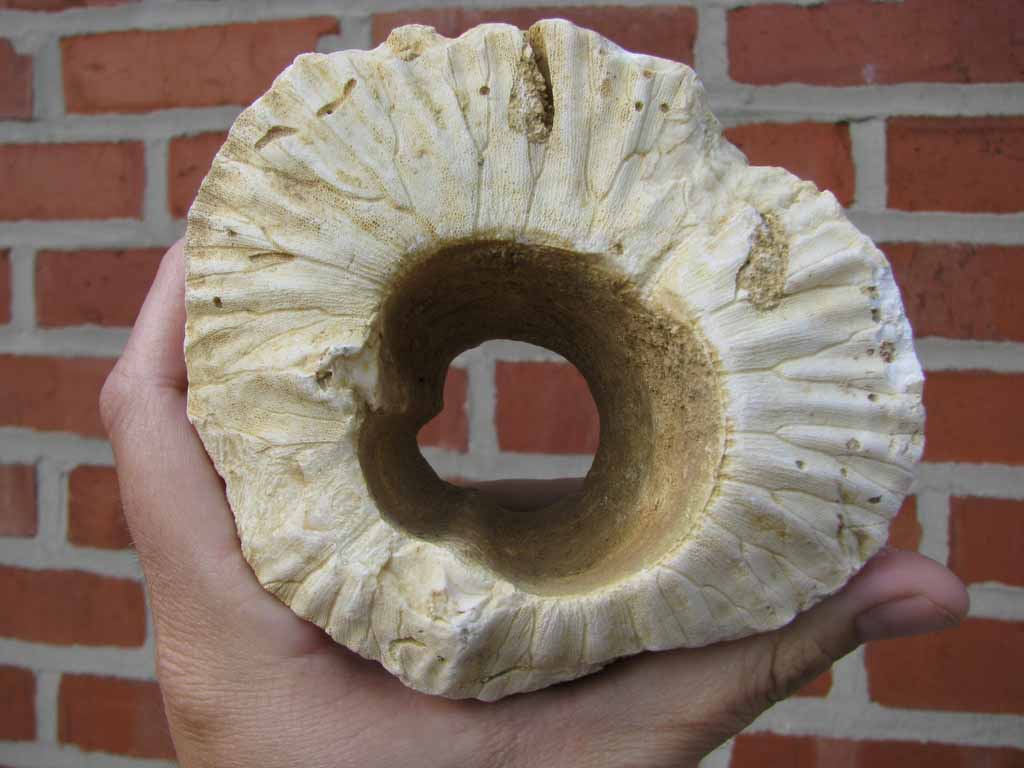
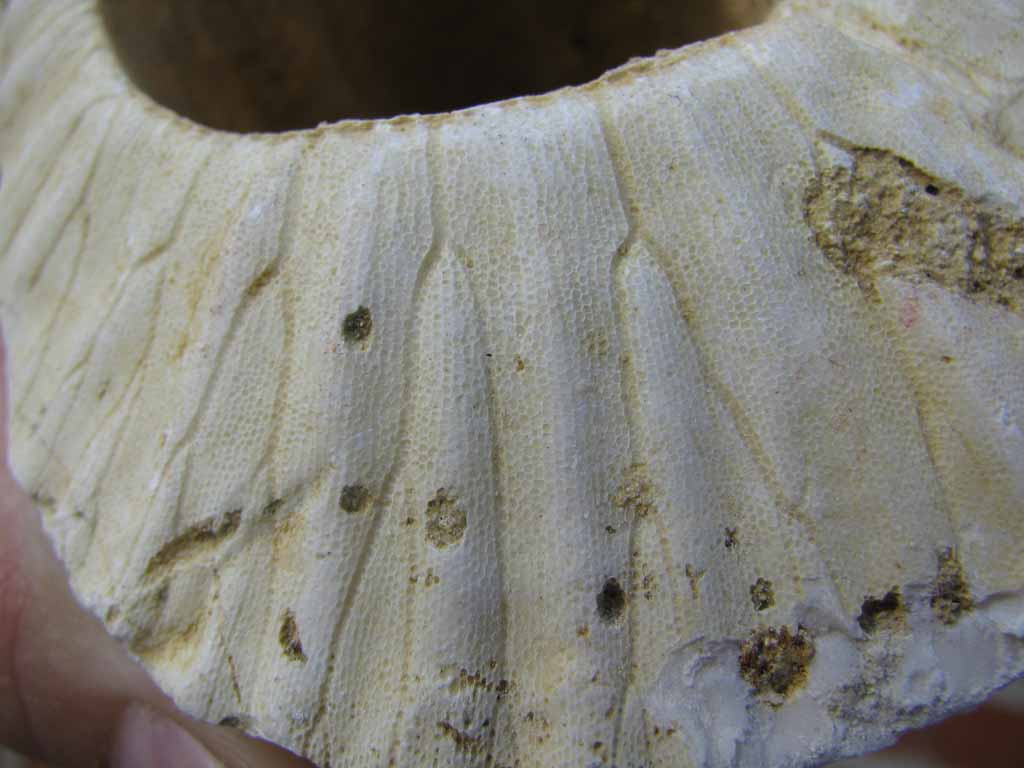
Rudists are a class of Pelcypods that have one valve that is much larger than the other. They are best known for being reef builders during the Cretaceous. Below is a specimen of Laperousia crateriformis from the Cretaceous (Cenomarian) near Magnac, France. It is just one of the valves from the animal.
In the top view you can see "veins" and patterning along the edges where the other valve (which would have been flat or slightly domed) would have rested.
This is a view into the body chamber where the animal lived.
Side view showing layered growth.
Bottom view of the specimen. This was not the very base but just a small portion of a much larger structure.
In the top view you can see "veins" and patterning along the edges where the other valve (which would have been flat or slightly domed) would have rested.
This is a view into the body chamber where the animal lived.
Side view showing layered growth.
Bottom view of the specimen. This was not the very base but just a small portion of a much larger structure.
Subscribe to:
Posts (Atom)