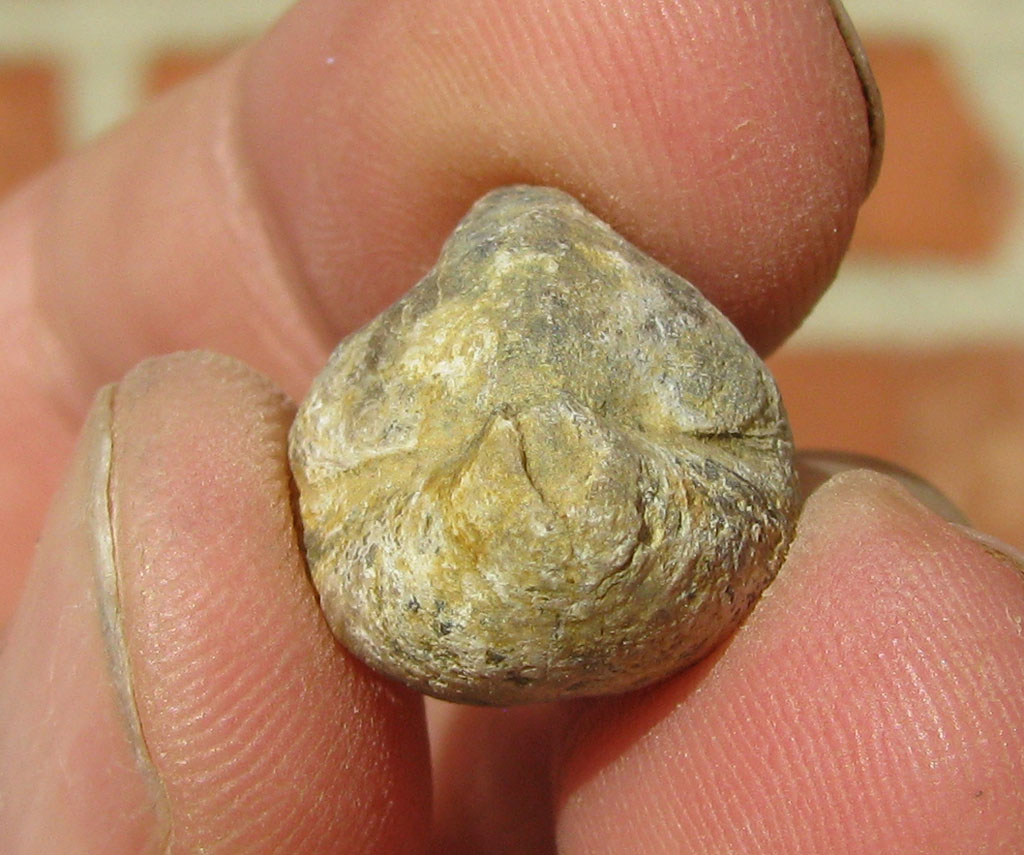
Here is another mystery brachiopod from the Chainman formation of Utah. It is a triangular shaped shell which is longer than wide. Both valves have coarse folds that extend from the hinge line to the anterior margins with a simple fold and sulcus. The hinge line is flat and runs the length of the anterior margin. A small triangular shaped delthyrium is present on the anterior of the pedicle valve but it is only 1/2 the length of the hinge line. My initial speculation as to the identity of this shell was that it is a Punctospirifer sp. But while reading through some publications concerning Mississippian faunas in Western US formations, I came across a similar looking shell called Spiriferellina sp. I want to lean towards the latter name because it would be more appropriate for the region I found it in. Still, without a complete shell or multiple examples I probably can not truly identify this specimen.
Brachial valve
Anterior
Pedicle valve
Posterior
Profile
This
specimen came from the Chainman formation at Conger Springs (west of
Delta), Utah and is Carboniferous (Mississippian epoch, Visean stage of
the ICS or
Mississippian period, Chesterian stage in the US) in age.
Showing posts with label Carboniferous. Show all posts
Wednesday, February 3, 2016
Sunday, January 31, 2016
Reticulariina sp. ? brachiopod from the Chainman formation of Utah
I believe this next fossil is a Reticulariina sp. brachiopod but am not sure of the species. It comes from the Chainman formation of Utah which is lower Carboniferous in age (Mississippian epoch, Visean stage of
the ICS or
Mississippian period, Chesterian stage in the US). The shell is small, with a very convex pedicle valve and a flat to slightly convex brachial valve. It sort of resembles a Cyrtia sp. type brachiopod that occurred in the Devonian. Each valve has very coarse plications with 2-3 on each side of the median. There is a sulcus and fold structure present on the valves but it is only noticeable at the anterior margins. It is hard to see but it appears there are some sort of concentric growth lines decorating the shell surface as well. The posterior of the pedicle valve has a large triangular interarea under a beak that recurves back.
Brachial valve
Anterior
Pedicle valve
Posterior
Profile
This specimen came from the Chainman formation at Conger Springs (west of Delta), Utah and is Carboniferous (Mississippian epoch, Visean stage of the ICS or Mississippian period, Chesterian stage in the US) in age.
Brachial valve
Anterior
Pedicle valve
Posterior
Profile
This specimen came from the Chainman formation at Conger Springs (west of Delta), Utah and is Carboniferous (Mississippian epoch, Visean stage of the ICS or Mississippian period, Chesterian stage in the US) in age.
Thursday, January 28, 2016
Anthracospirifer sp. brachiopod from the Chainman formation of Utah
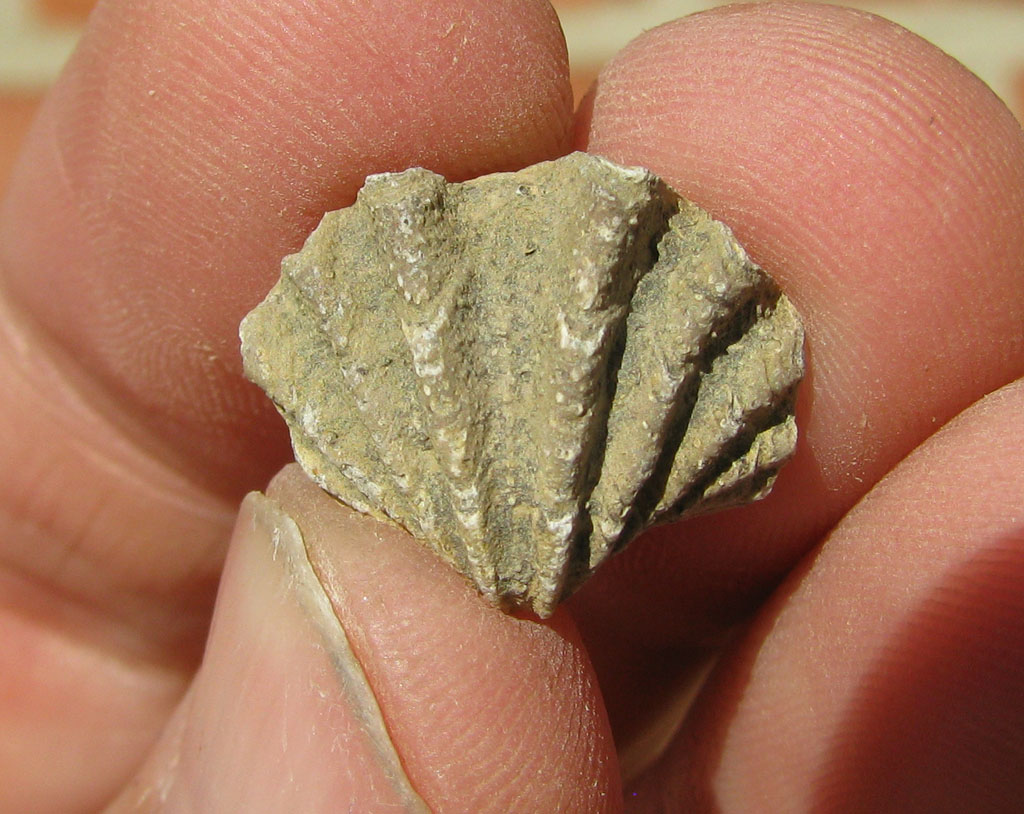
I believe this next brachiopod fossil is Anthracospirifer sp.. It comes from the Chainman formation at Conger Springs in Utah. The shell is missing part of a "wing" but enough is left to help identify it. The pedicle and brachial valves are equally convex, rectangular shaped and have coarse plications. A sulcus on the pedicle valve corresponds with a single fold on the brachial valve. The pedicle valve has a wide interarea with a recurved beak.
Brachial valve
Anterior
Pedicle valve
Posterior
Profile
There are a number of known species of Anthracospirifer but little literature on what specific forms occur in the Chainman formation. One resource, "Mississippian Stratigraphy of the Diamond Peak Area, Eureka County, Nevada", Brew, David, 1971, Indicates that A. occiduus, A. pellaensis, A. increbescens and A. bifurcatus are found in equivalent strata in Nevada but I can find no clear illustrations of those species or those I find do not match what I have here..
The reference "Brachiopoda of the Amsden Formation (Mississippian and Pennsylvanian) of Wyoming.", MacKenzie Gordon, Jr., 1975 lists multiple species of Anthracospirifer, including A. occiduus but none seem to match my specimen.
This specimen came from the Chainman formation at Conger Springs (west of Delta), Utah and is Carboniferous (Mississippian epoch, Visean stage of the ICS or Mississippian period, Chesterian stage in the US) in age.
Brachial valve
Anterior
Pedicle valve
Posterior
Profile
There are a number of known species of Anthracospirifer but little literature on what specific forms occur in the Chainman formation. One resource, "Mississippian Stratigraphy of the Diamond Peak Area, Eureka County, Nevada", Brew, David, 1971, Indicates that A. occiduus, A. pellaensis, A. increbescens and A. bifurcatus are found in equivalent strata in Nevada but I can find no clear illustrations of those species or those I find do not match what I have here..
The reference "Brachiopoda of the Amsden Formation (Mississippian and Pennsylvanian) of Wyoming.", MacKenzie Gordon, Jr., 1975 lists multiple species of Anthracospirifer, including A. occiduus but none seem to match my specimen.
This specimen came from the Chainman formation at Conger Springs (west of Delta), Utah and is Carboniferous (Mississippian epoch, Visean stage of the ICS or Mississippian period, Chesterian stage in the US) in age.
Monday, January 25, 2016
Cleiothyridina hirsuta brachiopod from the Chainman formation of Utah
Looking very much like an Athyris sp. brachiopod, this fossil is Cleiothyridina hirsuta. It is a rounded to subovate shell with both the pedicle and brachial valve equally convex. The surface of each valve has concentric growth lines but no obvious costae or sulcus.
Brachial valve
Anterior
Pecidle valve
Posterior
Profile
I used the reference "Brachiopoda of the Amsden Formation (Mississippian and Pennsylvanian) of Wyoming.", MacKenzie Gordon, Jr., 1975 pg. 56, plate 7, fig 31, 38-40, 42-45, 58, 59 to identify this brachiopod. This specimen came from the Chainman formation at Conger Springs (west of Delta), Utah and is Carboniferous (Mississippian epoch, Visean stage of the ICS or Mississippian period, Chesterian stage in the US) in age.
Brachial valve
Anterior
Pecidle valve
Posterior
Profile
I used the reference "Brachiopoda of the Amsden Formation (Mississippian and Pennsylvanian) of Wyoming.", MacKenzie Gordon, Jr., 1975 pg. 56, plate 7, fig 31, 38-40, 42-45, 58, 59 to identify this brachiopod. This specimen came from the Chainman formation at Conger Springs (west of Delta), Utah and is Carboniferous (Mississippian epoch, Visean stage of the ICS or Mississippian period, Chesterian stage in the US) in age.
Friday, January 22, 2016
Inflatia sp. brachiopod from the Chainman formation of Utah
I found this specimen of a spiny productid brachiopod at Conger Springs, Utah. I believe it is an example of the genus Inflatia. I am unsure as to the species because the preservation is not the best. It was a spiny brachiopod but not as spiny as a similar genus, Juresania. The pedicle valve is very convex while the brachial valve is flat to slightly convex and the margins of both meet at a 90 degree angle to the brachial valve. Both valves are decorated with linear costae but only the pedicle valve has spines. The spines appear somewhat randomly placed although there could be a pattern that I don't recognize.
Pedicle valve
Anterior
Brachial valve
Posterior
Profile
I used the reference "Brachiopoda of the Amsden Formation (Mississippian and Pennsylvanian) of Wyoming.", MacKenzie Gordon, Jr., 1975 pg. 36, plate 3, fig 1-9 to identify this brachiopod.
This specimen came from the Chainman formation at Conger Springs (west of Delta), Utah and is Carboniferous (Mississippian epoch, Visean stage of the ICS or Mississippian period, Chesterian stage in the US) in age.
Pedicle valve
Anterior
Brachial valve
Posterior
Profile
I used the reference "Brachiopoda of the Amsden Formation (Mississippian and Pennsylvanian) of Wyoming.", MacKenzie Gordon, Jr., 1975 pg. 36, plate 3, fig 1-9 to identify this brachiopod.
This specimen came from the Chainman formation at Conger Springs (west of Delta), Utah and is Carboniferous (Mississippian epoch, Visean stage of the ICS or Mississippian period, Chesterian stage in the US) in age.
Tuesday, January 19, 2016
Crurithyris sp.? brachiopod from the Chainman formation of Utah
This next brachiopod looks very similar to a genera called Crurithyris that is present in the Pennsylvanian. I can't locate any literature or examples from the Chainman formation at Conger Springs, Utah that indicate this could be any other genera. So I am tentatively labeling this as Crurithyris sp. The shell is small, wider than long with a very convex pedicle valve and a slightly convex brachial valve. The valves are smooth with no obvious ornamentation. The pedicle valve recurves back over the interarea and the margins of the valves are flat with no evidence of a fold or sulcus.
Brachial valve
Anterior
Pedicle valve
Posterior
Profile
This specimen came from the Chainman formation at Conger Springs (west of Delta), Utah and is Carboniferous (Mississippian epoch, Visean stage of the ICS or Mississippian period, Chesterian stage in the US) in age.
Brachial valve
Anterior
Pedicle valve
Posterior
Profile
This specimen came from the Chainman formation at Conger Springs (west of Delta), Utah and is Carboniferous (Mississippian epoch, Visean stage of the ICS or Mississippian period, Chesterian stage in the US) in age.
Wednesday, January 13, 2016
Composita elongata brachiopod from the Chainman formation of Utah
Another Composita species that I found in the Chainman formation of Utah is Composita elongata. This species is narrower than some but this particular specimen has a very strong fold and sulcus that is well developed. According to MacKenzie (see below for reference), C. elongata may intergrade with C. subtilita (see previous post). This means that the two species sometimes share the same form but remain distinct.
I used the reference "Brachiopoda of the Amsden Formation (Mississippian and Pennsylvanian) of Wyoming.", MacKenzie Gordon, Jr., 1975 pg. 64, plate 10, fig 16-25 to identify this brachiopod.This specimen came from Conger Springs west of Delta, Utah and is Carboniferous (Mississippian epoch, Visean stage of the ICS or Mississippian period, Chesterian stage in the US) in age.
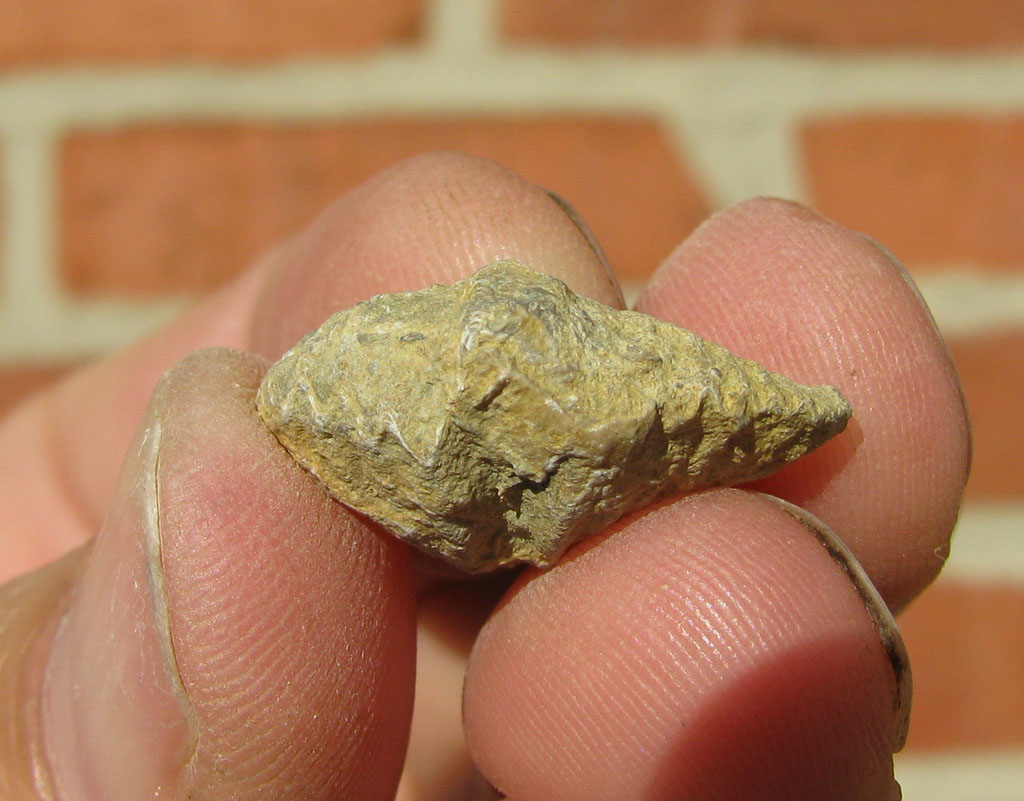
Pedicle valve
Anterior
Brachial valve
Posterior
Profile (with pedicle valve on top)
Profile (with brachial valve on top)
I used the reference "Brachiopoda of the Amsden Formation (Mississippian and Pennsylvanian) of Wyoming.", MacKenzie Gordon, Jr., 1975 pg. 64, plate 10, fig 16-25 to identify this brachiopod.
I used the reference "Brachiopoda of the Amsden Formation (Mississippian and Pennsylvanian) of Wyoming.", MacKenzie Gordon, Jr., 1975 pg. 64, plate 10, fig 16-25 to identify this brachiopod.This specimen came from Conger Springs west of Delta, Utah and is Carboniferous (Mississippian epoch, Visean stage of the ICS or Mississippian period, Chesterian stage in the US) in age.
Pedicle valve
Anterior
Brachial valve
Posterior
Profile (with pedicle valve on top)
Profile (with brachial valve on top)
I used the reference "Brachiopoda of the Amsden Formation (Mississippian and Pennsylvanian) of Wyoming.", MacKenzie Gordon, Jr., 1975 pg. 64, plate 10, fig 16-25 to identify this brachiopod.
Sunday, January 10, 2016
Composita subtilita brachiopod from the Chainman formation of Utah
Today I have a specimen of what I believe is Composita subtilita from the Carboniferous (Mississippian epoch, Visean stage of the ICS or Mississippian period, Chesterian stage in the US) rocks of Utah. It was found near Conger Springs which is about 63 miles (as the crow flies) west of the town of Delta in Millard County. The rocks exposed at Conger springs are the Chainman formation and are the youngest Mississippian layers before changing to the Pennsylvanian. The shell of Composita subtilita is round to ovate with a fold in the pedicle valve that corresponds to a sulcus in the brachial valve. The fold is shallow at the beak and gets gradually wider and deeper as it progresses to the anterior margins. Both valves are equally convex and are widest about mid way between the anterior and posterior.
Brachial valve
Anterior
Pedicle valve
Posterior
Profile
I used the reference "Brachiopoda of the Amsden Formation (Mississippian and Pennsylvanian) of Wyoming.", MacKenzie Gordon, Jr., 1975 pg. 64, plate 10, fig 33-37 to identify this brachiopod.
Brachial valve
Anterior
Pedicle valve
Posterior
Profile
I used the reference "Brachiopoda of the Amsden Formation (Mississippian and Pennsylvanian) of Wyoming.", MacKenzie Gordon, Jr., 1975 pg. 64, plate 10, fig 33-37 to identify this brachiopod.
Friday, November 14, 2014
Fossil Paleosol with root impressions
While exploring an old coal strip mine in Gilberton, PA I noticed that
there was an exposed wall of rock that used to be covered in overburden.
The wall was relatively smooth but had some grooves in it. Upon closer
inspection, the grooves turned out to be the impressions of tree roots
called Stigmaria. Since these are roots, and they appear to have been preserved in situ, makes
me think that the exposed rock is a Paleosol or fossil soil horizon.
I encourage you to click on the photos to examine the detail.
Above is one section of an exposed Stigmaria with a length over six feet. It actually is exposed a little more as it heads right but it dives under some rock and is less visible.
Here is the wall from father away.
And I took a bunch of photos to make a panorama of a closer view of the wall was well.
What is preserved in this wall is a glimpse of a forest from long ago. Sure, it may not have lots of leaf or bark impressions but the fact that there are so many long, spindly roots preserved gives an indication about how crowded the forest must have been.
I encourage you to click on the photos to examine the detail.
Above is one section of an exposed Stigmaria with a length over six feet. It actually is exposed a little more as it heads right but it dives under some rock and is less visible.
Here is the wall from father away.
And I took a bunch of photos to make a panorama of a closer view of the wall was well.
What is preserved in this wall is a glimpse of a forest from long ago. Sure, it may not have lots of leaf or bark impressions but the fact that there are so many long, spindly roots preserved gives an indication about how crowded the forest must have been.
Monday, November 10, 2014
Results of a recent hunt in some old Coal tailings
I've been very busy these last few weeks going collecting and that has caused me to be a little backed up on the blog. Once the weather turns cold I will have more time to focus on writing entries. In the meantime, posts may be a little more sporadic and focused on what I'm finding in the field. Today is just such a post and I'm showing off some Lepidodendron bark impressions that I found this past weekend near Gilberton, PA. They were collected from some old coal mine tailings piles. The coal mines in Schuylkill County, where Gilberton is located, exploited the anthracite coal seams of the Llwellyn formation which is Upper Carboniferous in age (Kasimovian-Gzhelian stage of the ICS or Upper Westphalian to Stephanian stage in Europe).
I first found this hunk of sandstone with a very nice bark impression. The sandstone is normally grey but is stained yellow-orange by iron deposits.
Next I found this larger piece which is in shale. It is damaged some but I brought home a couple of pieces with better definition.
Then I found this branch impression of what I think in Sigillaria. It's hard to see from the photo but there is curvature to the fossil. It was too delicate to remove so it was left in place.
Lastly I found this partial log (or stump?) partially buried in the pile. Once I excavated it I found that it was about 20" wide, 18" tall and 8" thick. No detail remained on the cast so I couldn't tell what kind of tree it was.
Unfortunately the piece was too heavy for me to try and haul back to my car, let alone lift it into the trunk. It must have weighed more than 100 lbs! It would have looked nice in my yard but I left it behind for some other, more enterprising collector to find.
I first found this hunk of sandstone with a very nice bark impression. The sandstone is normally grey but is stained yellow-orange by iron deposits.
Next I found this larger piece which is in shale. It is damaged some but I brought home a couple of pieces with better definition.
Then I found this branch impression of what I think in Sigillaria. It's hard to see from the photo but there is curvature to the fossil. It was too delicate to remove so it was left in place.
Lastly I found this partial log (or stump?) partially buried in the pile. Once I excavated it I found that it was about 20" wide, 18" tall and 8" thick. No detail remained on the cast so I couldn't tell what kind of tree it was.
Unfortunately the piece was too heavy for me to try and haul back to my car, let alone lift it into the trunk. It must have weighed more than 100 lbs! It would have looked nice in my yard but I left it behind for some other, more enterprising collector to find.
Subscribe to:
Comments (Atom)