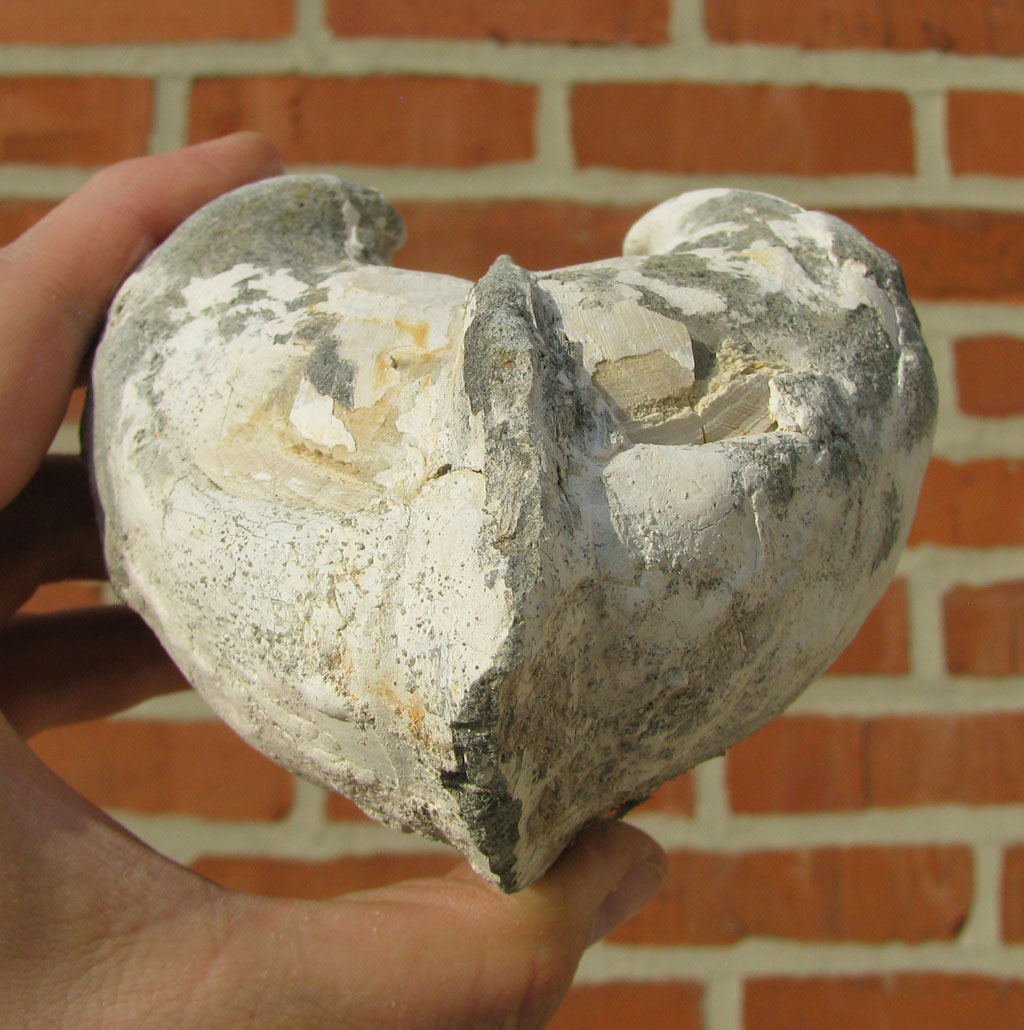
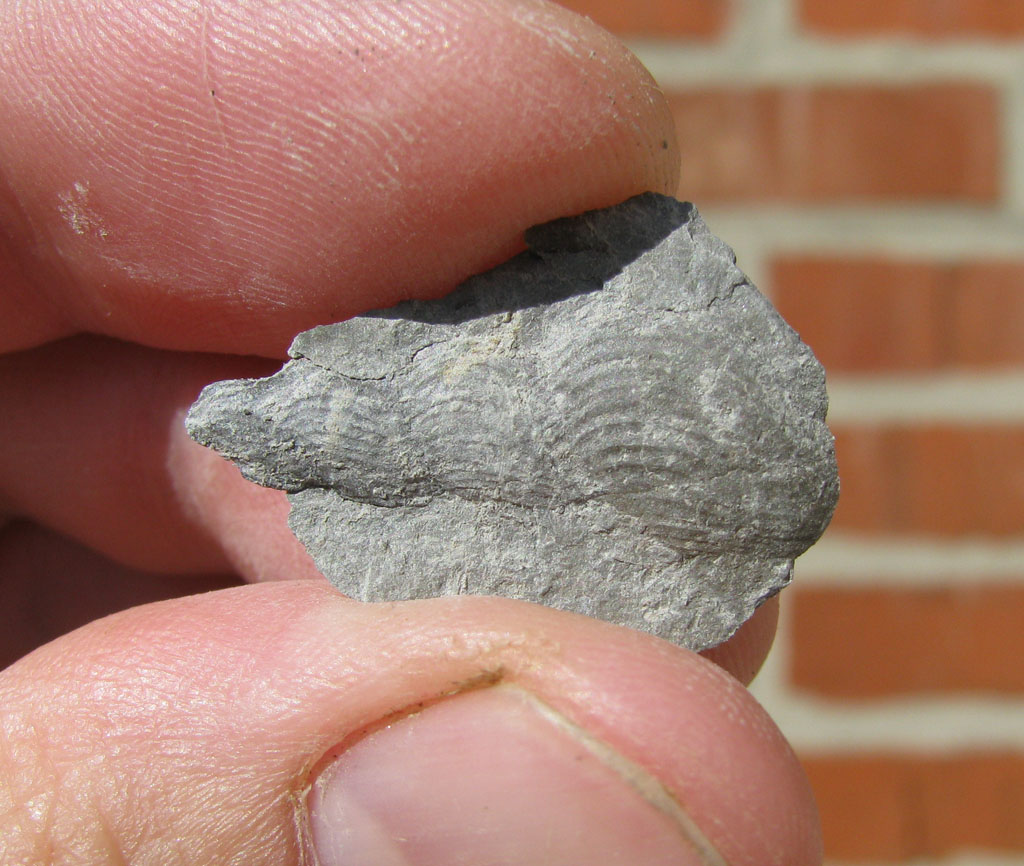
This is a small piece of an Arachnophyllum sp. coral from the Silurian aged Fiborn limestone member of the Hendricks formation. It was found near Trout Lake, Michigan. I purchased it as a comparison piece for those that I have from the Louisville Limestone of Kentucky.
The information I can find on the Fiborn Limestone indicates that, Chronostratigraphically, it is part of the Niagaran series. It is part of the Burnt Bluff group which comprise the lower to middle section of the Niagaran series with the Fiborn Limestone near the top of the group. Thus I am speculating that it is within the Wenlock epoch and Sheinwoodian stage of the UCS charts.
Wednesday, August 13, 2014
Monday, August 11, 2014
Cucullaea gigantea pelecypod from the Aquia Formation
I recently traded with a fellow in my local club for these two Cucullaea gigantea from Henson Creek, Maryland. They come from the Aquia Formation (Paleocene age). It earns its name as these casts are really huge! I've read about the site where these can be found but just have not been able to get down there to collect some myself.
Specimen #1
Specimen #2
Specimen #1
Specimen #2
Saturday, August 9, 2014
Greenops pygidium from the Windom shale
Here is a very large Greenops sp. pygidium that I found in the Bay View Coral bed of the Windom shale (Moscow Formation, Givetian stage of the Devonian). It's remarkable for me due to the size of the specimen and the preservation of the "tail feathers" (as I like to call them).
Thursday, August 7, 2014
A few recent mollusks from the Windom Shale
My spring visit to the Penn Dixie site near Blasdell, NY yielded some new mollusk fossils for me that I'd not found at the site previously.
First is this very delicate Paleozygopleura sp. gastropod. It's preserved on both sides of a very thin shale chip. the curved growth lines that can be seen are the tell tale sign of what this is.
Next up is a Paleoneilo emarginata next to a Rhipidomella penelope brachiopod
Lastly are these Nuculoidea corbuliformis
All three specimens came from the Bay View Coral bed in the Windom shale member of the Moscow Formation (Devonian, Givetian stage).
First is this very delicate Paleozygopleura sp. gastropod. It's preserved on both sides of a very thin shale chip. the curved growth lines that can be seen are the tell tale sign of what this is.
Next up is a Paleoneilo emarginata next to a Rhipidomella penelope brachiopod
Lastly are these Nuculoidea corbuliformis
All three specimens came from the Bay View Coral bed in the Windom shale member of the Moscow Formation (Devonian, Givetian stage).
Tuesday, August 5, 2014
Favosites turbinatus coral from the Onondoga Formation
Prior to finding the specimen below, Favosites turbinatus was a species that I'd found only in Givetian aged rocks. This specimen was found in the Edgecliff member of the Onondoga Formation south of Syracuse, NY. The fossil is somewhat cramped looking so let me walk you through the pictures.
This is a view of the bottom of the coral. This is the side that would have been lying in the mud. Note that in this view the corrallites appear smooth but without an epitheca as though they were in contact with a surface. This is because Favosites turbinatus grew inside the shells of dead pelecypods and gastropods. Note also the large partial crinoid column section (the rectangular piece that appears to have "layers" perpendicular to it) that is embedded with the specimen.
Now I've turned the piece 90o towards the camera. Starting on the left and proceeding right is the tell tale curved portion that resembles the interior of a pelecypod or gastropod shell.
This picture has the piece rotated 90o left and now you can see some of the individual corrallites that grew against the edge of the shell in which the colony was growing. Weathering has pitted some of the corrallites, giving a false impression that they were open and exposed. What is evident here is that the colony budded to the side and continued expanding along the sides of the shell. Some matrix is still attached above them.
Now I have rotated the specimen 180o from the first picture, but this time it was towards the camera. At this angle you can see the edge of the colony and the first corrallites that were actually exposed to the water. There is still quite a bit of matrix that covers the rest of the colony surface. From what I can tell the colony did not grow upwards as quickly as it did "sideways".
For reference see this F. turbinatus specimen from the Widder formation, this specimen from the Ludlowville formation or these specimens from the Jeffersonville limestone.
The Edgecliff member is from the Emsian stage of the Devonian. I confirmed my initial suspicions as to the ID of the coral after reading - STRATIGRAPHY OF THE ONONDAGA LIMESTONE (DEVONIAN) IN CENTRAL NEW YORK By William A. Oliver, Jr (Bulletin of the Geological Society of America VOL. 66. PP. 621-662. JULY 1954).
This is a view of the bottom of the coral. This is the side that would have been lying in the mud. Note that in this view the corrallites appear smooth but without an epitheca as though they were in contact with a surface. This is because Favosites turbinatus grew inside the shells of dead pelecypods and gastropods. Note also the large partial crinoid column section (the rectangular piece that appears to have "layers" perpendicular to it) that is embedded with the specimen.
Now I've turned the piece 90o towards the camera. Starting on the left and proceeding right is the tell tale curved portion that resembles the interior of a pelecypod or gastropod shell.
This picture has the piece rotated 90o left and now you can see some of the individual corrallites that grew against the edge of the shell in which the colony was growing. Weathering has pitted some of the corrallites, giving a false impression that they were open and exposed. What is evident here is that the colony budded to the side and continued expanding along the sides of the shell. Some matrix is still attached above them.
I've rolled the specimen about 180o from the first picture.
Now I have rotated the specimen 180o from the first picture, but this time it was towards the camera. At this angle you can see the edge of the colony and the first corrallites that were actually exposed to the water. There is still quite a bit of matrix that covers the rest of the colony surface. From what I can tell the colony did not grow upwards as quickly as it did "sideways".
For reference see this F. turbinatus specimen from the Widder formation, this specimen from the Ludlowville formation or these specimens from the Jeffersonville limestone.
The Edgecliff member is from the Emsian stage of the Devonian. I confirmed my initial suspicions as to the ID of the coral after reading - STRATIGRAPHY OF THE ONONDAGA LIMESTONE (DEVONIAN) IN CENTRAL NEW YORK By William A. Oliver, Jr (Bulletin of the Geological Society of America VOL. 66. PP. 621-662. JULY 1954).
Subscribe to:
Posts (Atom)