Showing posts with label Maryland. Show all posts

Monday, August 11, 2014

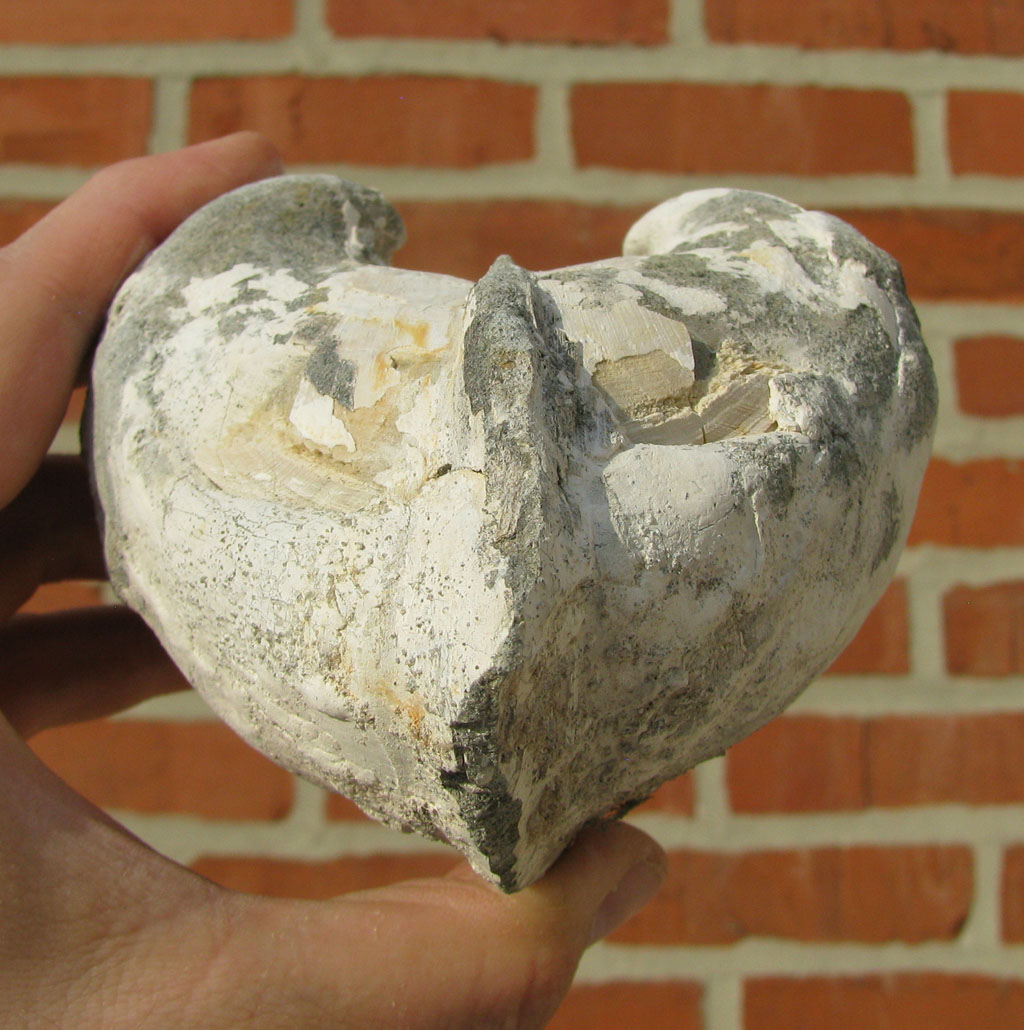
Cucullaea gigantea pelecypod from the Aquia Formation

I recently traded with a fellow in my local club for these two Cucullaea gigantea from Henson Creek, Maryland. They come from the Aquia Formation (Paleocene age). It earns its name as these casts are really huge! I've read about the site where these can be found but just have not been able to get down there to collect some myself.

Specimen #1


Specimen #2


Monday, August 26, 2013

Chesapecten nefrens pelecypod from Maryland

Another group of pictures from my folder clean up feature this Chesapecten nefrens pelecypod from the Calvert formation of Maryland. I collected this 25 years ago while on a trip to Calvert Cliffs in Maryland. It was found in the Choptank formation while staying at Matoaka Cottages.

Left valve

Right valve
Right profile
Posterior

Interior of both valves. The white paint and ink lettering were a short lived attempt by my younger self to catalog my fossil collection at the time. In this case the "CC" stood for Calvert Cliffs and the number indicates that this was the first numbered specimen (but not necessarily the first specimen I found).

The Choptank formation dates to the Miocene epoch (Langhian to Serravallian stages) of the Neogene period.

Sunday, August 12, 2012

Marcellus shale Crinoids

This past April I took a trip through Virginia and West Virginia exploring some sites that were listed in the book "Fossil Collecting in the Mid-Atlantic States" by Jasper Burns. This is an old shale pit that exposed some Marcellus formation rocks in Maryland.


The Marcellus shale is not know for it's fossils as it was a deep water black shale formed in anoxic conditions. It's more commonly known for being the rock formation that all the natural gas drillers in the NE are trying to "frack". However this site does happen to have some notable fossils of, surprisingly, Crinoids. Intact and articulated Crinoids. I spent about a hour searching the site and fossils can be found but they are very isolated and difficult to locate.

An isolated arm with pinnules.

More arms

I think there may be a calyx hidden where this three arms disappear into the rock.

This piece definitely has a calyx (on the right side of the slab) but the preservation is not good enough for an ID.

The only other fossil I found besides Crinoids were these occasional productid brachiopods.

I came across this specimen at a fossil show back in March that I think is from the same locality. I think it's an Arthroacantha similar to this specimen from the Silica Shale in Ohio. It's a nice piece to compare with what I found at the site myself and to tempt me to go back again.


I would be interested in learning more about this paleoecology of this site and how articulate crinoids came to be preserved here. Did they colonize the substrate when oxygen levels were higher only to succumb when the dropped again? Were they "blown" in by storm currents? Were they attached to floating debris but dropped off? Whatever the case it's a rare thing to find any parts of a crinoid articualted so I will be back to this site again in the future.

I came across this specimen at a fossil show back in March that I think is from the same locality. It's a nice piece to compare with what I found.

The above specimen came from an old quarry near Big Spring in Washington county, Maryland. The cut is listed as site #21 in the book "Fossil Collecting in the Mid-Atlantic States" by Jasper Burns. The Marcellus formation is part of the Givetian stage of the middle Devonian. 

Friday, September 24, 2010

Aquia Fm. visit part 2

My previous post explained my trip and the local geology so this one will be about the fossils I found.

I'll start with the greenish oysters that I left off with in my last post. These seems to be two different species.

The first is Ostrea compressirostra which is identified by it's wide flattened valves:


The second is Gryphaeostrea vomer which has a fuller profile than O. compressirostra:


As Oysters are wont to do, it's easy to find the shells clustered and growing on/with each other:


Some sections of the sediments have been cemented with leached iron from overlying sediments. This seems to have been the case with a layer that is profuse with Turritella fossils as the internal molds are very abundant on the beach resembling corkscrews.


Here is a chunk of matrix with a Turritella internal mold preserved in situ.


Some clam shells had been preserved in the same way and their internal molds were occasionally found as well:


One of the more fascinating fossils were the spiderweb like remains of the shell boring sponge Cliona. They had been preserved as though hovering above the internal shell molds like a net holding a precious cargo:


More Sand Shark teeth were found with one poking out of the cliff face:


My find for the day was this extinct Mackerel shark tooth Otodus obliquus that I found lying next to my backpack.


This site was very productive for me on this trip and I will definitely visit it again in the near future when the tides are low.

Wednesday, September 22, 2010

Aquia Fm. visit part 1

Recently I visited the Potomac river in Maryland to check out a river exposure of the upper Paleocene aged Aquia Formation. There are many exposures of Tertiary period sediments along the Potomac river and Chesapeake Bay but most are only accessible via watercraft. A friend from the Fossil Forum suggested a good area that I could reach on foot as I have no kayak or other boat to navigate the river.

The river was calm as was the weather with a sunny low 80's forecast for the day.


I walked along the beach stopping every now and again to closely examine the gravel along the tide line. I found my first tooth quickly:


It was a small one as were several others I found as I continued down the beach dodging the fallen trees as I went.


As I continued I came up to some sheer cliffs that exposed the formation and the plethora of mollusk shells contained within. You can large blocks of the cliff that have fallen and can be more easily picked over at the base.


This picture shows you the strata of the cliffs with a basal unit that is full of greenish Glauconite clay and it grades (somewhat abruptly) into lighter colored sandy sediments.


Most of the Tertiary sediments that are exposed along the east coast of the United States are generally unconsolidated (not turned to rock yet). The exceptions are limestone or coquina rock which have been cemented with calcium carbonate. At this location we have sandy marls that are full of mollusk shells. I could see cross sections of clams and Gastropods as well as some more complete shells, but they were all soft and crumbled at my touch. This was likely due to exposure to weathering which leached much of the calcium carbonate from the shells and left them friable. This is not an uncommon occurrence in unconsolidated sediments but can vary from site to site due to regional differences in weathering and original deposition.


Here a Turitella sp. gastropod shell is exposed. You can see that it's very fragile and part has already broken off with the rest soon to follow. It's little to no use trying to salvage blocks of the sediment as the shells crumble whether they are wet or dry.


In fallen blocks of the cliff you could see horizontal sections of the sediments, but the results were similar. I did collect a few small pieces of matrix and I need to soak them in a liquid consolidator and maybe that will help preserve the delicate shells.


In this picture you can see some greenish oyster shells preserved in the sediment along with the gastropods and clams. Surprisingly the oysters are very solid and easily collected.


They often weather out of the cliffs intact and can be found at the base or along the tide line easily. I'll post some pictures of them and some of the other fossils I found in my next post.