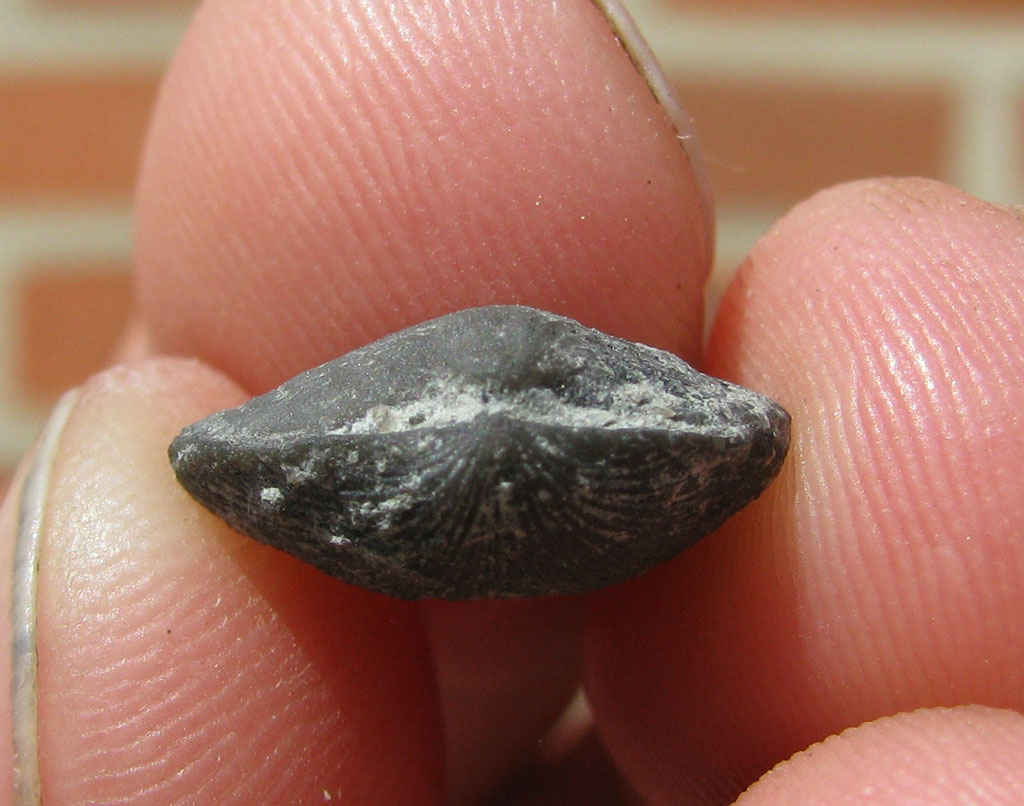
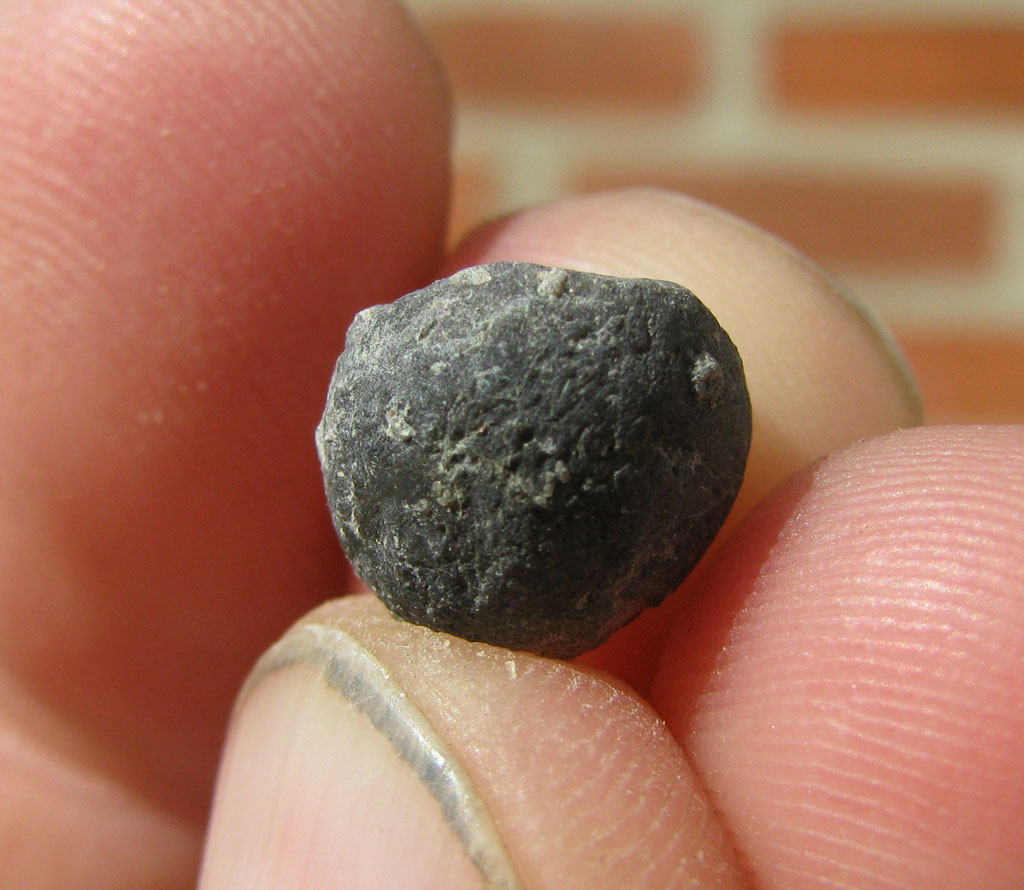
I'm really torn on how to classify these next fossils from the Kalkberg formation. To my eye they look like Rhipidomella sp., which is very common in middle Devonian aged rocks, but I cannot find any literature that lists that genus as being found in the Kalkberg formation. What I have been able to find lists shells that look similar to these as belonging to the genus Orthis. Doing a little research on the Fossilworks.org website indicates that both Rhipidomella and Orthis are part of the same order, Orthida, but they diverge into separate families from there. It may be that minute details of the internal structure is what differentiates them from one another,
Here are two different specimens that show the size range of these brachiopods.
The smaller specimen is more complete so I will profile that for this post. This is the Brachial valve
Anterior
Pedicle valve
Posterior
Profile - note that in the profile, the anterior appears to be nearly flat. In some specimens of both Rhipidomella and Orthis, species can be differentiated if the pedicle valve sticks out beyond the margin.
These specimens were collected from the Kalkberg formation (Devonian, Lockhovian to Pragian stage) in a road cut near Schoharie, NY.
Sunday, August 2, 2015
Friday, July 31, 2015
Edriocrinus policiformis crinoid "cup" from the Kalkberg formation of New York
These little Edriocrinus policiformis crinoid cups are somewhat common in the Kalkberg formation of New York. They are a pretty good indicator that the rocks are lower Devonian in age. These fossils are just the base of the crinoid calyx (which may have been free floating) and there were other plates attached that would extend the calyx up to the arms. They are fairly easy to ID as they look like small gumdrops that are hollow.
Specimen #1 - The first three photos in this sequence is viewing a profile of the calyx as I rotate it 120 degrees between shots.
This is the "oral" side of the cup.
This is the anterior or bottom of the cup.
This specimen is still attached to matrix and is a little taller than the previous specimen.
The Edriocrinus policiformis fossils I found in the Kalkberg formation compare nicely to those that I found in the Licking Creek formation of Virgina as seen here. The Virginia specimens are a little larger and "more complete" but have been replaced with silica. The Kalkberg formation is concurrent with the Licking Creek formation. Both are dated to the Lockhovian-Pragian stage of the lower Devonian. I found all the above specimens at a roadcut near Schoharie, NY.
Specimen #1 - The first three photos in this sequence is viewing a profile of the calyx as I rotate it 120 degrees between shots.
This is the "oral" side of the cup.
This is the anterior or bottom of the cup.
This specimen is still attached to matrix and is a little taller than the previous specimen.
The Edriocrinus policiformis fossils I found in the Kalkberg formation compare nicely to those that I found in the Licking Creek formation of Virgina as seen here. The Virginia specimens are a little larger and "more complete" but have been replaced with silica. The Kalkberg formation is concurrent with the Licking Creek formation. Both are dated to the Lockhovian-Pragian stage of the lower Devonian. I found all the above specimens at a roadcut near Schoharie, NY.
Wednesday, July 29, 2015
Trilobites from the Kalkberg formation of New York
I have not found too many trilobite fossils in my limited searching of the Kalkberg formation but I did find pieces of two different species.
The first are these free cheeks from Acidaspis tuberculatus. Note the knobby extensions that are spaced along the edge of the genal spine up to where the cheek attached to the rest of the cephalon.
The other, major piece of trilobite that I found was this thorax-pygidium combo from what I believe was a Paciphacops logani. I was very excited when I first spied this fossil lying on the surface of the rock. At the time the anterior was covered with some loose rocks but once I removed them only this remained. Since I found it in a road cut, perhaps it fell from a higher rock and landed on the bench I was exploring. It's too bad the cephalon was not with it as this would be a really nice specimen. As it is, a little light cleaning and I should be able to expose more of the exoskeleton.
It's a very thin fossil on a very thin piece of shaly limestone.
Both of these fossils came from the same roadcut near Schoharie, NY which exposed the Lockhovian to Pragian stage (Devonian) aged Kalkberg formation.
The first are these free cheeks from Acidaspis tuberculatus. Note the knobby extensions that are spaced along the edge of the genal spine up to where the cheek attached to the rest of the cephalon.
The other, major piece of trilobite that I found was this thorax-pygidium combo from what I believe was a Paciphacops logani. I was very excited when I first spied this fossil lying on the surface of the rock. At the time the anterior was covered with some loose rocks but once I removed them only this remained. Since I found it in a road cut, perhaps it fell from a higher rock and landed on the bench I was exploring. It's too bad the cephalon was not with it as this would be a really nice specimen. As it is, a little light cleaning and I should be able to expose more of the exoskeleton.
It's a very thin fossil on a very thin piece of shaly limestone.
Both of these fossils came from the same roadcut near Schoharie, NY which exposed the Lockhovian to Pragian stage (Devonian) aged Kalkberg formation.
Monday, July 27, 2015
Kozlowskiellina perlamellosa brachiopod from the Kalkberg formation of New York.
This next fossil is one that always gives me trouble when naming it. Some refer to it as Kozlowskiellina and some as Delthyris. Both are very similar shells and appear to be valid names. The former seems to be confined to the Silurian and lower Devonian while the latter ranges from the Silurian up into the lower Mississippian (based on what I read on the Fossilworks.org website). The best reference found that lists the fauna of the Kalkberg formation (L.V. Rickard and D.H. Zenger. 1964. Stratigraphy and Paleontology of the Richfield Springs and Cooperstown Quadrangles, New York. Bulletin of the New York State Museum and Science Service 396:101) uses Kozlowskiellina perlamellosa and that is what I will settle on as the name for this brachiopod fossil.
Kozlowskiellina perlamellosa is a half moon shaped shell with a straight hingeline. Both valves are covex and roughly equal in size with the pedicle valve being slightly larger. The pedicle valve recurves back and mostly covers a small delthyrium. The surface of the valves have strong ribbing which in turn has prominent growth lines.
Brachial valve
Anterior
Pedicle valve
Posterior
Profile
This fossil was found in a road cut near Shoharie, NY in the Kalkberg formation (Lower Devonian, Lockhovian to Pragian stage).
Kozlowskiellina perlamellosa is a half moon shaped shell with a straight hingeline. Both valves are covex and roughly equal in size with the pedicle valve being slightly larger. The pedicle valve recurves back and mostly covers a small delthyrium. The surface of the valves have strong ribbing which in turn has prominent growth lines.
Brachial valve
Anterior
Pedicle valve
Posterior
Profile
This fossil was found in a road cut near Shoharie, NY in the Kalkberg formation (Lower Devonian, Lockhovian to Pragian stage).
Saturday, July 25, 2015
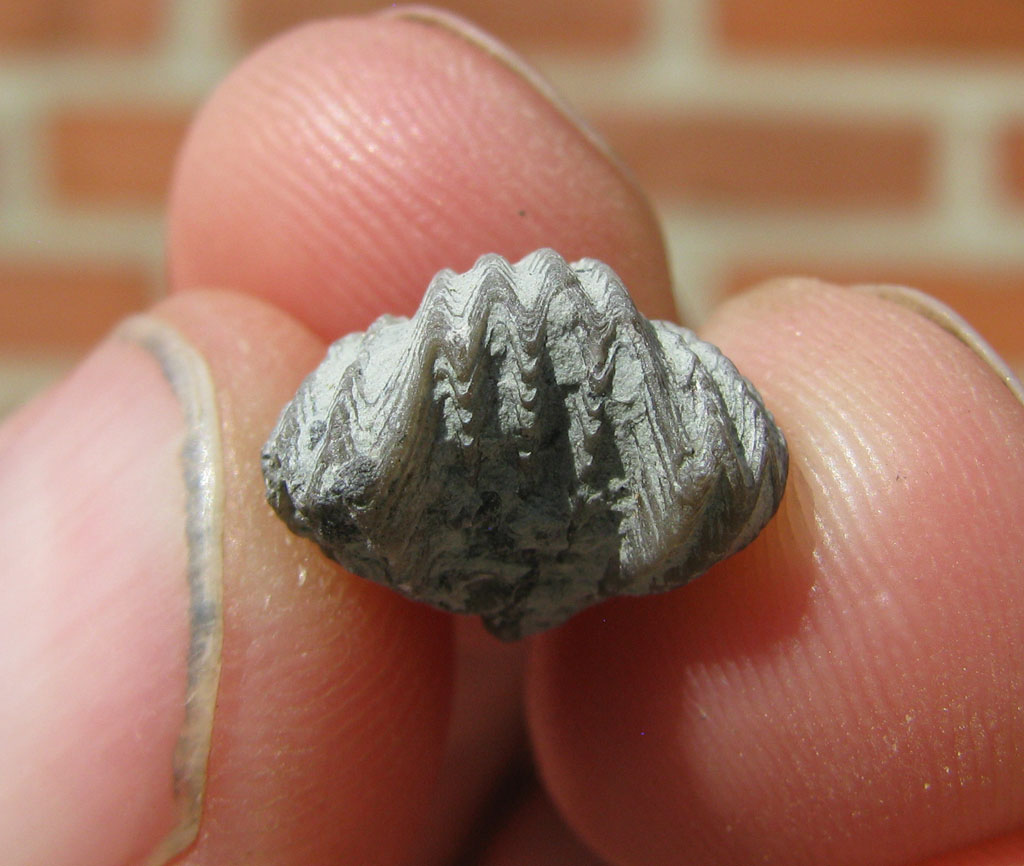
Machaeraria formosa brachiopod from the Kalkberg formation of New York
This specimen, that I collected from the Kalkberg formation of New York, has given me some trouble trying to identify it but I think I've narrowed it down to Machaeraria formosa. I'm basing this due to the description by Hall in "Paleontology of New York", Vol III part 1, page 236:
Brachial valve
Anterior
Pedicle valve
Posterior
Profile
The Kalkberg formation is lower Devonian in age (Lockhovian to Pragian stage). I collected this specimen from a roadcut near Shoharie, NY.
SHELL subtriangular or transversely oval; lateral margins forming an angle at the beak of about 90° to 110°. Ventral valve somewhat more depressed than the opposite: beak prominent, arched, not strongly incurved. Dorsal valve larger, declining with a gentle curve towards the margins: beak incurved.Hall's originally named the species Rhynchonella formosa in the aforementioned 1859 publication but that appears to have since been updated to Machaeraria formosa based on Karl Wilson's 2014 book "Field Guide to the Devonian Fossils of New York".
SURFACE marked by twenty to twenty-four simple angular plications on each valve, from two to four of which in the middle are coarser and depressed in the ventral valve, having a corresponding number abruptly elevated upon the dorsal valve; concentrically marked by fine closely arranged striae.
Brachial valve
Anterior
Pedicle valve
Posterior
Profile
The Kalkberg formation is lower Devonian in age (Lockhovian to Pragian stage). I collected this specimen from a roadcut near Shoharie, NY.
Subscribe to:
Posts (Atom)