Red Hill is a road cut in north central Pennsylvania that exposes part of the Catskill formation from the late Devonian (Famennian stage). I've never been there but hope to visit in a week or two with the Delaware Valley Paleontological Society. In the meantime I have a couple of fossils I can show you that I've purchased.
Below is a single scale from a Sarcopterygians (lobe-fin fish) called Hyneria lindae
Closeups of the scale edge shows a lacy structure
I like the layering that is visible in some parts
There are lots of good resources out on the internet for this site and the fossils found there. The best that I've found is the "Devonian Times" site.
Tuesday, April 10, 2012
Sunday, April 8, 2012
Pygites brachiopod from Spain
Pygites is unusual for a Terebratulid brachiopod. It shares many of the same features that other brachiopods in it's order except that it has a hole in the middle of it. The hole is created as the shell grows and splits into lobes that then eventually meet back together and enclose a hollow area. This is odd behavior for a brachiopodand I've only seen a handful of genera that have even exaggerated lobes, such as Dicoelosia from the Haragan formation, let alone those that surround a hole. Below are three specimens from the Cretaceous (Hauterivian stage) of Spain that show you the variation in the genera.
Specimen #1
Pedicle valve
Anterior
Brachial valve
Posterior
Profile
Specimen #2
Pedicle valve
Anterior
Brachial valve
Posterior
Profile
Specimen #3
Pedicle valve
Anterior
Brachial valve
Posterior
Profile
I found this blog post about Pygites on the Wooster Geologists site which has some interesting information about the history of the studies of this oddball brachiopod.
Thanks to my friends Jenaro for sending me specimen #1 and Gery for specimens #2 and #3.
Specimen #1
Pedicle valve
Anterior
Brachial valve
Posterior
Profile
Specimen #2
Pedicle valve
Anterior
Brachial valve
Posterior
Profile
Specimen #3
Pedicle valve
Anterior
Brachial valve
Posterior
Profile
I found this blog post about Pygites on the Wooster Geologists site which has some interesting information about the history of the studies of this oddball brachiopod.
Thanks to my friends Jenaro for sending me specimen #1 and Gery for specimens #2 and #3.
Friday, April 6, 2012
Interesting example of Favosite colony growth
Below are some pictures of a piece of Favosites coral that shows some interesting growth patterns.
From the top you see the typical honeycomb like arrangement of the corralites.
A cross section view shows long, continuous corallite growth. The white areas are Calcite while the orange areas are Dolomite.
The bottom reveals a wrinkled looking surface that is indicative of the colony growing over sediment.
Here is the most interesting part to me. When you view a cross section of the colony on edge you can see how new area was added.
Here is how I interpret this piece: A new corallite would bud off and as it starts to grow, other buds form between it and the main colony which forces it to grow outward a little further. Eventually the growth of that corallite and the others stabilizes and they grow more vertically as part of the main colony. The process repeats itself and also reflects the relative surface of the sediments that surround the colony. At some point the influx of new sediment is greater than the speed of growth of the colony or maybe it suffers some other sort of calamity like anoxia which kills the corallites or gets buried by a storm.
I found this piece of Favosites coral near Arkona, Canada. It came from the Hungry Hollow member of the Widder formation which is middle Devoian (Givetian) in age.
From the top you see the typical honeycomb like arrangement of the corralites.
A cross section view shows long, continuous corallite growth. The white areas are Calcite while the orange areas are Dolomite.
The bottom reveals a wrinkled looking surface that is indicative of the colony growing over sediment.
Here is the most interesting part to me. When you view a cross section of the colony on edge you can see how new area was added.
Here is how I interpret this piece: A new corallite would bud off and as it starts to grow, other buds form between it and the main colony which forces it to grow outward a little further. Eventually the growth of that corallite and the others stabilizes and they grow more vertically as part of the main colony. The process repeats itself and also reflects the relative surface of the sediments that surround the colony. At some point the influx of new sediment is greater than the speed of growth of the colony or maybe it suffers some other sort of calamity like anoxia which kills the corallites or gets buried by a storm.
I found this piece of Favosites coral near Arkona, Canada. It came from the Hungry Hollow member of the Widder formation which is middle Devoian (Givetian) in age.
Wednesday, April 4, 2012
Stromatopora from Gotland, Sweden
Another fine fossil that I received in trade is this Stromatoporid mound.Stromatoporids are calcareous sponges that often forms mounds or encrustations. The specimen below is from Gotland, Sweden and lived during the Silurian (Wenlock epoch).
Side 1
Top
Side 2
Underside
Profile
Thanks go out to my friend Christian for sending me this cool fossil.
I've written before about Stromatoporids that I've found in the Keyser limestone Here and Here.
Side 1
Top
Side 2
Underside
Profile
Thanks go out to my friend Christian for sending me this cool fossil.
I've written before about Stromatoporids that I've found in the Keyser limestone Here and Here.
Monday, April 2, 2012
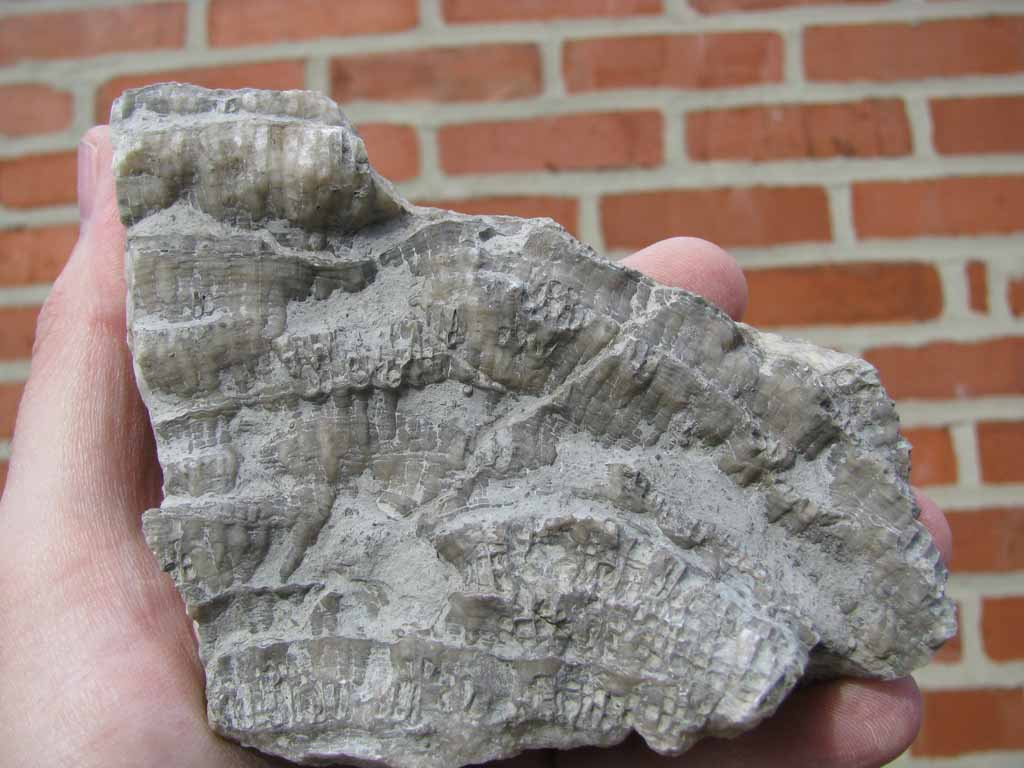
Heliolites from Gotland, Sweden
I have been fortunate to be able to trade with a friend, named Christian, who visits the island of Gotland in Sweden to hunt for fossils. Below is a large colony of Heliolites that he sent me. The rocks of Gotland are Silurian (Wenlock to Ludlow Epoch) in age but I don't know the particular location or formation that this came from.
Heliolites is a sort of encrusting tabulate coral rather than a massive, continually growing colony like Favosites. You can see how there are many generations that overlap on top of one another.
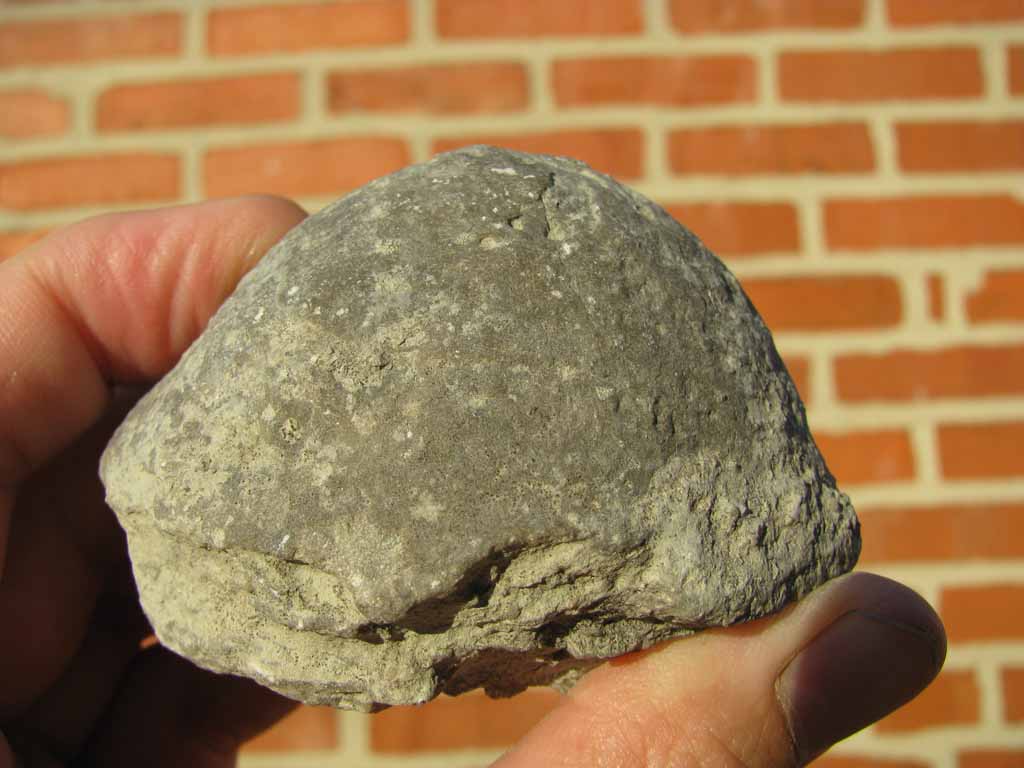
This is an underside view that show the wrinkled epitheca where the coral was laying on a semi-solid muddy substrate.
Anotehr view of some of the many layers that compose this coral mound. I wonder if it was periodically smothered or partially buried and that only a portion survived to then recolonize the dead areas.
Thank you to my friend Christian for sending me this fossil.
Heliolites is a sort of encrusting tabulate coral rather than a massive, continually growing colony like Favosites. You can see how there are many generations that overlap on top of one another.
This is an underside view that show the wrinkled epitheca where the coral was laying on a semi-solid muddy substrate.
Anotehr view of some of the many layers that compose this coral mound. I wonder if it was periodically smothered or partially buried and that only a portion survived to then recolonize the dead areas.
Thank you to my friend Christian for sending me this fossil.
Subscribe to:
Posts (Atom)