Showing posts with label Triassic. Show all posts

Wednesday, February 26, 2020

Dinophyton spinosus Plant fossil from the Stockton formation

Dinophyton spinosus is an odd plant that is found in the late Triassic of rocks across the US. It's often found as a small branch or sprig of tiny rounded leaves. Paleontologists have been trying to figure out how it fits within the evolution of plants but have so far been frustrated. What research I have found (Source 1, Source 2, Source 3)says that it is a gymnosperm (it's seeds are not protected by a fruit) which puts it close to conifers, Ginko's and cycads. The specimens below come from the late Triassic aged Stockton formation near Phoenixville, PA. This is practically in my back yard and I'd never heard, let alone seen anything like these before. 

During the late Triassic, Southeastern PA was a rift zone as Pangea split up. The Stockton formation was deposited on a level plain during drier, savanna like conditions. It inter-tongues with the Lockatong formation which represents lake sediments that would wax and wane as the climate changed. The specimens below were probably preserved in small, temporary ponds.

Sample 1 - Just a small leaf cluster on this piece.


Sample 2 - This piece has a few more sprigs of Dinophyton spinosus.


Previously, I blogged about some Conchostracans that I found from the Lockatong formation.

The Stockton formation is dated to the Triassic, roughly Carnian stage. I purchased these fossils in 2018.

Monday, February 24, 2020

Rhynchosauroides sp. swim traces from the Newark Supergroup

Today I have a fossil trackway to show you. This is more properly called an Ichnofossil as the body of the animal is not present. On this piece of shale are what appear to be scratch marks. I lost the original tag that came with the specimen but I recall that they were traces from swimming. An inquiry to the Fossil Forum website and the hive mind came up with Rhynchosauroides sp. as the name of the traces.  These represent a primitive reptile that was swimming in a pond or pool near a river. The creature floated in the water but it was shallow enough that it's claws grazed the sediment below and left traces. The pond may have been temporary and subject to frequent flooding as the substrate was firm enough to preserve the initial traces before they washed away, and then get buried with a new layer of sediment.   As I mentioned before, I lost the original tag but I believe this was Triassic aged and came from the rocks of the Newark Supergroup in Pennsylvania.  These rocks were originally laid down in a rift valley as the super continent Pangea was breaking up.


Saturday, October 4, 2014

Fossil starfish and their traces

I'm showing off some starfish today starting with these Asteriacites lumbricalis from the Raethian stage of the Triassic that were found near Dijon, France. They are classified as trace fossils since they are the resting traces of starfish that later moved on. From what I can find, the theory is that the starfish burrowed into softer sediment to protect themselves when stranded during low tides. The burrows were filled in with sand once the tide came back in and the occupants crawled back into the sea. They are found from the Ordovician onwards to today.


This blog touches on these fossils briefly and has a modern example as well (scroll down about 1/2 way).
There is a brief article on Wikipedia about Asteriacites with some other pictured examples.

I have some other examples that I wrote about previously Here.

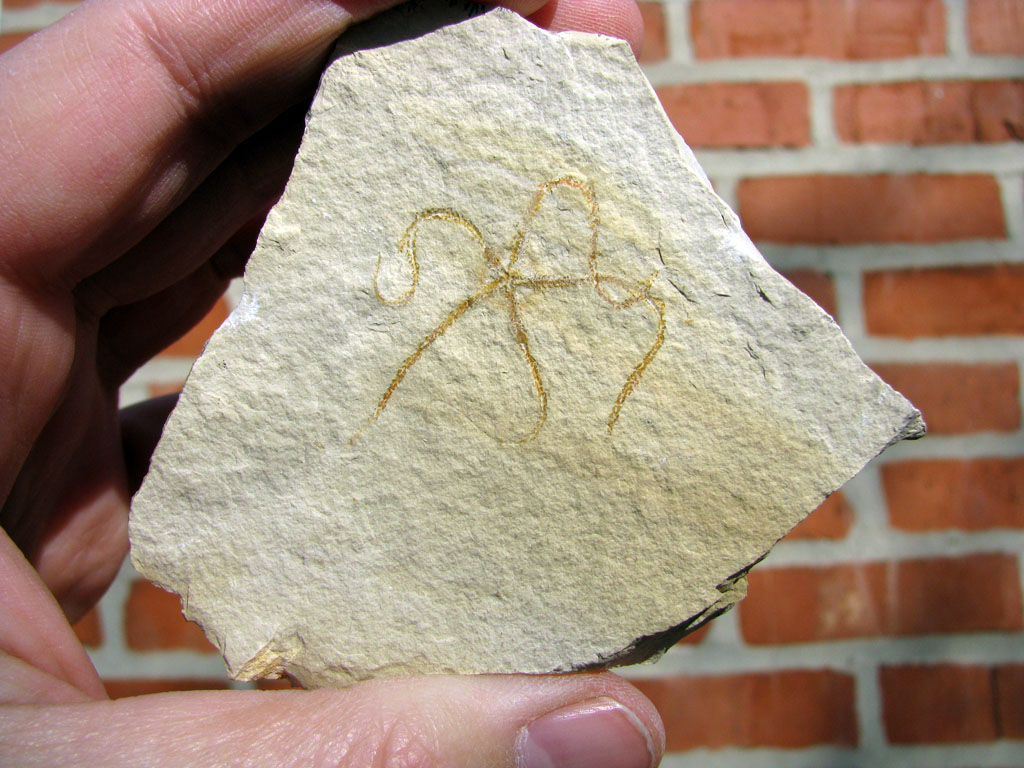
These next two fossils are legitimate starfish that both come from the famous quarries around Solenhofen, Germany. The rocks that yield these fossils are dated to the Tithonian stage of the Jurassic. Both look very similar to each other but it seems that Sinosura kelheimense has thinner arms than Ophiopetra lithographica.

Sinosura kelheimense


Ophiopetra lithographica


Thanks to Gery for the first two fossils.

Monday, March 12, 2012

Cyzicus clam shrimp from the Lockatong formation

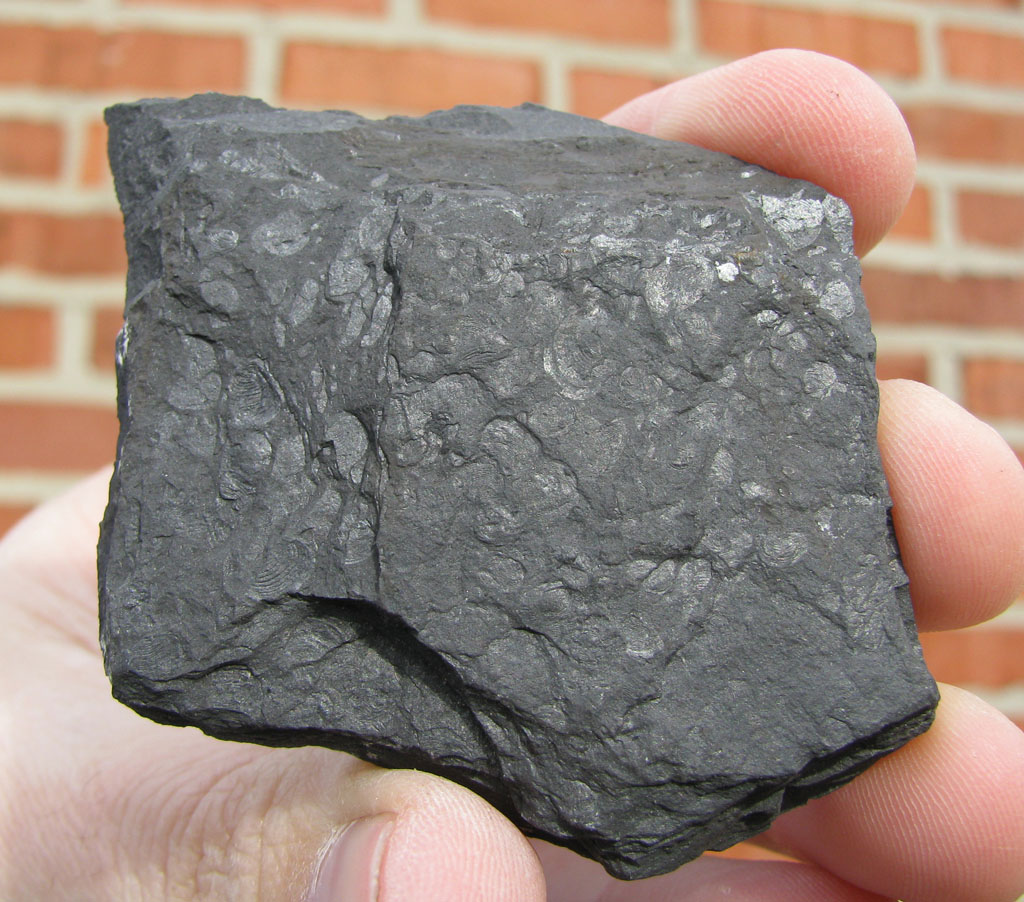
Where I live in Pennsylvania, the underlying bedrock is Triassic aged lacustrine deposists lain down when Pangea was splitting apart. Not many fossils are found but occasionally fish, reptiles, plants and dinosaurs are discovered. While exploring a building foundation excavation near my house I found some black shale which has shiny shells on the surfaces.


Above is a piece with both the front and back covered with the shells. It turns out that the shells are of a freshwater Conchonstracan called Cyzicus. It's an crustacean similar to ostracods but more closely related to shrimp. It been nicknamed the "Clam Shrimp" since it has two chitonous shells that enclose the body.

Here are some closer views of the shells that I took with my Zorb micro imager.


Here is a page with a nice anatomical picture and description plus some other fossils.

This page has links to a whole series of pages with more information about Conchonstracans.