The nacerous shell of Mesopholidostrophia semicircularis is typical of the genera. It can be seen in it's N. America cousins, Pholidostrophia nacera, which are common in the Givetian stage of the middle Devonian. The specimen of M. semicircularis shown below comes from the Eifelian stage (Devonian) of the Junkerberg formation near Gondelsheim, Eifel region, Germany.
Specimen #1
Pedicle valve
Anterior
Brachial valve
Posterior
Profile
Specimen #2
Pedicle valve
Anterior
Posterior
Profile
Examples of Pholidostrophia geniculata from the Silica Shale of Ohio, Pholidostrophia nacrea from the Widder formation of Ontario, Canada and the Mahantango formation of Pennsylvania.
Showing posts with label Germany. Show all posts
Wednesday, March 25, 2015
Monday, March 23, 2015
Athyris concentrica brachiopod from Eifel, Germany
I have yet another species of Athyris from Germany which makes three compared to the single species that I find here in New York and Pennsylvania. Athyris concentrica comes from the Devonian, Eifelian stage, aged Junkerberg formation, near Gondelsheim, Eifel, Germany. The shell is generally round with a shallow sulcus and narrow concentric growth lines decorating the surface. This species looks very similar to A. vittata from Michigan.
Specimen #1
Pedicle valve
Anterior
Brachial valve
Posterior
Profile
Specimen #2
Brachial valve
Anterior
Pedicle valve
Posterior
Profile
Compare this species to others from Germany, A. tumida and A. amanshauseri or here in N. America, A. spiriferoides from New York.
Specimen #1
Pedicle valve
Anterior
Brachial valve
Posterior
Profile
Specimen #2
Brachial valve
Anterior
Pedicle valve
Posterior
Profile
Compare this species to others from Germany, A. tumida and A. amanshauseri or here in N. America, A. spiriferoides from New York.
Saturday, March 21, 2015
Spinatrypa aspera brachiopod from Eifel, Germany
Spinatrypa is somewhat common in the lower to middle Devonian of Europe while it is more prevalent in the US during the late middle to upper Devonian. To me this is an indication of the genera originating in Europe and migrating to the US as the continents moved closer during the Devonian. The specimen of Spinatrypa aspera below comes from the Junkerberg formation (Devonian, Eifelian stage), near Gondelsheim, Eifel, Germany. It is a robust, rounded shell with the typical rippled surface that one expects.
Specimen #1
Brachial valve
Profile
Pedicle valve
Posterior
Profile
Specimen #2
Brachial valve
Anterior
Pedicle valve
Posterior
Profile
I have plenty of other examples of this genera including S. aspera from Poland (of which I am having doubts my specimens are labelled correctly), S. spinoa from the Windom shale of New York (with and without spines preserved) as well as and S. rockfordensis from Iowa.
Thursday, March 19, 2015
Primipilaria primipilaris brachiopod from Eifel, Germany
I've featured Primipilaria primipilaris on the blog previously as a fossil from the Skaly beds in Poland. Today I have a specimen from the Eifel region of Germany to compliment that earlier specimen. Hailing from the Junkerberg formation near Gondelsheim (SW of Bonn, near the border with Belgium), this brachiopod (when viewed from above of below) has a pointed umbo that grades out to the egdes of the shell in a wide, obtuse angle while the rest of the perimeter is roughly rectangular in shape. The most notable feature is seen when viewing the anterior portion of the shell where a deep "U" shape can be seen along the margin where the valves meet. This normally might be associated with a deep sulcus but the pedicle valve is only slightly bent. Also notable is that all along the margin where the valves meet around the shell (excepting the hinge line) the shell looks "puckered" as though eating a lemon drop. Shell ornamentation is minimal with fine radiating ribs.
Specimen #1
Pedicle valve
Anterior
Beachial valve
Posterior
Profile
Specimen #1
Brachial valve
Anterior
Pedicle valve
Posterior
Profile
The Junkerberg formation is Devonian in age (Eifelian stage).
Specimen #1
Pedicle valve
Anterior
Beachial valve
Posterior
Profile
Specimen #1
Brachial valve
Anterior
Pedicle valve
Posterior
Profile
The Junkerberg formation is Devonian in age (Eifelian stage).
Wednesday, November 19, 2014
Furcaster palaeozoicus starfish from the Hunsruck slate near Bundenbach, Germany
In the last post I showed you some pictures of fossils from the Hunsruck Slate (Emsian stage of the Devonian) in Bundenbach, Germany that were on display at a rock, fossil and mineral show. Today I'm going to show you the piece of the Hunsruck that graces my collection. At the same show that I saw the display of fossils from Bundenbach, I also came across this piece of slate with two Fucaster palaeozoicus starfish showing some current orientation.
The plate is 22cm along the longest edge and 17 cm along the shorter edge. They are both ventral views with some nice detail.
This specimen is 12cm long by 5.5cm wide
The "halo" that surrounds the central star shape and arm bases is the soft body of the animal. Unlike the arms, the body didn't have any special armor to protect it.
The second specimen is shorter at 7cm long, since part of one arm extends off the plate, and 4cm wide.
I also love the little string of white quartz that cuts across the right specimen. It lends some authenticity to the piece and adds some interest. The obvious star shape in the middle of the body is the result of the muscles that controlled the mouth relaxing after the animal died. Normally they would be closed and the bottom of the animal would look more armored.
Monday, November 17, 2014
Bundenbach fossil display
The name Bundenbach is one which excites me because it is the name of a town that is near a layer of rock, called the Hunsruck Slate, that preserves some extraordinary fossils. It's what is called a Lagerstätte which are sedimentary rocks that have exceptional preservation of fossils, sometimes including soft parts which usually rot away before being fossilized. The Burgess Shale outcrop in Yoho National Park, BC, Canada is the perhaps the ultimate example of this type of fossil treasure trove but they exist all over the world.
So what attracts me to Bundenbach? Well, it preserves a slice of the Devonian period, which is my favorite era to collect fossils from, the fossils are preserved in slate, which is what happens to shale when it is metamorphosized by tremendous heat and pressure, and many of the animals that are preserved are Starfish, which is very rare. Not that Starfish are the only animals preserved in the Hunsruck Slate, there are also trilobites, crinoids, various arthropods, cephalopods, corals, cystoids, worms, and fish among others. The fossil deposit preserves a window in time that showcases animals swept into anoxic waters and buried that we don't normally see preserved.
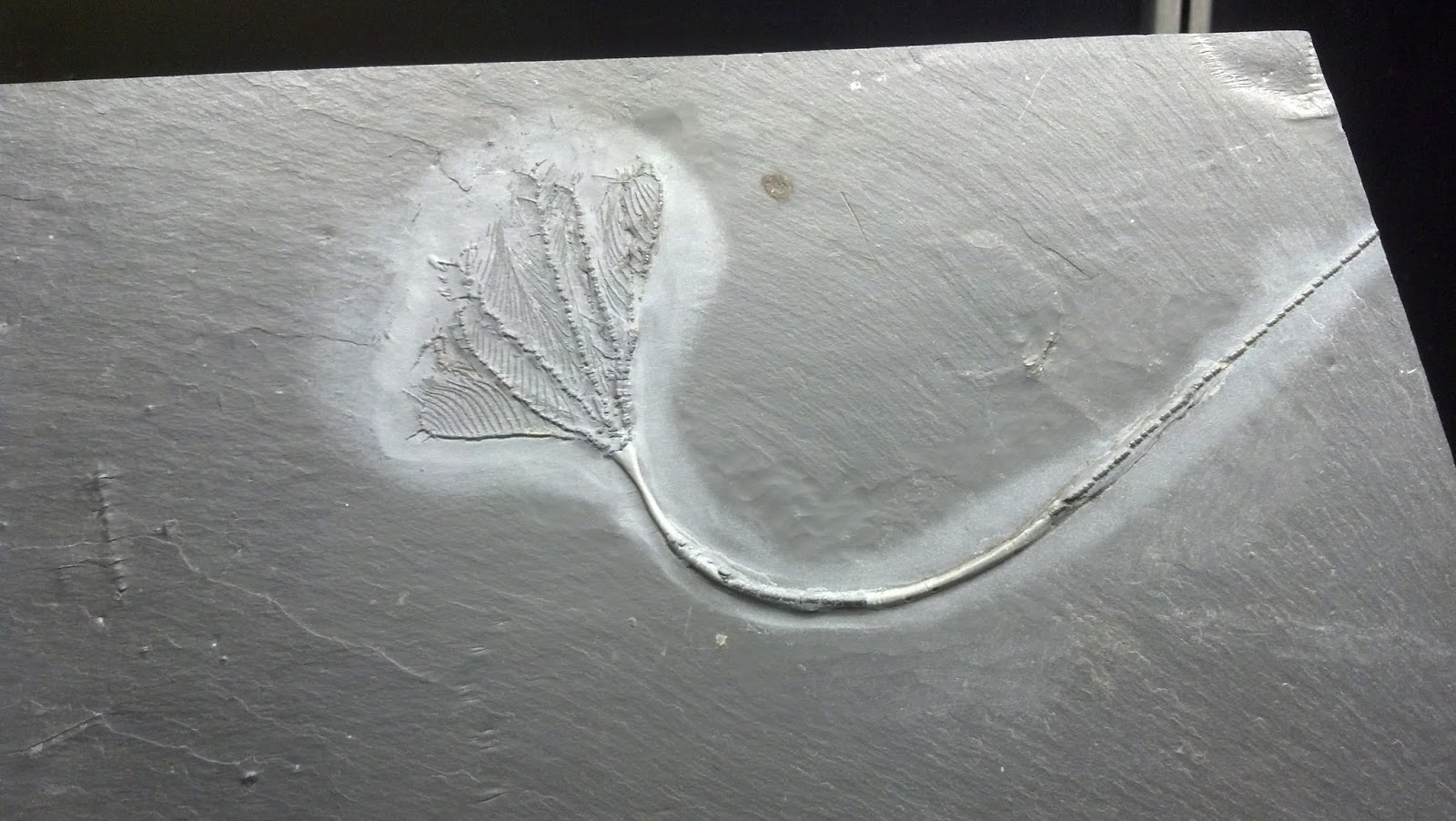
At the 2014 NY/NJ Fossil, Gem And Mineral Show, they had a display of fossils from the Hunsruck Slate that I was able to drool over. Here are the cases that the fossils were on display in.
And here are some of the fossils:
Urasterella asperula
Euzonosoma tischbeinianum
Phacops ferdinandi
Mimetaster hexagonalis - This guy is on my bucket list of specimens I'd like in my collection! It's an arthropod related to the Burgess shale fossil Marrella splendens.
A crinoid (didn't get a pic of it's label, sorry)
And a phyllocarid (didn't get a pic of it's label, sorry)
I took many more pictures but most turned out blurry so they are not as useful as I would like. Chalk it up to taking pictures through a glass display case with a cell phone camera.
It turns out that one of the dealers at the show was also the guy who'd brought the display and had this booklet that he'd written with him. I purchased a copy and he was kind enough to sign it for me. It is a nice souvenir to remind me of the awesome fossils I saw that day.
I highly recommend the book "Visions of a Vanished World" by Kühl, Bartels, Briggs and Rust. It has a very thorough explanation of the deposit, it's history and the fossils found within. Note: I do not get any compensation for the Amazon.com link above.
Subscribe to:
Posts (Atom)