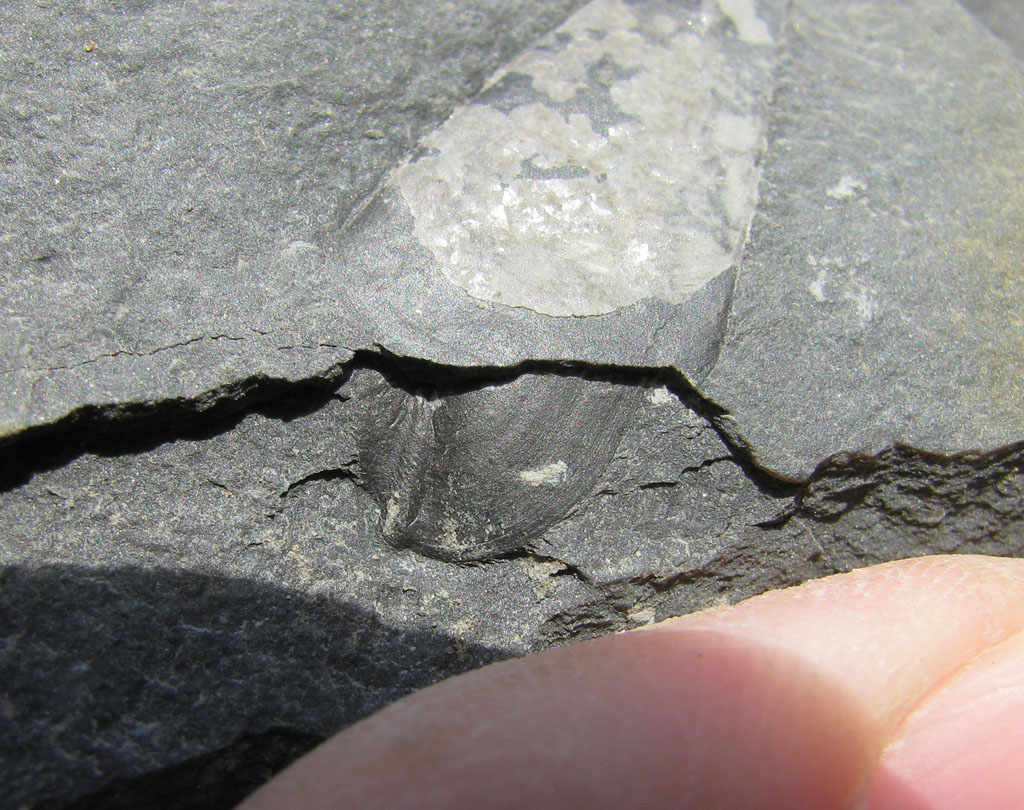
Hyoliths are enigmatic creatures that existed from the Cambrian until the Permian. They have triangular shaped shells that are half moon shaped in cross section, an operculum that covered the head and two little horns, called helens, that protruded out from where the operculum and body met. I found a specimen of a Hyolith called Hallotheca aclis in Madison County, NY in the Moscow Formation (Devonian, Givetian stage). The view is of the ventral surface, or underside, of the shell and you can see the fine concentric growth lines.
The coolest part of this specimen is that the operculum is preserved as well and nearly articulated. It's rotated from the life position but the fact that it's even present is rare. This is the only specimen of the operculum that I've found.
The only other examples of this odd fossil that I've found have been from the Mahantango formation in PA of which a portion is roughly equivalent to the Moscow formation.
Showing posts with label Hyolith. Show all posts
Sunday, February 15, 2015
Thursday, May 9, 2013
Hallotheca aclis mollusks(?) from the Mahantango formation
I was having an e-mail exchange with a friend regarding some Hyolith snails in the Arkona formation when I recalled that I have found them in my local Mahantango formation. Below are some specimens of Hallotheca aclis that were found at various sites in central Pennsylvania.
This is an unusual 3-D specimen
Hyoliths are odd creatures that some ascribe to mollusks (and more specifically gastropods) and others to annelids (worms) but little evidence has been found to support any one theory. They lived from the Cambrian (which was their peak) into the Permian.
This is an unusual 3-D specimen
Hyoliths are odd creatures that some ascribe to mollusks (and more specifically gastropods) and others to annelids (worms) but little evidence has been found to support any one theory. They lived from the Cambrian (which was their peak) into the Permian.
Subscribe to:
Posts (Atom)