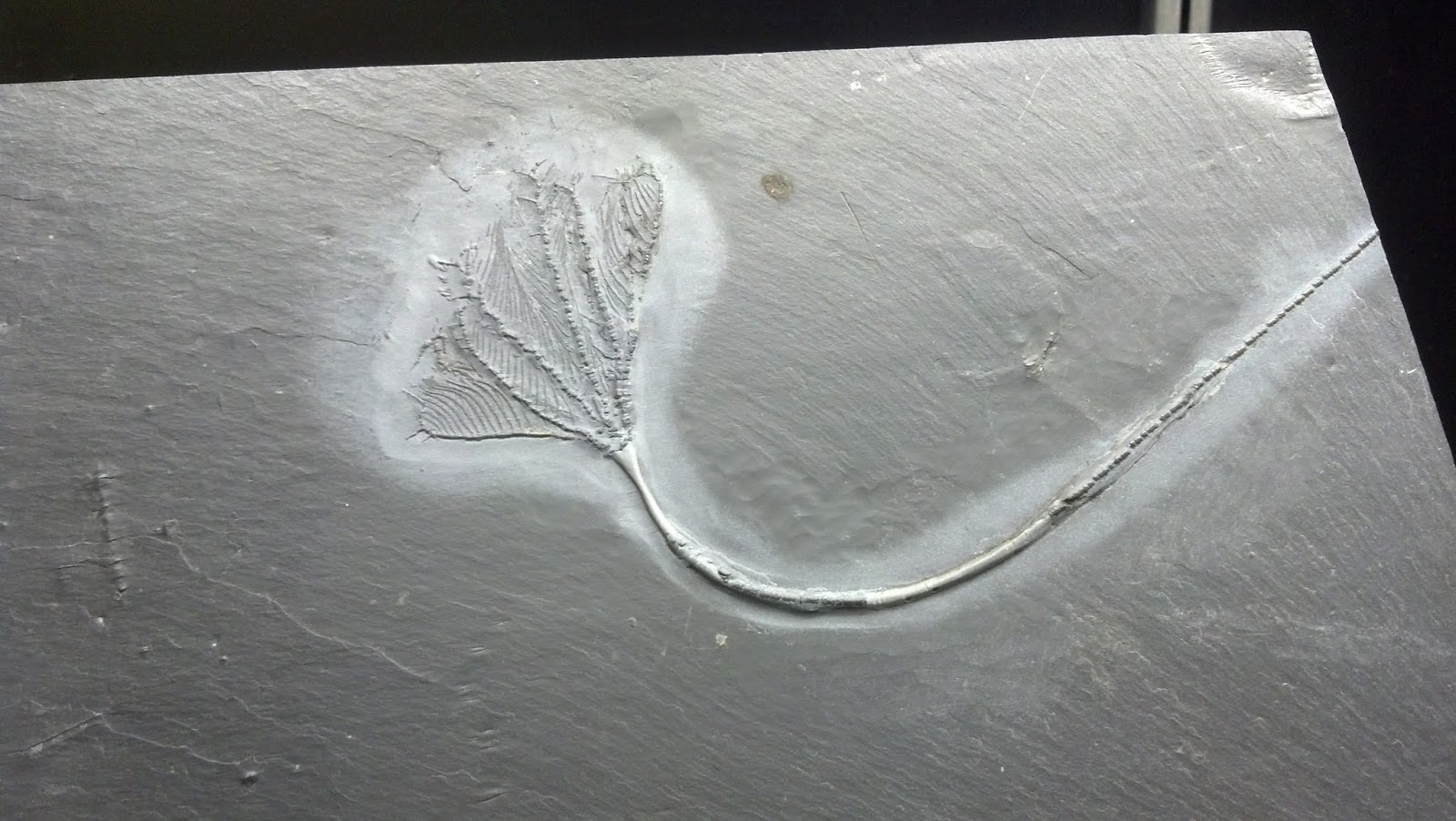
The name Bundenbach is one which excites me because it is the name of a town that is near a layer of rock, called the Hunsruck Slate, that preserves some extraordinary fossils. It's what is called a Lagerstätte which are sedimentary rocks that have exceptional preservation of fossils, sometimes including soft parts which usually rot away before being fossilized. The
Burgess Shale outcrop in Yoho National Park, BC, Canada is the perhaps the ultimate example of this type of fossil treasure trove but they exist all over the world.
So what attracts me to Bundenbach? Well, it preserves a slice of the Devonian period, which is my favorite era to collect fossils from, the fossils are preserved in slate, which is what happens to shale when it is metamorphosized by tremendous heat and pressure, and many of the animals that are preserved are Starfish, which is very rare. Not that Starfish are the only animals preserved in the Hunsruck Slate, there are also trilobites, crinoids, various arthropods, cephalopods, corals, cystoids, worms, and fish among others. The fossil deposit preserves a window in time that showcases animals swept into anoxic waters and buried that we don't normally see preserved.
At the 2014 NY/NJ Fossil, Gem And Mineral Show, they had a display of fossils from the Hunsruck Slate that I was able to drool over. Here are the cases that the fossils were on display in.
And here are some of the fossils:
Urasterella asperula
Euzonosoma tischbeinianum
Phacops ferdinandi
Mimetaster hexagonalis - This guy is on my bucket list of specimens I'd like in my collection! It's an arthropod related to the Burgess shale fossil
Marrella splendens.
A crinoid (didn't get a pic of it's label, sorry)
And a phyllocarid (didn't get a pic of it's label, sorry)
I took many more pictures but most turned out blurry so they are not as useful as I would like. Chalk it up to taking pictures through a glass display case with a cell phone camera.
It turns out that one of the dealers at the show was also the guy who'd brought the display and had this booklet that he'd written with him. I purchased a copy and he was kind enough to sign it for me. It is a nice souvenir to remind me of the awesome fossils I saw that day.
I highly recommend the book "
Visions of a Vanished World" by
Kühl, Bartels, Briggs and Rust. It has a very thorough explanation of the deposit, it's history and the fossils found within. Note: I do not get any compensation for the Amazon.com link above.