Showing posts with label Paleogene. Show all posts

Tuesday, May 24, 2016

Results from a short visit to the Florissant Fossil Quarry

As part of my vacation last fall I had an hour or so to kill in my schedule and happened to be passing near Florissant, Co. The town is well known for the Florissant Fossil Beds National Monument which preserves an ancient lake bed from the Eocene that was near a field of volcanoes. The volcanoes would erupt with lots of ash and this would rain onto the lake and the surrounding environment. As the ash settled it would cover anything that happened to be floating on or above the lake surface. The ash layers deposited as thin films and millions of years later have been compressed into "paper" shale (so called because each layer is as thin as a sheet of paper). Splitting the shale is easy but also hard. You have to use a very thin, sharp blade (a razor blade is perfect) to split the fine layers. If you are lucky you will find an insect or plant trace from long ago.

Outside of the park boundaries is a fee quarry, on private land, that allows you to split some of the paper thin shale and keep the fossils you find. It's called the Florissant Fossil Quarry and I've been to this site several times over the years. You can see some of the other fossils I've collected  by clicking here, here, here, or here. This trip only allowed me a hour but I found a few interesting specimens.

This is a small snail with a partial leaf. The shell has been crushed but you can still see some of the shiny nacre.
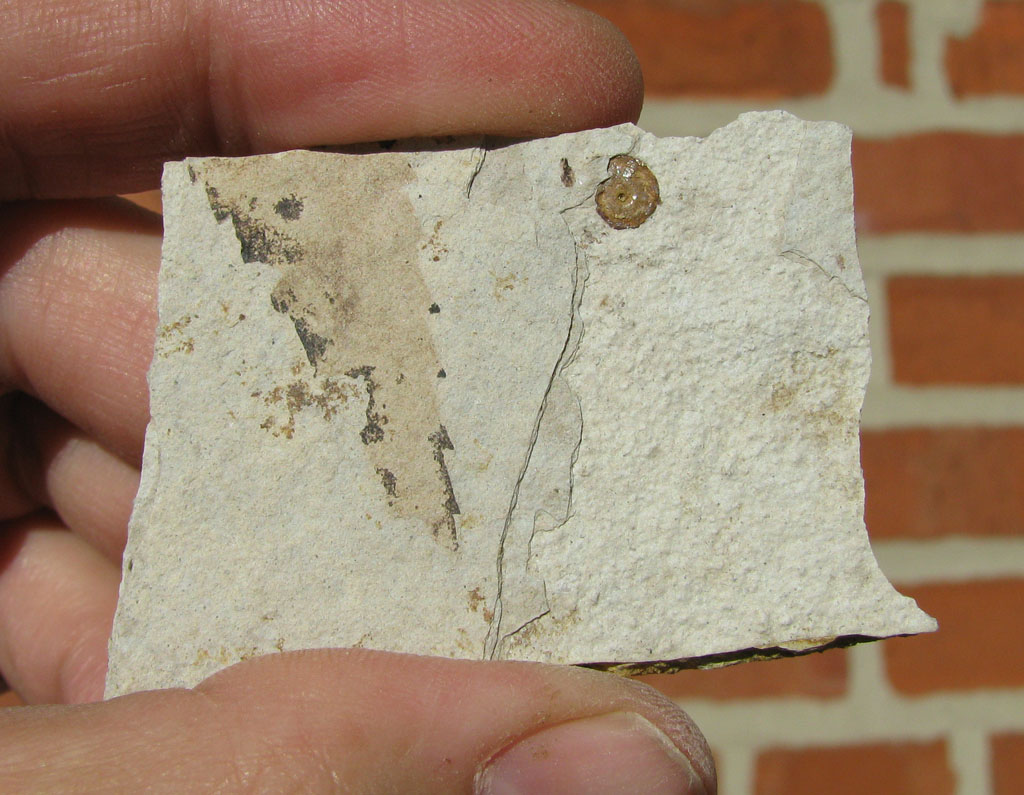

A beech or elm type leaf

A seed of some sort, although it looks like the seed itself is missing and only the surrounding "wings" are left. This looks similar to slippery elm seeds.


Lastly, a fly or bee (wasp?) of some sort. The preservation is not the best and it looks better from a distance than up close.


The Florissant fossil beds are called the Florissant formation and are dated to the latest Eocene epoch (Priabonian stage) of the Paleogene.

Monday, October 6, 2014

Fossil bird feathers from the Green River Fm. of Colorado

Bird feathers are somewhat rare in the fossil record but some circumstances allow them to be more easily preserved. Such is the case in the Parachute Creek member of the Green River formation. The Parachute Creek member is an oil shale that was deposited by a series of freshwater lakes in the Eocene located in northwestern Colorado and northeastern Utah. Here are some examples of the feathers that can be found within these fossil lake deposits.

Specimen #1


Specimen #2


Specimen #3


All three of the feathers look to be fairly simple and could just be down feathers. Sometimes color patterns can be preserved but I don't see any on these.

Monday, August 11, 2014

Cucullaea gigantea pelecypod from the Aquia Formation

I recently traded with a fellow in my local club for these two Cucullaea gigantea from Henson Creek, Maryland. They come from the Aquia Formation (Paleocene age). It earns its name as these casts are really huge! I've read about the site where these can be found but just have not been able to get down there to collect some myself.

Specimen #1


Specimen #2


Friday, July 18, 2014

Three Cenozoic gastropods from France

These first two shells come from the Neogene (Miocene series) age sediments in the Gironde state of France (near Bordeaux). First is Cerithium margaritaceum


Next is Turritells terebralis

Then its Clavilithes noae from the Paleogene (Eocene series, Lutetian stage) which was collected near Paris, France.


Thanks to Gery for sending me these fossils!

Thursday, August 22, 2013

Fossil Ginkgo leaves from British Colombia

I'm cleaning out a folder of pictures this week. Here are some photos I took a few years ago of a few Ginkgo fossils from the Eocene aged Tranquille shale in British Columbia, Canada.

Ginkgo dissecta

Ginkgo dissecta


Gingko adiantoides

Sunday, February 3, 2013

Clypeaster rogersi echinoid from Alabama

Compared to the last Clypeaster that I featured on my blog, Clypeaster rogersi is much much smaller. It still has the typical features of the genera, namely a central mound shape in the center on the top (adapical) surface and an overall round shape to the test (exoskeleton). The size is not determinative of the species as there are specimens in the 7cm range known from Georgia.

Adapical (top) surface
Anterior (side the farthest from the anal pore)

Adoral (bottom or underside)
Side profile


This specimen comes from the early Oligocene (Rupelian stage) aged Mariana formation of Mississippi.

Here is a general write up of the species and how to differentiate it from another common species found in the same aged rocks.

This site has an official description of the species including some typical occurrence areas in the US, Cuba and Mexico.