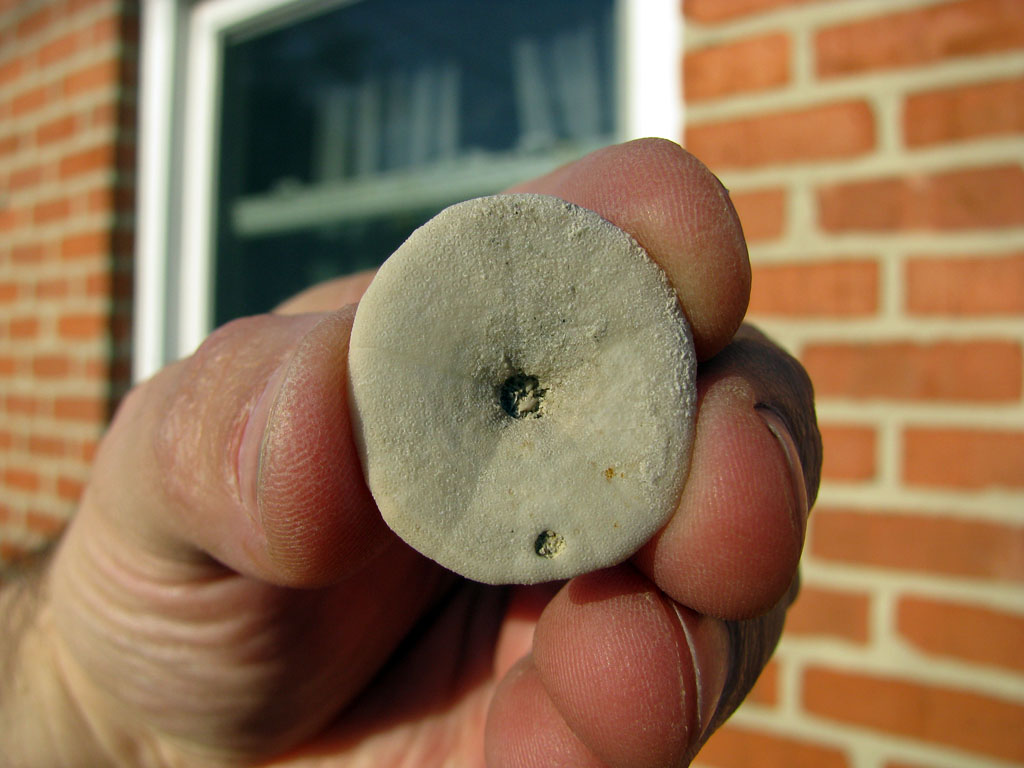
Compared to the last Clypeaster that I featured on my blog, Clypeaster rogersi is much much smaller. It still has the typical features of the genera, namely a central mound shape in the center on the top (adapical) surface and an overall round shape to the test (exoskeleton). The size is not determinative of the species as there are specimens in the 7cm range known from Georgia.
Adapical (top) surface
Anterior (side the farthest from the anal pore)
Adoral (bottom or underside)
Side profile
This specimen comes from the early Oligocene (Rupelian stage) aged Mariana formation of Mississippi.
Here is a general write up of the species and how to differentiate it from another common species found in the same aged rocks.
This site has an official description of the species including some typical occurrence areas in the US, Cuba and Mexico.
Showing posts with label Tertiary. Show all posts
Sunday, February 3, 2013
Friday, August 12, 2011
Mummified walnut and misc plant debris
Today I want to show you a couple of interesting fossils from France. The first is a walnut (Juglans bergomensis) seed. This fossil was found in the Alsace region of France and can also be found in the Netherlands and Germany within Pliocene aged lignite that was once deposited by ancient rivers. These fossils are often called Mummified due to their dessicated look. They have been preserved and partially silicified by the muddy river sediments.
This next specimen is of some reedy plant debris that came from a lacustrine (freshwater lake) deposit near Cereste in the south of France. The sediments have been dated to the Oligocene epoch of the Tertiary period. While the plant remains are not easy to identify, there is a small Planorbis snail near the bottom left hand side. This is an index fossil that can be used to tell if the sediments were deposited in fresh or salt water as it can only be found within lake and river deposits.
Thanks you to Gery for sending me these specimens.
Subscribe to:
Posts (Atom)