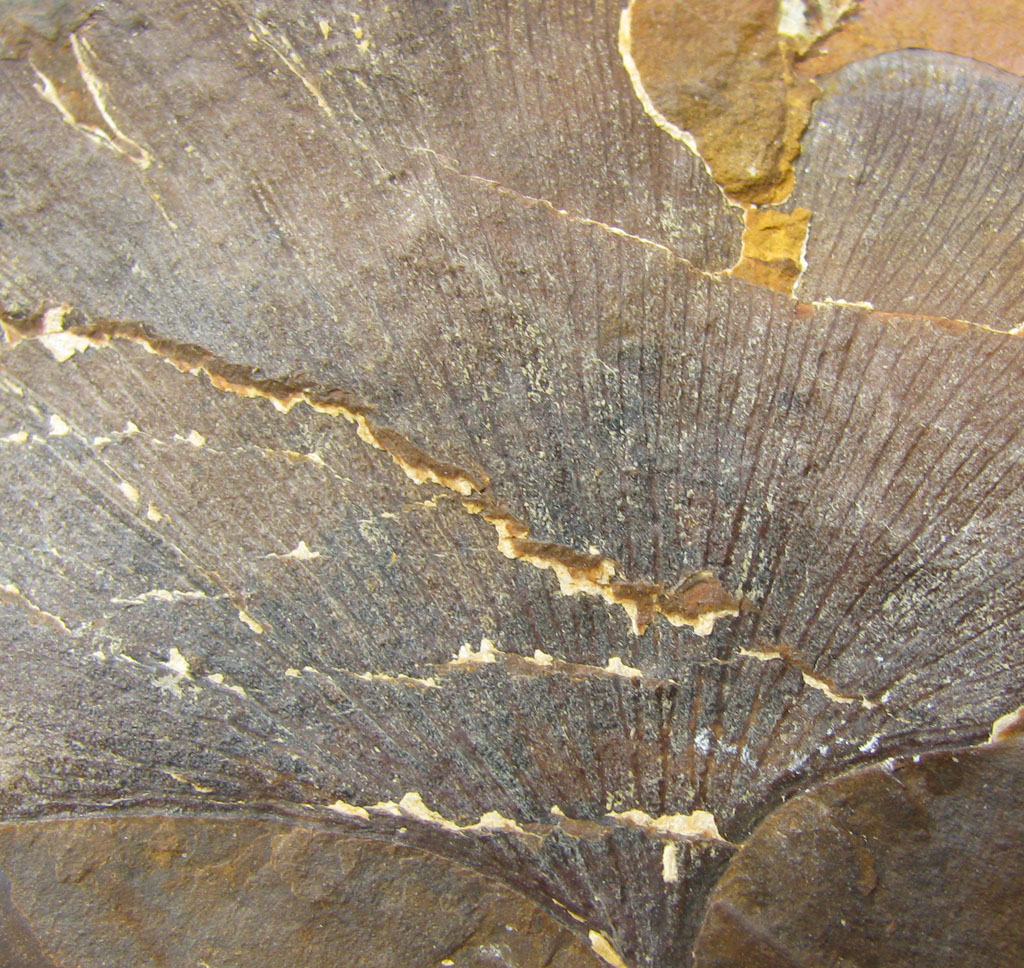
The fossils that are found in the Sentinel Butte Formation of North Dakota always grab my eye when the I see them. Usually I see a piece of brown-tan shale with a Ginkgo leaf impression on it and I'm immediately drawn in.The Sentinel Butte formation was deposited as part of a large basin called the Williston Basin during the late Paleocene period (Thanetian stage). The portion of the formation that contains the fossils I am most interested in comes from isolated clay lenses deposited in abandoned channels which were then later enriched with iron and silica.(1) The silica is key as that is what helps to preserve the amazing detail of the plant fossils that are found within.
One of the pieces I have is somewhat thick and you can see some interesting sedimentary structures when viewing a section that was cut.
Here are some of the fossils from the Sentinel Butte formation that are in my collection:
A maple seed with the thin veins from along the "wing" preserved in nice detail.
A ginkgo leaf, likely Ginkgo adiantoides. I have a couple of Ginkgo leaves from the Sentinel Butte formation since they are my favorite tree. Another one of my specimens was part of an early post on my blog.
This piece has two distinct plant fossils on it.
The first is a seed from a Cyclocarya brownii tree. This species, related to walnuts, has modern relatives living in China but is no longer found naturally in North America (just like Gingkos!).
The other fossil is of some kind of conifer, possibly a Metasequoia.
After reading the paper below, I know now that most of the fossils from the Sentinel Butte formation come from the Almont, North Dakota area although there was another site found near Beicegel creek, ND with similar preservation and flora.
1.) Pigg, Kathleen B., and MELANIE L. DeVore. "Floristic composition and variation in late Paleocene to early Eocene floras in North America." Bulletin of Geosciences 85.1 (2010): 135-152.
Showing posts with label Paleocene. Show all posts
Friday, March 13, 2015
Monday, August 11, 2014
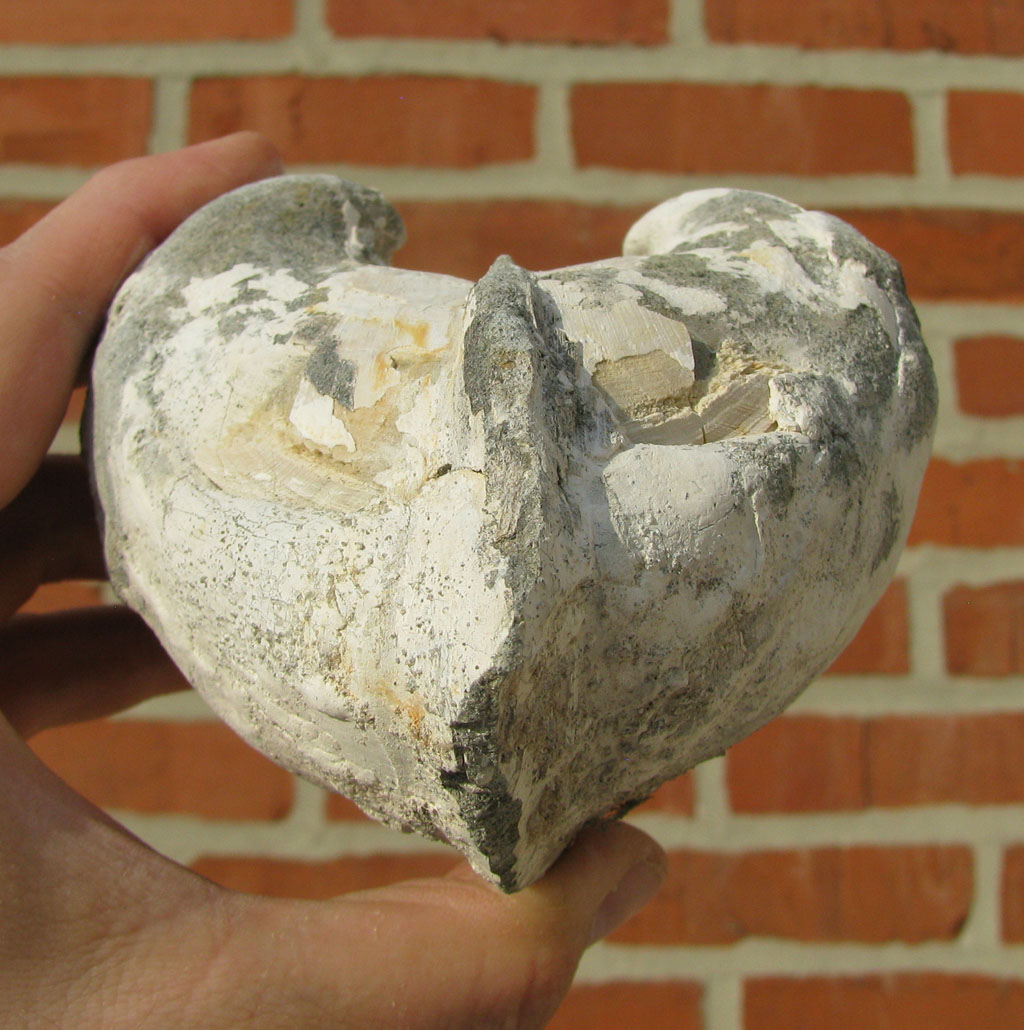
Cucullaea gigantea pelecypod from the Aquia Formation
I recently traded with a fellow in my local club for these two Cucullaea gigantea from Henson Creek, Maryland. They come from the Aquia Formation (Paleocene age). It earns its name as these casts are really huge! I've read about the site where these can be found but just have not been able to get down there to collect some myself.
Specimen #1
Specimen #2
Specimen #1
Specimen #2
Monday, May 28, 2012
Echinocorys sulcatus from Denmark
This fantastic 3-D echinoid fossil is from near Holtug, Denmark and is called Echinocorys sulcatus. It was sent to me by my friend Christian as part of a trade.
I like this specimen because of the seemingly exaggerated vertical shape of the fossil. Most irregular echinoids are generally shorter and more compact than Echinocorys. Perhaps the shape is due to the cold water habitat it occupied which was the same as Dendrophyllia and Dromiopsis from the previous post.
Saturday, May 26, 2012
Dendrophyllia and Dromiopsis from Denmark
Dendrophyllia candelabrum is a very odd looking coral. It's known from Paleocene age rocks in Europe but is primarily found in the Danish basin and notably at exposures near Faxe, Denmark. It's a scleractinian coral but has a very dendritic growth pattern of loose, tube like shapes. They formed reef mounds in deeper, colder areas of water within the basin.
Sometimes there are decapod fossils among the coral branches. Below is a carapace from a Dromiopsis rugosa crab. This is typically how this species is found and rarely are they articulated.
The specimens shown above came from the seashore near Faxe, Denmark and are from the Paleocene (Danian stage). Thanks to Christian for sending me these specimens!
Location:
Nørregade 7, 4640 Faxe Brewery, Denmark
Friday, September 24, 2010
Aquia Fm. visit part 2
My previous post explained my trip and the local geology so this one will be about the fossils I found.
I'll start with the greenish oysters that I left off with in my last post. These seems to be two different species.
The first is Ostrea compressirostra which is identified by it's wide flattened valves:


The second is Gryphaeostrea vomer which has a fuller profile than O. compressirostra:


As Oysters are wont to do, it's easy to find the shells clustered and growing on/with each other:


Some sections of the sediments have been cemented with leached iron from overlying sediments. This seems to have been the case with a layer that is profuse with Turritella fossils as the internal molds are very abundant on the beach resembling corkscrews.


Here is a chunk of matrix with a Turritella internal mold preserved in situ.


Some clam shells had been preserved in the same way and their internal molds were occasionally found as well:


One of the more fascinating fossils were the spiderweb like remains of the shell boring sponge Cliona. They had been preserved as though hovering above the internal shell molds like a net holding a precious cargo:


More Sand Shark teeth were found with one poking out of the cliff face:


My find for the day was this extinct Mackerel shark tooth Otodus obliquus that I found lying next to my backpack.


This site was very productive for me on this trip and I will definitely visit it again in the near future when the tides are low.
Subscribe to:
Posts (Atom)