Showing posts with label Edgecliff Member. Show all posts

Tuesday, August 5, 2014

Favosites turbinatus coral from the Onondoga Formation

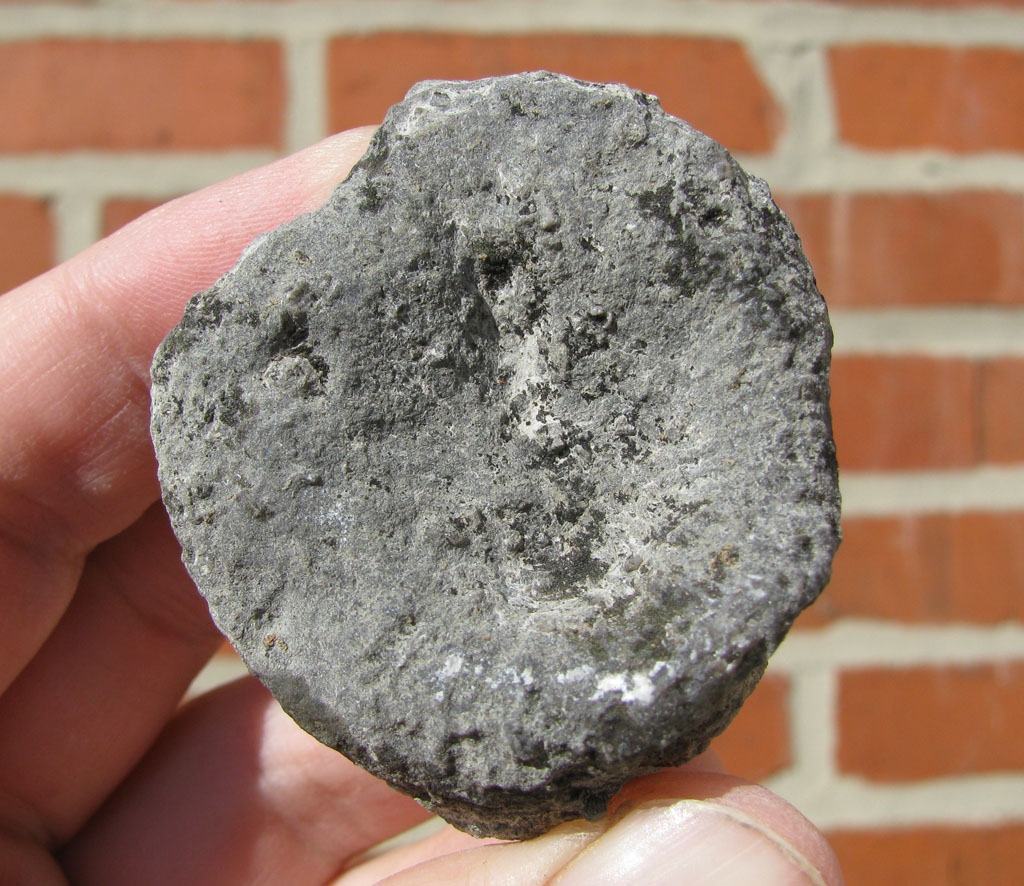
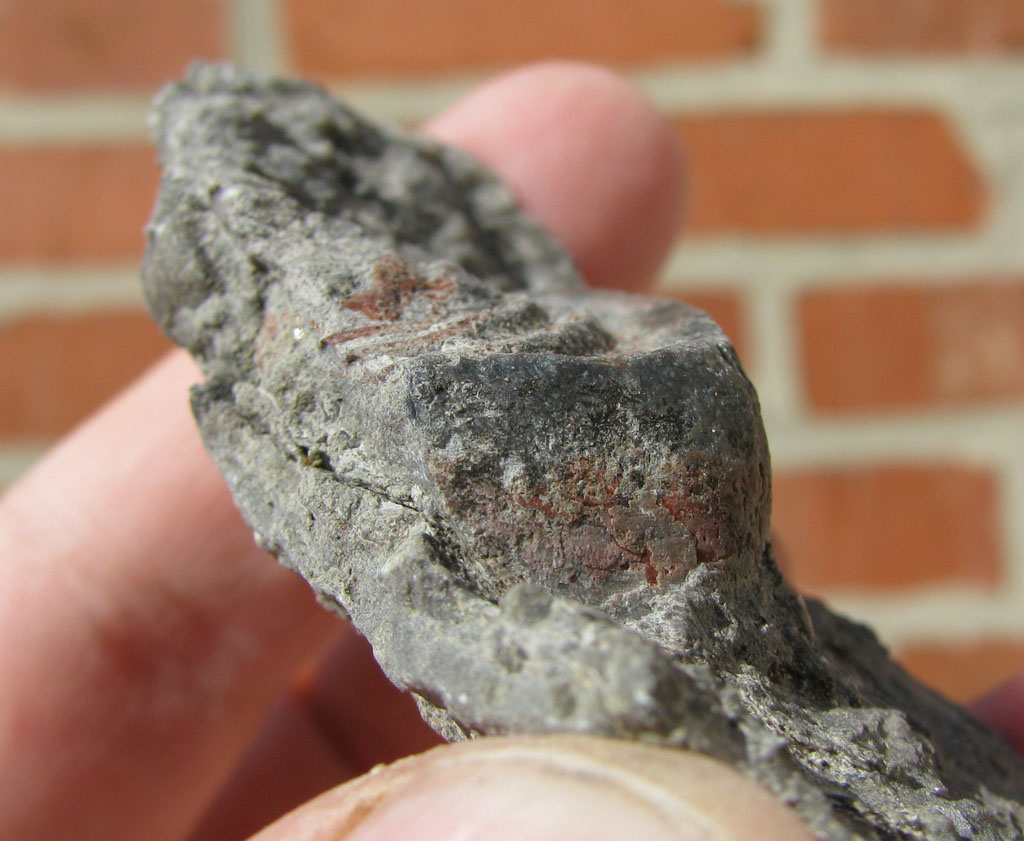
Prior to finding the specimen below, Favosites turbinatus was a species that I'd found only in Givetian aged rocks. This specimen was found in the Edgecliff member of the Onondoga Formation south of Syracuse, NY. The fossil is somewhat cramped looking so let me walk you through the pictures.

This is a view of the bottom of the coral. This is the side that would have been lying in the mud. Note that in this view the corrallites appear smooth but without an epitheca as though they were in contact with a surface. This is because Favosites turbinatus grew inside the shells of dead pelecypods and gastropods. Note also the large partial crinoid column section (the rectangular piece that appears to have "layers" perpendicular to it) that is embedded with the specimen.

Now I've turned the piece 90o towards the camera. Starting on the left and proceeding right is the tell tale curved portion that resembles the interior of a pelecypod or gastropod shell.

This picture has the piece rotated 90o left and now you can see some of the individual corrallites that grew against the edge of the shell in which the colony was growing. Weathering has pitted some of the corrallites, giving a false impression that they were open and exposed. What is evident here is that the colony budded to the side and continued expanding along the sides of the shell. Some matrix is still attached above them.

I've rolled the specimen about 180o from the first picture.

Now I have rotated the specimen 180o from the first picture, but this time it was towards the camera. At this angle you can see the edge of the colony and the first corrallites that were actually exposed to the water. There is still quite a bit of matrix that covers the rest of the colony surface. From what I can tell the colony did not grow upwards as quickly as it did "sideways".

For reference see this F. turbinatus specimen from the Widder formation, this specimen from the Ludlowville formation or these specimens from the Jeffersonville limestone.

The Edgecliff member is from the Emsian stage of the Devonian. I confirmed my initial suspicions as to the ID of the coral after reading - STRATIGRAPHY OF THE ONONDAGA LIMESTONE (DEVONIAN) IN CENTRAL NEW YORK By William A. Oliver, Jr (Bulletin of the Geological Society of America VOL. 66. PP. 621-662. JULY 1954).

Sunday, August 3, 2014

Atrypa reticularis brachiopod from the Onondoga formation

The gigantic brachiopod fossil shown below is an Atrypa reticularis that I found in the Edgecliff member of the Onondoga formation.The size is rather remarkable to me but seems to be a similar trend in other brachiopods that I found at the same site. I guess the environment was rich enough to support individuals for a long period of time and storm events or predators were few.


My initial ID was confirmed after reading  - STRATIGRAPHY OF THE ONONDAGA LIMESTONE (DEVONIAN) IN CENTRAL NEW YORK By William A. Oliver, Jr (Bulletin of the Geological Society of America VOL. 66. PP. 621-662. JULY 1954).

Friday, August 1, 2014

Coenites? coral from the Onondoga formation

I found the plate shown below in a quarry south of Syracuse that exposes the Edgcliff member of the Onondoga formation (Devonian, Eifelian stage). It was the only piece I found with such densely packed corals. I'm not entirely sure on the ID but a review of - STRATIGRAPHY OF THE ONONDAGA LIMESTONE (DEVONIAN) IN CENTRAL NEW YORK By William A. Oliver, Jr (Bulletin of the Geological Society of America VOL. 66. PP. 621-662. JULY 1954). leads me to believe these could be Coenites sp. fossils.


Wednesday, July 30, 2014

Heterophrentis prolifica coral from the Onondoga formation

One of the more common rugose corals I found in the Edgecliff member of the Onondoga Formation (Devonian, Eifelian stage), in rocks exposed in a quarry south of Syracuse, are the specimens below that I think are Heterophrentis prolifica. They are relatively small and highly curved which indicates to me that they were near the wave base and could easily get knocked over. Considering that the Edgecliff member is considered a Biostrome (an area that surrounds a reef but is not the reef itself) this is not too surprising.

Specimen #1


Specimen #2


I used the paper - STRATIGRAPHY OF THE ONONDAGA LIMESTONE (DEVONIAN) IN CENTRAL NEW YORK By William A. Oliver, Jr (Bulletin of the Geological Society of America VOL. 66. PP. 621-662. JULY 1954). to ID these fossils.

Monday, July 28, 2014

Platystoma gastropod from the Onondoga formation

I didn't find too many gastropod fossils in the quarry, south of Syracuse, NY that exposed the Onondoga formation, except for this specimen. It's been weathered quite a bit but still looks pretty good. It's a Platystoma sp. gastropod and was found in the Edgecliff member of the Onondoga formation (Devonian, Eifelian stage).


The specimen above looks similar to some Platysoma sp. Gastropods that I have from the Haragan formation in Oklahoma (Devonian, Lockhovian stage).

I looked through the paper STRATIGRAPHY OF THE ONONDAGA LIMESTONE (DEVONIAN) IN CENTRAL NEW YORK By William A. Oliver, Jr (Bulletin of the Geological Society of America VOL. 66. PP. 621-662. JULY 1954) but I could not find anything that could help me ID this fossil beyond the generic level.

Saturday, July 26, 2014

Leptaena rhomboidalis and Levenea lenticularis brachiopods from the Onondoga formation

Two more brachiopods that I found in a quarry near Syracuse this past May are this Leptaena rhomboidalis....


...and what I think is a Levenea lenticularis


Both specimens come from the Edgecliff member of the Onondoga Formation (Devonian, Eifelian stage) and were ID'ed using the paper "STRATIGRAPHY OF THE ONONDAGA LIMESTONE (DEVONIAN) IN CENTRAL NEW YORK By William A. Oliver, Jr (Bulletin of the Geological Society of America VOL. 66. PP. 621-662. JULY 1954)."

Thursday, July 24, 2014

Meristella arcuata & Kozlowskiella raricesta brachiopods from the Onondoga formation

I found these two types of brachiopod on the floor of a old quarry near Syracuse, NY. They come from the Edgecliff member of the Onondoga formation (Devonian, Eifelian stage). They are fairly weathered but based on the paper "STRATIGRAPHY OF THE ONONDAGA LIMESTONE (DEVONIAN) IN CENTRAL NEW YORK By William A. Oliver, Jr (Bulletin of the Geological Society of America VOL. 66. PP. 621-662. JULY 1954)." I have some tentative ID's.

I think these are Meristella arcuata brachiopods Not enough detail for me to determine the pedicle vs. the brachial valve.

Specimen #1


Specimen #2


Then there is this Kozlowskiella raricesta valve (I think it's the pedicle valve)


Tuesday, July 22, 2014

Large Crinoid stems from the Onondoga Formation

This past May I visited an old quarry south of Syracuse, NY that exposed part of the Onondoga formation (middle Devonian, Eifelian stage). The floor of the quarry exposed part of a Biostrome (an area that surrounds a reef but is not the reef itself) that is contained within the Edgecliff member. One particular layer was chock full of large diameter, stoloniferous crinoid stems.

Specimen #1 (reassembled)


Specimen #2 (reassembled)


In places the stems seemed to be the substrate upon which everything else resided. For example, this Fistuliporid bryozoan....


.... and the base of fenestellid type bryozoan.

There is a paper called "STRATIGRAPHY OF THE ONONDAGA LIMESTONE (DEVONIAN) IN CENTRAL NEW YORK By William A. Oliver, Jr (Bulletin of the Geological Society of America VOL. 66. PP. 621-662. JULY 1954)" that has been helpful in identifying some of the fossils I found, but there is not much info for Bryozoans.