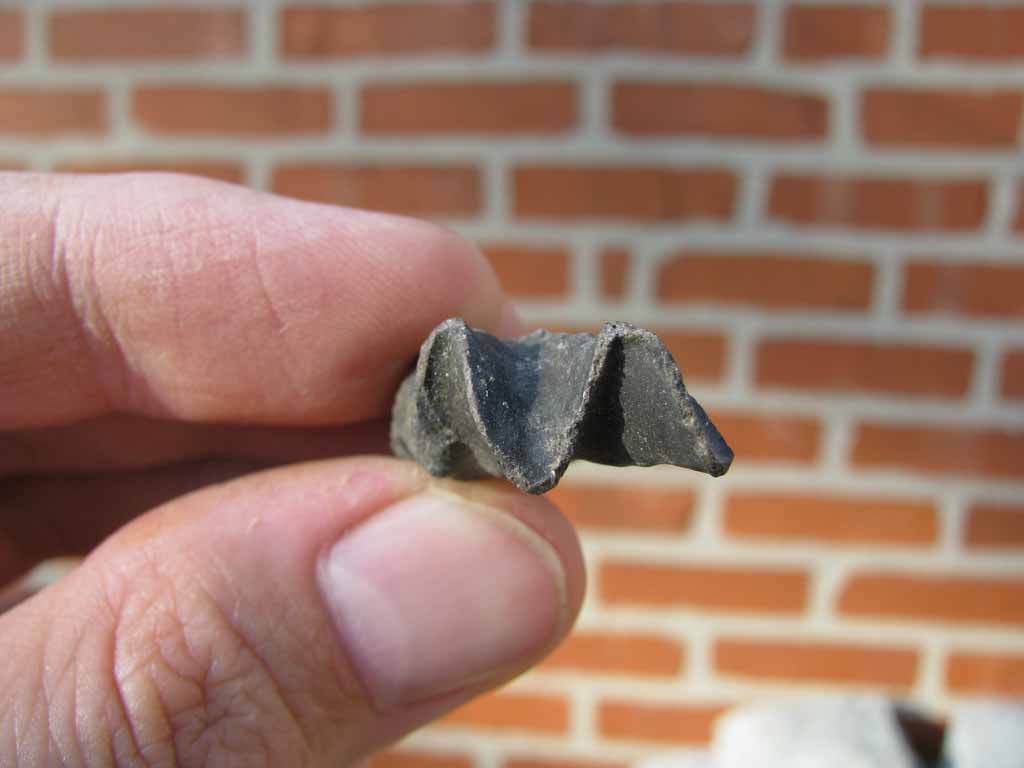
Up for viewing today are a couple of Ostrea falcata fossil oysters from the Cretaceous of New Jersey. These are uncommon fossils that I found in the Navesink formation exposed along Big Brook in Monmouth County, NJ. There is a layer where these are found in more abundance that could represent a storm deposit or possibly a calm period which allowed colonization of the seafloor. This species is very similar looking to the more common Ostrea mesenterica (that I'll post about later) but O. falcata has obvious surface ornamentation.
Left valve
Anterior
Left profile
Posterior
Right profile
Right valve
Here is a second specimen: Left valve
Anterior
Left profile
Posterior
Right profile
Right valve... Note the bore hole made by a predatory snail.
I also have a steinkern of a much larger specimen of O. falcata that came from the C&D canal in Delaware. I purchased it at a show put on by the Delaware Mineralogical Society.
Left valve
Right valve
Anterior
Left profile
Posterior
All the above specimens come from the Masstrichtian stage of the Cretaceous when New Jersey and Delaware were submerged under the Atlantic Ocean and Philadelphia was beachfront property.
Showing posts with label C&D Canal. Show all posts
Monday, August 12, 2013
Thursday, August 8, 2013
Neithea quincostata & Liopistha protexta pelecypod steinkerns from Delaware
Here are a couple more steinkerns from the Cretaceous sediments of Delaware. As I mentioned in previous posts, these are clay casts of the interior space of Pelecypod shells.
This is a cast from a Neithia shell and could be Neithea quincostata
Right valve
Left valve
Anteiror
Left profile
Posterior
Right profile
This cast is very likely Liopistha protexta
Right valve
Left valve
Anterior
Right profile
Posterior
Left profile
Both specimens come from the C and D canal in Delaware and were collected from spoil piles left over from dredging efforts. Their age is late Cretaceous (Campanian to Maastrichtian stages).
Thanks to John's site Fossils of New Jersey for helping me ID these fossils.
Another sites with an extensive collection of fossils from the canal is Dr. Fossil's site about the "Deep Cut"
This is a cast from a Neithia shell and could be Neithea quincostata
Right valve
Left valve
Anteiror
Left profile
Posterior
Right profile
This cast is very likely Liopistha protexta
Right valve
Left valve
Anterior
Right profile
Posterior
Left profile
Both specimens come from the C and D canal in Delaware and were collected from spoil piles left over from dredging efforts. Their age is late Cretaceous (Campanian to Maastrichtian stages).
Thanks to John's site Fossils of New Jersey for helping me ID these fossils.
Another sites with an extensive collection of fossils from the canal is Dr. Fossil's site about the "Deep Cut"
Tuesday, August 6, 2013
Cardium sp. pelecypod steinkerns from Delaware
Much of the mollusk fauna preserved in the unconsolidated Cretaceous aged sediments of New Jersey and Delaware is found as steinkerns or internal casts of the original shells. The original shell material often has been dissolved away by ground water or otherwise weathered such that it is no longer present. It makes things a bit more difficult when trying to ID what you found down to the species level.
Here is a specimen of a steinkern from a Cardium type shell. It is a little beat up along the sides but it could be a Cardium spillmani. Notice all the indentations that are preserved in the cast. I interpret these as molds of various worm or bryozoa fauna that colonize or parasitize old shells.
Left valve
Left profile
Right valve
Right profile
Anterior
Posterior
Another specimen that likely fits in the Cardium genus and could be a Granocardium tenuistriatum is shown below. It is smaller than the above specimen and in better shape.
Right valve
Left valve
Anterior
Left profile
Posterior
Right profile
Both specimens come from the C and D canal in Delaware but I can't say for sure what formation. They were collected from spoil piles left over from the dredging of the canal which mixed the sediment from several formations together. What I do know is that they are from the late Cretaceous (Campanian stage to Masstrichtian stage). I tried to ID the specimens from Bulletin 61, "Cretaceous Fossils of New Jersey" published by the New Jersey Geological Survey, 1958. There are two volumes of Bulletin 61: Part 1 and Part 2 .
Here is a specimen of a steinkern from a Cardium type shell. It is a little beat up along the sides but it could be a Cardium spillmani. Notice all the indentations that are preserved in the cast. I interpret these as molds of various worm or bryozoa fauna that colonize or parasitize old shells.
Left valve
Left profile
Right valve
Right profile
Anterior
Posterior
Another specimen that likely fits in the Cardium genus and could be a Granocardium tenuistriatum is shown below. It is smaller than the above specimen and in better shape.
Right valve
Left valve
Anterior
Left profile
Posterior
Right profile
Both specimens come from the C and D canal in Delaware but I can't say for sure what formation. They were collected from spoil piles left over from the dredging of the canal which mixed the sediment from several formations together. What I do know is that they are from the late Cretaceous (Campanian stage to Masstrichtian stage). I tried to ID the specimens from Bulletin 61, "Cretaceous Fossils of New Jersey" published by the New Jersey Geological Survey, 1958. There are two volumes of Bulletin 61: Part 1 and Part 2 .
Subscribe to:
Posts (Atom)