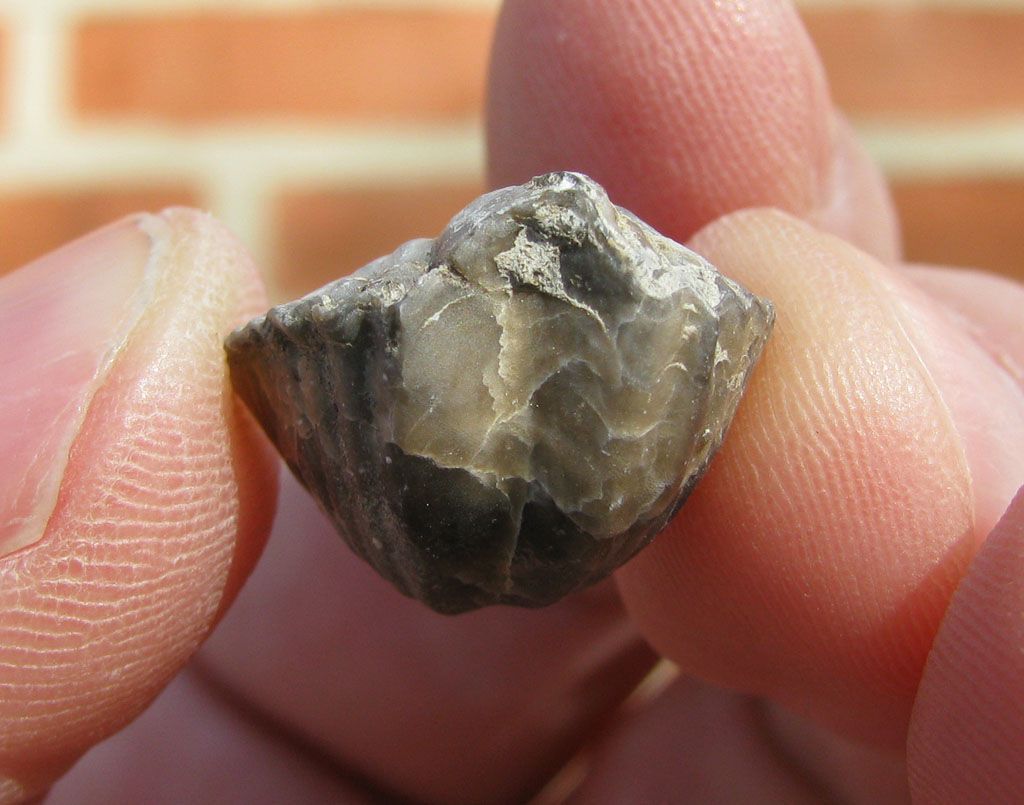
Brachial valve

Anterior

Pedicle valve

Posterior

Right profile with pedicle valve on top

Left profile with brachial valve on top

After I posted them on the forum one member, Fossilcrazy, suggested it might be Camarotoechia pauciplicata based on David M. Linsley's "Devonian Paleontology of New York" (Pg.188 Plt. 83 Items 1-5). This seemed like a good fit except that my specimen lacks a fold and sulcus (the divot that is often seen in the middle of some brachiopods).
Another member, Plantguy, took it upon himself to reach out to some experts and came back with the following:
Dr. Lindsey Leighton, of the University of Alberta, responded:
I have collected a lot of brachs from the Devonian of the Alpena region, as well as Ontario and New York, and I have never seen that particular brachiopod. It does not look like a typical Camarotoechia, but it is possible that the species is atypical for the genus. Camarotoechia, by definition, should have a fold and sulcus present the length of the brach, and based on the photos, I don't really see a fold and sulcus at all. Similarly, I don't see any costae (ribs), which again, is part of the genus definition. But this could be that I can't see the relevant features on the photo. The combination of weak to absent fold and sulcus, and the lack of costae, is a little weird. My best guess is that it is not a rhynchonellide at all, but something in the Pentamerida, possibly some odd species of Pentamerella or Gypidula, but it doesn't quite look right for either of those two genera either. There are leiorhynchids that have a more or less naked (lacking in ornament such as ribbing) umbonal area and few plicae, so it might still be a rhynchonellide of some sort.Dr. Leighton suggested contacting Dr. Jed Day, of Illinois State University, who subsequently reviewed the pictures and came back with this:
Your specimen appears to be crushed near the posterior end of its lateral margin and may be a juvenile specimen of one of two things I know of from eastern side of the Lower Peninsula area. The only things I know of that look like the specimen (s) you show in the photos are from the Ferron Point (Pentamerella lingua, Imbrie, 1959) and Norway Point (Pentamerella pericosta, Imbrie, 1959) formation quarry and natural exposures in Alpena County (See old Guidebook series, Ehlers and Kesling, 1970) . There are a number of other pentamerids that have been described from the west side of the LP that also resemble the specimen described in the older litherature (Imlay, etc.). There also rhynchonellids that it might be, especially Eumetabolotoechia.Here is specimen of P. lingua from the Ferron Point Fm. on the Michigan Basin Fossils website:
http://michiganbasinfossils.org/viewrecord/1506. They have a specimen of P. pericosta as well: http://michiganbasinfossils.org/viewrecord/1508. The former appears to be the closest match to what I have although the width of my specimen is less than those pictured. Maybe that is because part of the one side is slightly crushed or this is a juvenile specimen.
In any case this has been an interesting mystery and may not yet be solved. For now I am labeling my specimens as Pentamerella lingua.