Friday, November 7, 2014

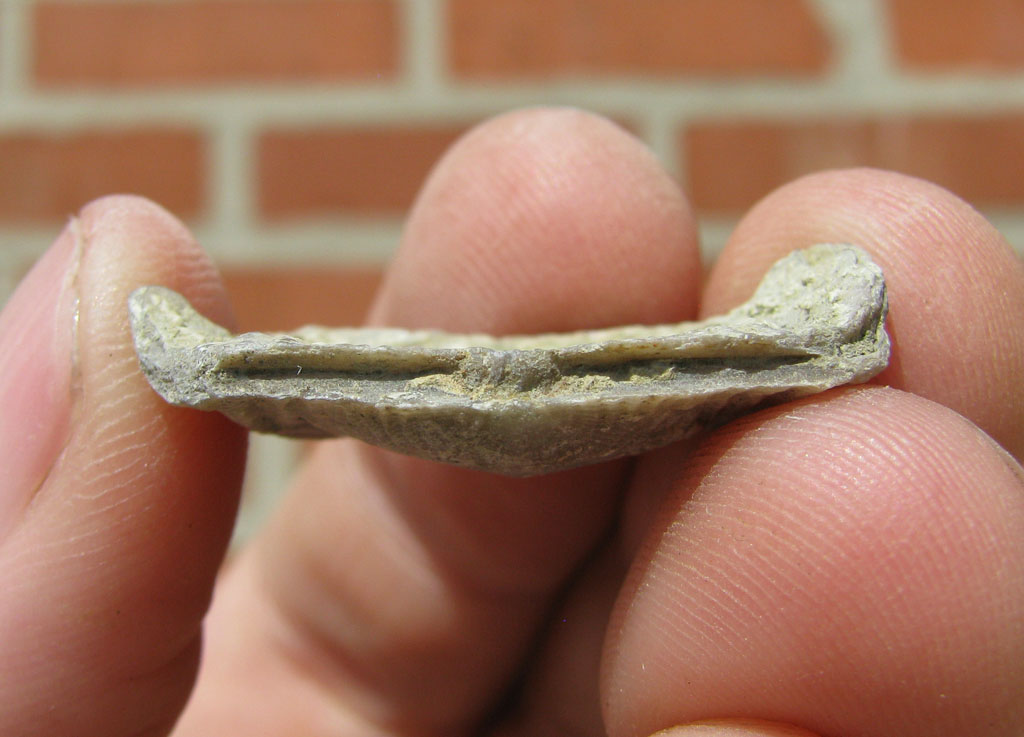
Howellella elegans brachiopod from the Wenlock formation

This tiny brachiopod is Howellella elegans from the Silurian aged (Wenloch epoch, Sheinwoodian to Homerian stage) Wenlock formation, near Dudley, England. It's a spiriferid type brachiopod with a wide hinge line, a protruding, beak-like Umbo and very coarse plication with somewhat prominent growth lines. This specimen has a very shallow but wide sulcus and is generally rectangular in shape. I found a similar looking shell in the Keyser formation.

Brachial valve
Anterior
Pedicle valve
Posterior
Profile

Wednesday, November 5, 2014

Meristella obtusa brachiopod from the Wenlock Formation

Contrasting with the small brachiopod in yesterday's post, today I have Meristella obtusa from the Silurian aged (Wenlock epoch, Sheinwoodian to Homerian stage) Wenlock formation, near Dudley, England. The shell is smooth and round, about the same ratio wide as it is long. There is a wide but shallow sulcus and a heavily recurved umbo on the pedicle valve.

Brachial valve
Anterior
Pedicle valve
Posterior
Profile

I have featured several species of Meristella on my blog before like Meristella atoka from the Haragan formation, Meristella haskinsi from the Centerfield mbr. of the Ludlowville formation, and Meristella arcuata from the Onondoga limestone.

Monday, November 3, 2014

Stegerhynchus lewissi brachiopod from the Wenlock Fm.

This tiny brachiopod is Stegerhynchus lewissi from the Silurian aged (Wenloch epoch, Sheinwoodian to Homerian stage) Wenlock formation, near Dudley, England. It's a rhynchonellid type brachiopod as evidenced by the lack of a wide hinge line, a protruding, beak-like Umbo and coarse plication. This specimen has a very shallow but wide sulcus and is generally rectangular in shape. Compare this miniscule species with the giant Stegerhynchus stricklandi from the Waldron shale.

Brachial valve
Anterior
Pedicle valve
Posterior
Profile

Saturday, November 1, 2014

Amphistrophia funculata brachiopod from the Wenlock Fm.

Amphistrophia funculata is a strophomenid type brachiopod from the Silurian aged (Wenlock epoch, Sheinwoodian to Homerian stage), Wenlock formation, near Dudley, England. It has the typical arrangement of valves with the pedicle valve being convex and the brachial valve concave. To me this looks very similar to a Strophomena sp. brachiopods from the Ordovician. Fine radial ribs decorate the surface and the shell makes a sharp turn along the margin to grow perpendicular to the previous direction. The hinge line is straight with a very long and narrow interarea between the valves.

Pedicle valve
Anterior
Brachial valve
Posterior

Thursday, October 30, 2014

Leptaena depressa brachiopod from Wenlock Fm

An ubiquitous member of many faunal assemblages of the early Paleozoic is Leptaena. It must have been quite the generalist because I've found it in rocks from the Ordovician through the Devonian. The specimen below is Leptaena depressa from the Silurian aged (Wenlock epoch, Sheinwoodian to Homerian stage), Wenlock formation near Dudley, England. The shell is rectangular in shape with wavy growth lines and very fine radial ribs. Most specimens also have a feature where the pedicle and brachial valves are equal until the edge where they meet. At this point the valves make a sharp turn downwards all along the margin except at the hinge line. In some specimens this can be quite developed and the shell will have a triangular shape in profile.

My theory is that these brachs were attached to a hard substrate for most of their lives until they got too big and the pedicle muscle couldn't hold them upright. The shell them fell over onto the pedicle valve but the animal was still alive. Thus the shell kept growing "upwards" towards the current.

Pedicle valve
Anterior
Brachial valve
Posterior
Profile

I've found other examples of the genus in the Irondequoit limestone & Haragan Formation.