Amongst the fossilized debris of the Mahantango seafloor I spotted a Bactrites aciculum cephalopod.The rock that it's on is a little fragile but the specimen is a good example of the species from the Mahantango formation.
Bactrites are identified by the lack of any septa (of even divided chambers), narrow body and the linear feature down the middle (which I believe is a compression fracture).
This specimens was collected from the Mahantango formation at Seven Stars, PA. The Mahantango is middle Devonian in age (Givetian stage) and I believe the locality exposes rocks that are equivalent to the upper Windom shale.
Saturday, February 8, 2014
Thursday, February 6, 2014
Favosites hamiltoniae coral from the Tichenor Limestone
Here is a partial specimen from a larger coral head of Favosites hamiltoniae. It's from the Tichenor Limestone member of the Moscow formation and was recovered from the Penn Dixie site at Blasdell, NY. It's not too uncommon to find these at the site as they are regularly turned up when they excavate drainage trenches on the site. The coral heads can reach several feet in size and indicated that the water they grew in was clear and relatively free of sediment (otherwise they would be buried by sediment influx).
This is a side view of the specimen that shows the individual corallites side by side in columns. The regular horizontal platforms were made by the animal as it grew upwards. Every now and again it would lift it's body and make a new shelf below it for support. Each colony increased clonally by budding off the side of a corallite as well as sexually by releasing eggs and sperm into the water. You can see how the central corallites grow more vertically while those that budded later are angled towards the side of the head.
Some of the cells are filled with Chert (white), Calcite (grey) or Dolomite (orange).
This is the top of the piece which still have some shale coating on it that obscures the honeycomb like pattern of the individual corallites.
The Tichenor Limestone is the basal member of the Moscow formation lying directly on top of the Wanakah shale of the Ludlowville formation. It is Devonian period, Givetian stage.
Tuesday, February 4, 2014
Eridophyllum archiaci coral from along Lake Erie
As I have been sorting through my finds from along Lake Erie and the Penn Dixie site in Blasdell, NY I've come across some coral specimens that I think are Eridophyllum archiaci. I showed a previous specimen (E. subcaespitosum) from the Penn Dixie site that showed the budding habit of reproducing but these are individual, finger like pieces and a few have the calice preserved.
Specimen #1
Here is the preserved calice. It could use a little cleaning but you can see some of the septa.
Specimen #2 appears to be a section from near the base of an individual. You can see a curve to the corallite and a couple of support structures coming off the side.
Specimen #3
This specimen's calice is better defined and you can see that it does have a depression in the middle.
These specimens come from along Lake Erie near 18 Mile Creek and could have originated within either the Wanakah shale of the Ludlow Formation or the Windom shale of the Moscow formation. Both are Devonian period, Givetian stage.
Sunday, February 2, 2014
Athyris spiriferoides brachiopod from the Wanakah shale
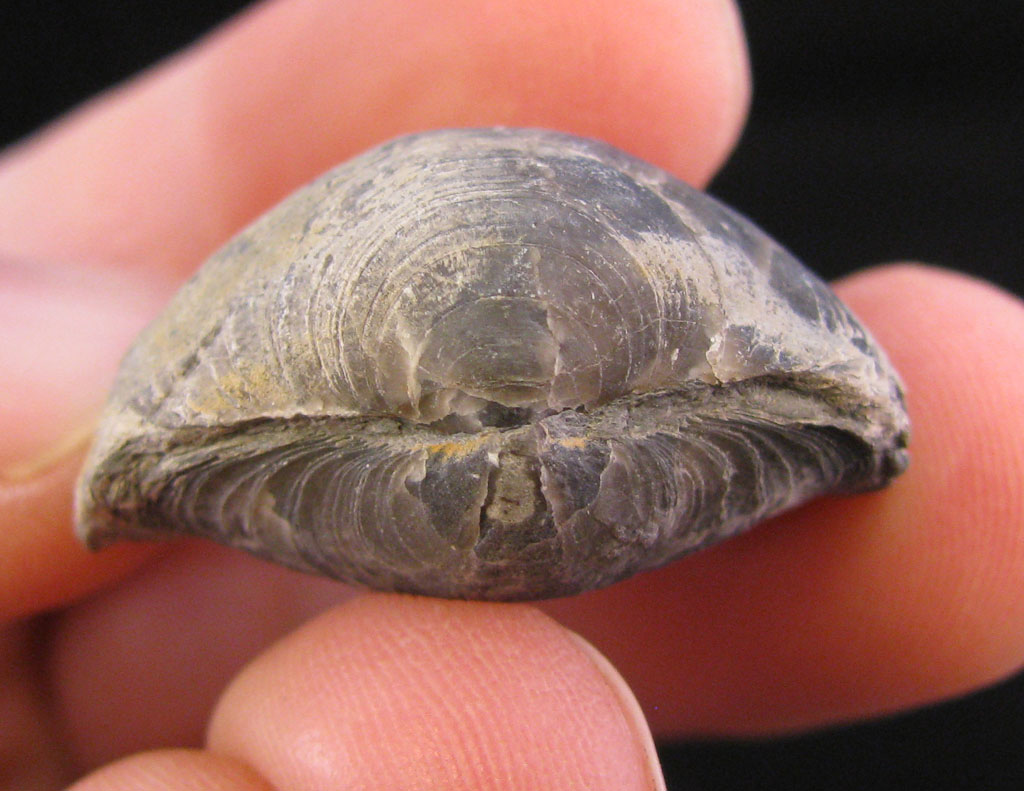
While reviewing all the fossils that I've written about from the Ludlowville and Moscow formations I realized that I'd never blogged about one of the most common fossils found in those rocks: Athyris spiriferoides. It's the most common fossil found along Lake Erie and is often found wave tossed and tumbled in the surf. It can be so abundant that in an hour of walking along the shoreline one can pick up two to three dozen specimens.
Here are three random specimens I picked up on my last trip to Lake Erie.
Specimen #1
Pedicle valve
Anterior
Brachial valve
Posterior
Profile
Specimen #2
Pedicle valve
Anterior
Brachial valve
Posterior
Profile
Specimen #3
Pedicle valve
Anterior
Brachial valve
Posterior
Profile
The three specimens show a size and shell shape range common to the species. At other localities the shell is much wider than long or they don't get this big. Some of the larger specimens will sometimes have a hollow cavity within filled with calcite. It's interesting to see that the shell is smooth for the most part until towards the edges where it shows some "flakes". I attribute that to the way the shell grew not as an result of erosion.
All three specimens came from the Wanakah Shale member of the Ludlowville formation along Lake Erie near 18 Mile Creek.
Friday, January 31, 2014
Leiopteria conradi & Actinopteria decussata pelecypods from the Windom shale
Two more pelecypods from the Windom Shale for your viewing pleasure. Both are a little fragmentary due to the poor preservation and unstable matrix. They are notable for their size as I do not often find large specimens as intact as these.
Actinopteria decussata, note the faint decoration still visible, highly oblique shell body and extended wing.
Leiopteria conradi, Note the lack of decoration (just growth lines) and less oblique shell body.
Both specimens were collected in Buffalo Creek near Marilla, NY from the Windom Shale mbr. of the Moscow Formation (Devonian, Givetian stage).
Labels:
Devonian,
Marilla,
New York,
Pelecypod,
Windom shale
Subscribe to:
Posts (Atom)