Monday, October 4, 2010

Derbyia

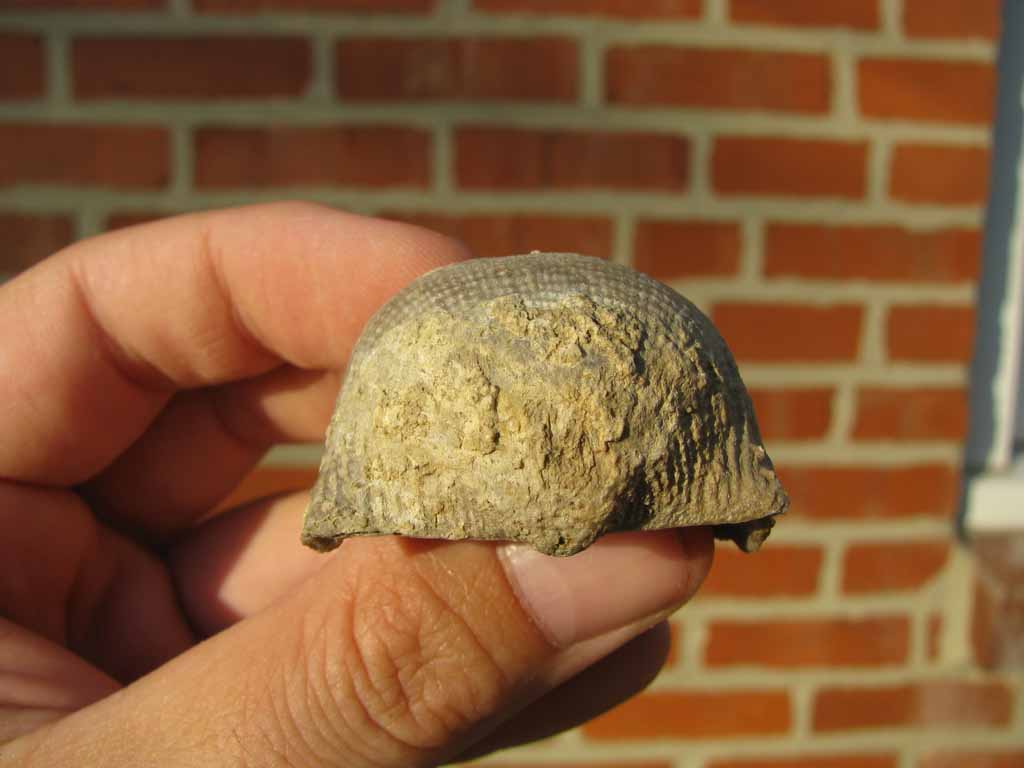
Another very large Brachiopod that I've acquired in estate sales is Derbyia. This member of the Orthotetida order lived primarily from the Carboniferous to the Permian. This particular specimen comes from the Wolfcamp series of Kansas. The overall look of the shell is rounded with an almost globular shape. Other than the large size and plentiful thin ribs the most notable feature is the back of the shell where the Pedicle and Brachial valves meet.


Here you can see a narrow, flat triangular shaped interarea which is unsual for brachiopods and there is not a clear pedicle exit hole at the hinge line. The pedicle was a muscle or series of threads that extended out of a hole in the pedicle valve and enabled the Brachiopod to attach itself to a surface. The current theory is that the pedicle threads extended through many small holes at the very tip of the pedicle valve. This would explain the deep interarea that would expand and get wider at the hinge as the animals shell grew.

Saturday, October 2, 2010

Reticulatia

During the Carboniferous and Permian period there were a group of Productid Brachiopods that grew to large sizes and had some odd body adaptations. Below are pictures of a genera called Reticulatia from the Permian aged Wolfcamp series of Kansas. These Brachiopods are identified best by the cross hatching pattern on their shells formed by crossing ribs and rays. You can see the pattern very clearly in the shell below.


This second specimen got to a ripe old age and has a very deep lip. Apparently the brachial valve grows generally flat but as they get older, instead of continuing to grow perpendicular, it parallels the pedicle valve and forms an exaggerated edge along the lip between the valves.

Thursday, September 30, 2010

Neospirifer

I often been purchase small lots of fossils from estate sales that are from areas I've not collected at or can't get to anymore. One of the lots included some Carboniferous (Pennsylvanian) aged fossils from Texas and among them was this Neospirifer.

Neospirifer is, as the name suggests, a member of the Spiriferida order or Brachiopods and has the typical body style of a wide hinged, fan shaped shell with a deep central sulcus. An interesting fact is that Spiriferid means "Spiral Bearer" and refers to the spiral shaped lophophore supports called brachidiums.


Tuesday, September 28, 2010

Calceola

So I was doing some research on Calceola, a strange genus of Devonian aged coral that has a lid, or operculum, and came across some new information that I'd not read before. Here is a good reference picture of Calceola from This Site


I'd known that these odd ball corals (that are closer to Rugose coral than Tabulate) are common from the Devonian in parts of Europe and Morocco but had never heard of them being found here in the US. As I looked through links and .pdf files I was surprised to find a reference from an 1885 Kentucky text. Click here It's a book that was published in 1885 by the Kentucky Geological Survey called "Kentucky Fossil Corals - A Monograph of the Fossil Corals of the Silurian and Devonain Rocks of Kentucky" by William J. Davis. On plate 131 are pictures of a reference specimen of Calceola sandalina along with other specimens that had been recovered from the "White Clay of Niagara" near Louisville. While all the specimens on the page are attributed be Calceola, some look like other types of rugose corals and, without examining the original specimens, I can't be sure of what they are but most do bear a resemblance to the aforementioned coral. It must be extremely rare, although I did read somewhere that they are occasionally found in Tennessee too.

The specimens that I have in my collection come from the Devonian of Morocco. Here is a large example that is missing it's lid (not uncommon).


And this specimen still has the lid in place:


This fossil has the septae lines preserved along the walls of the coral.


The other bit of info was a paper that discussed the Ontogenetic development (The origin and development of an individual organism from embryo to adult) of Calceola. As I was reading through I learned that Calceola was one of the last genera from a line of these "lidded corals" that extended to Cambrian time through to the middle Fransian stage of the upper Devonian. It also conjectured that the individual animals lived with the flat side of the coral on the surface of the sea floor rather than being upright like a Rugose coral. It has some good illustrations of the life habit of the animal (see image below) as well as passing reference to other species of these corals.


Another publication Middle Devonian Calceola sandalina (Linnaeus, 1771) (Anthozoa, Rugosa) from Moravia (Czech Republic): aspects of functional morphology, gerontic growth patterns and epibionts. provided the following image of the life position of Calceola:


This reference from Steinkern.de has some good pics of specimens and a little info about the genera from Germany (although it's in German and so you will want to translate it with Babelfish or another translating service.)


Stolarski, J. 1993. Ontogenetic development and functional morphology in the early growth-stages of Calceola sandalina (Linnaeus, 1771). Courier Forschungs-Institut Senckenberg 164: 169-177.


Galle, A. and F. Ficner (2004). Middle Devonian Calceola sandalina (Linnaeus, 1771) (Anthozoa, Rugosa) from Moravia (Czech Republic): aspects of functional morphology, gerontic growth patterns and epibionts. Geodiversitas, 26(1).

Sunday, September 26, 2010

Atrypa vs. Pseudoatrypa

Recently a friend of mine on the Fossil Forum site asked me what the difference was between Atrypa and Pseudoatrypa. He has been looking for a Pseduoatrypa from the Arkona/Widder formations and wanted to be sure that he was able to tell it apart from Atrypa. The way I tell the difference between the two genera is the shape of the shell. Pseudoatrypa has a much deeper, domed brachial valve and flatter pedicle valve than Atrypa. Also Atrypa is more round shaped while Pseudoatrypa is more box shaped when viewed from the top down. Here are some pics of a side by side comparison of samples from the similar aged Silica Shale of Sylvania, Ohio.

Brachial valve


Front


Pedicle valve


Back


Side


This is a group shot for scaling purposes with the two above shells side by side in the top row. I also included a sample of each genera from my local upper Silurian/ lower Devonian Keyser formation for comparison in the bottom row. I think they started small and got larger as the Devonian wore on. The monster on the far left is from the middle Devonian of Iowa and is called Desquamatia (Independatrypa) and is included to show you just how big some of these genera became. The Canadian quarter used to show scale is equivalent in size to the American quarter or the one Euro coin.