Showing posts with label Permian. Show all posts

Monday, August 22, 2016

Linoproductus sp. brachiopod from Texas

These next two, giant brachiopod shells are Linoproductus sp. from the early Permian aged (Asselian stage to Sakmarian stage of the ICS, Wolfcampian stage in US stratigraphy) sediments of Callahan County, Texas. This genus is known for having some of the largest shells for brachiopods from the period. The pedicle valve is very convex and the brachial valve startes our flat but becomes concave as the animal got older. The margins of the two valves are often turned 90 degrees from the hinge and (at least in the two specimens I am blogging about today) become very elongated. The surface of  both valves are marked with fine striations that are slightly wavy. Occasional spines are present but appear to not be in any planned arrangement.

Specimen #1 - Pedicle valve (note the grooves and marks in the shell which may be indicative of a boring sponge called Clionolithes sp.)
Anterior
Brachial valve and shell margins
Posterior
Profile
Another view of the brachial valve and the shell pattern


Specimen #2 - Pedicle valve

Anterior
Brachial valve
Posterior
Profile

These specimens come from rocks near Putnam, Texas in Callahan County.

Thursday, July 19, 2012

Permian Ammonites from West Timor

I have very few Permian aged fossils in my collection and even fewer that don't come from the US. Thus I was very happy to receive these next two Ammonites in an exchange with a friend, Laurent, in France. Both are from the Artinskian stage of the lower Permian and come from West Timor which is a part of Indonesia.

Sundaites laevis


Popanoceras sp. I like this one because it has been polished to show the internal sutures which separated the shell into hollow chambers. The pattern of mineral replacement is very nice and there are two small vugs with Calcite crystals as well.


Tuesday, July 17, 2012

A couple of Permian echinoderms from Indonesia

I was at home of a fossil dealer not to long ago when he brought out some echinoderms that he'd picked up at the Tuscon show. They were from Indonesia, more specifically the island of Timor and are Permian in age.

The first one is Timorocrinus mirabilis which I think is a type crinoid but it's hard to find any information online.It looks very similar to a blastoid but I can't see any ambulacra (mesh like openings) in the gaps between ridges as one would expect.

Anterior

Posterior


These next two specimens are true blastoids called Deltoblastus

Specimen 1, anterior


Posterior

Specimen 1, anterior


 Posterior

The label that was included with all three specimens stated that the fossils came from the Maubisse formation near Basleo on the island of Timor.

Monday, October 4, 2010

Derbyia

Another very large Brachiopod that I've acquired in estate sales is Derbyia. This member of the Orthotetida order lived primarily from the Carboniferous to the Permian. This particular specimen comes from the Wolfcamp series of Kansas. The overall look of the shell is rounded with an almost globular shape. Other than the large size and plentiful thin ribs the most notable feature is the back of the shell where the Pedicle and Brachial valves meet.


Here you can see a narrow, flat triangular shaped interarea which is unsual for brachiopods and there is not a clear pedicle exit hole at the hinge line. The pedicle was a muscle or series of threads that extended out of a hole in the pedicle valve and enabled the Brachiopod to attach itself to a surface. The current theory is that the pedicle threads extended through many small holes at the very tip of the pedicle valve. This would explain the deep interarea that would expand and get wider at the hinge as the animals shell grew.

Saturday, October 2, 2010

Reticulatia

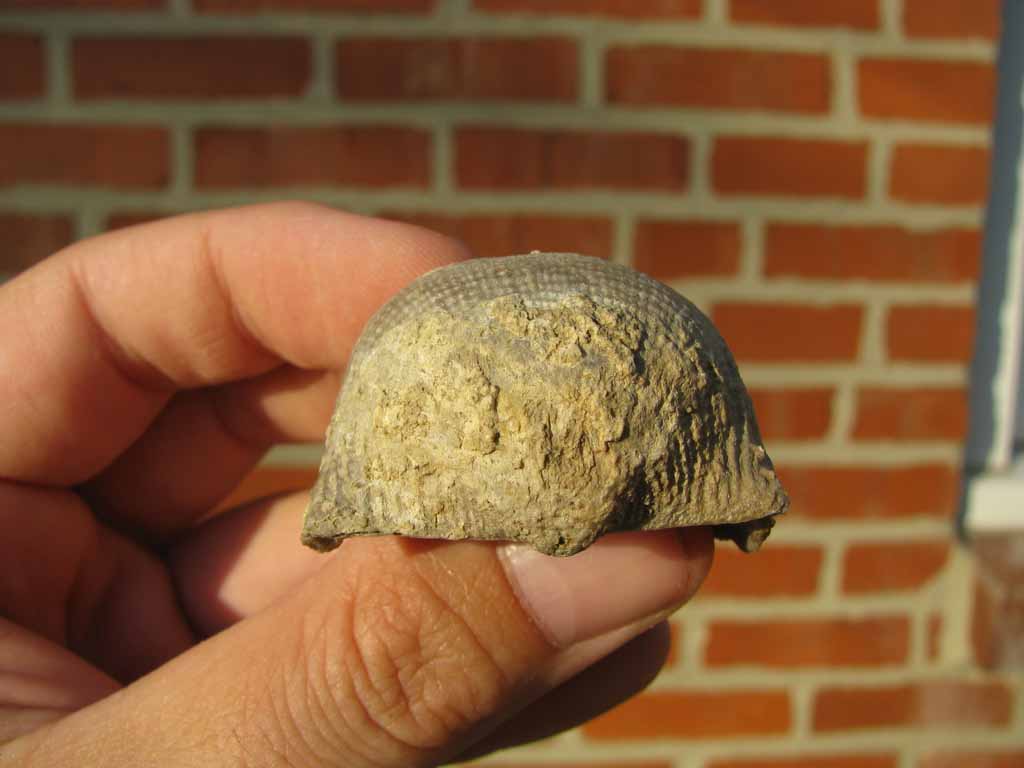
During the Carboniferous and Permian period there were a group of Productid Brachiopods that grew to large sizes and had some odd body adaptations. Below are pictures of a genera called Reticulatia from the Permian aged Wolfcamp series of Kansas. These Brachiopods are identified best by the cross hatching pattern on their shells formed by crossing ribs and rays. You can see the pattern very clearly in the shell below.


This second specimen got to a ripe old age and has a very deep lip. Apparently the brachial valve grows generally flat but as they get older, instead of continuing to grow perpendicular, it parallels the pedicle valve and forms an exaggerated edge along the lip between the valves.